Taiwan rules in favor of same-sex marriage

An outdoor concert in favor of same-sex marriage was held in Taipei in 2016. [Photo/ETtoday.net]

A top Taiwan court ruled in favor of same-sex marriage on Wednesday, a landmark ruling that paves the way for Taiwan to become the first place in Asia to legalize same-sex unions.

The court said Taiwan’s current Civil Code provision, which does not allow two persons of the same sex to marry, is in violation of both the people’s freedom of marriage and the people’s right to equality as guaranteed by its Constitution.

The court rules that the authorities concerned shall complete the amendment of relevant laws in accordance with the ruling within two years. If the amendment of relevant laws is not completed within the two-year time frame, then two persons of the same sex may apply for marriage registration.

The case was brought by gay rights activist Chi Chia-wei after the Taipei city government rejected his and his long-time partner’s application to marry in 2013.


China’s first Hualong One nuclear project taking shape

China’s first pilot nuclear power project using Hualong One technology, a domestically-developed third generation reactor design, will soon take shape with its containment dome expected to be installed within the next two days.

Yu Peigen, deputy general manager of China National Nuclear Corporation (CNNC), told a press conference Wednesday that its No. 5 unit in Fuqing, southeast China’s Fujian Province, was ready for the dome installation, slated for Thursday or Friday.

A hemispherical dome, 340 tonnes in weight and 16.8 meters in diameter, will be installed by crane on the reactor featuring Hualong One design, according to Yang Ming, a member of the project management.

Yang said the exact date would depend on weather conditions.

“The installation, if successful, will mark the completion of the construction work of the pilot and the beginning of the assembling stage,” Yu said.

Started in May 2015, the pilot should take about 62 months to finish. Yu said the equipment manufacturing and construction work was on schedule, and he was confident that the project would be completed on time.

The Hualong One reactor was jointly designed by two nuclear power giants, China General Nuclear Power Group and CNNC, and passed inspection by a national panel in August 2014.

The government has since approved the use of Hualong One technology to build two reactors in Fujian Province, one being the No. 5 unit.


2 Chinese arrested for flying drones over confidential target

Police in a central Chinese city said Wednesday that two men had been arrested for flying a drone that captured images of a confidential target.

Police said the men worked for a small film company. They flew the drone to film the skyline of Wuhan, capital of Hubei Province, on May 18, but had not been authorized.

Police were tipped off by an employee who noticed the drone hovering above his office. Police arrested the two men on the spot and found detailed high-definition images of a confidential nature.

The men were ordered to be detained for ten days, with their memory card confiscated. Police said they would temporarily keep the drone.

Police are launching a city-wide inspection on drone use.

Reckless drone-flying caught the nation’s attention this year, with flights repeatedly distrupted at airports across southwest China.

This prompted the government to require civilian drones weighing more than 250 grams to be registered under real names starting June 1.


President Xi calls for ‘strong, modern’ navy

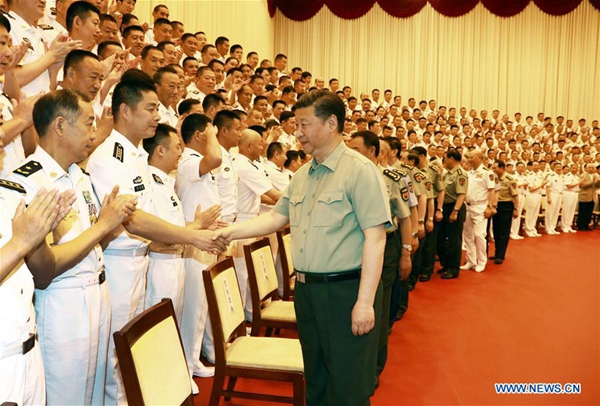
Chinese President Xi Jinping (R, front), who is also general secretary of the Communist Party of China (CPC) Central Committee and chairman of the Central Military Commission, shakes hands with delegates to the 12th Party congress of the People’s Liberation Army (PLA) Navy, during an inspection of the PLA Navy headquarters, in Beijing, capital of China, May 24, 2017. [Photo/Xinhua]


Chinese President Xi Jinping on Wednesday called for efforts to build the People’s Liberation Army (PLA) Navy into a strong and modern force to lend support for the realization of the Chinese dream of national rejuvenation and the dream of a strong army.

Xi, who is also general secretary of the Communist Party of China (CPC) Central Committee and chairman of the Central Military Commission (CMC), made the remarks during an inspection of the PLA Navy headquarters.

Xi expressed congratulations on the 12th Party congress of the PLA Navy, met delegates to the congress and conveyed greetings to all navy members.

Noting that the navy is a strategic military service concerning national security and overall development, Xi asked naval authorities to build a world-class force by promoting political awareness, reforms and rule of law.

Xi visited the navy’s operational command center, where he greeted via video navy officers who were performing duties at sea.

He first talked with members of flotilla 150, which was in an overseas journey of good-will visit. The members told Xi that they had visited five countries in more than one month and were warmly welcomed by the host countries. Xi asked them to pass on friendship and contribute to world peace.

Xi also talked with staff who were carrying out a patrol mission aboard ship 538.

“You continuously fight wind and waves. Thanks for your hard work!” Xi said. “I hope all you comrades perform duties loyally and merit the trust of the Party and the people.”

After hearing a report on naval work, Xi said a strong navy is a symbol of a world-class army and is a pivot for building the nation into a great maritime power.

He asked navy authorities to advance the transformation of the PLA Navy and focus on combat capabilities.

He said the navy should improve overall fighting capacity by combining the “mechanization and informationization,” promoting both offshore and high sea forces and balancing operations on the water surface, below the sea and in the air.

Innovation is key to improving and transforming the navy, according to Xi. He noted the transformation must be carried out in accordance with the law. The navy must resolutely safeguard the CPC Central Committee’s authority and unwaveringly stick to the Party’s absolute leadership, Xi stressed.

He called for efforts to thoroughly purge the pernicious influence of Guo Boxiong and Xu Caihou, former corrupt senior CMC officials, and promote the anti-corruption drive.

He asked naval authorities to improve their own abilities while training a large number of capable military staff.


A third of graduates to work in first-tier cities

A recent employment survey has revealed 33.5 percent of new graduates from colleges and universities this year have signed contracts with employers in the country’s first-tier cities: including Beijing, Shanghai, Guangzhou and Shenzhen.

The survey was recently carried out by Zhilian Recruitment, one of China’s biggest recruitment websites. The company surveyed 93,420 respondents, which included graduates holding master’s and doctoral degrees.

An additional 33.1 percent of graduates, who took part in the survey, were expected to work in newer first-tier cities, which referred to more than 10 large metropolises including Tianjin, Qingdao, Wuhan, Nanjing and Chengdu.

A total of 14.4 percent of graduates were also willing to work in smaller cities, and an additional 19 percent of graduates expected to work in large regional cities.

While comparing the low cost of living and ever-increasing job opportunities in small and medium cities, the survey revealed graduates still preferred to live in larger municipalities due to inclusiveness and acceptance.

Graduates were also shown to earn an average monthly salary of 4,014 yuan ($582.3). However, on average, graduates with degrees in law, engineering and medicine earned 5,545 yuan, 4,512 yuan and 4,500 yuan per month respectively.