Cybersecurity law starts for better personal info protection

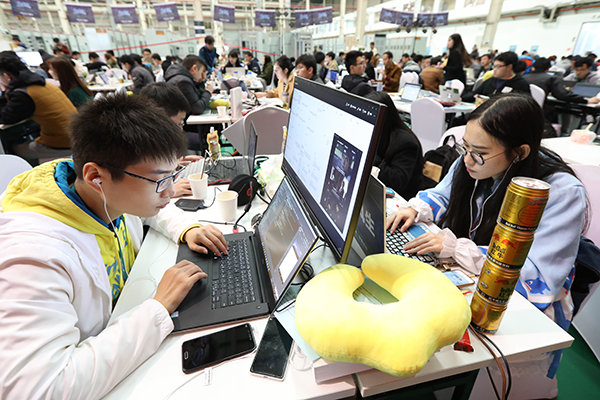
Cybersecurity Law aims to “protect people’s interests.” [File photo]

China’s Cybersecurity Law will take effect on June 1, banning online service providers from collecting and selling users’ personal information.

The internet service providers cannot collect user information that is irrelevant to the services, and they should handle such information in line with laws and agreements, according to the new law that was adopted by China’s top legislature in November last year.

Users now have rights to ask service providers to delete their information if such information is abused.

Cybersecurity management staff must also protect information obtained, and are banned from leaking or selling the information, including privacy and commercial secrets.

Those who violate the provisions and infringe on personal information will face hefty fines.

The law also made it clear that no one can use the internet to conduct fraud or sell prohibited goods.

Several other regulations will come into force on June 1.

A regulation on online news requires individuals and groups to get government permission before releasing news on instant messaging apps or social websites.

Civilian drones weighing more than 250 grams must be registered under real names to improve civil aviation safety.

An amended regulation on farming pesticide bans the use of highly toxic pesticides on edible agricultural products and strictly limits the use of pesticide.


Yangtze to see first rainstorms this summer

Areas along the Yangtze, China’s longest river, will soon be hit by the first round of heavy rainfall this flood season, authorities said.

According to a report published by the Yangtze flood control and drought relief headquarters Saturday night, the southern bank of the main stream of the river will receive moderate to heavy downpours and rainstorms, from May 30 to June 1.

The rain will mainly affect areas around the Wujiang River — the longest tributary on the southern bank of the upper reaches of Yangtze, and the Poyang and the Dongting — two large lakes on the southern bank of the middle reaches of Yangtze.

On May 30, Wujiang will see moderate to heavy rain. On May 31, Wujiang and the two lakes will see moderate to heavy rainfall or rainstorms. On June 1, the lakes will see heavy rainfall or severe rainstorms.

The headquarters asked the areas to strengthen flood control efforts, prevent disasters such as mountain torrents and landslides, and relocate affected people in a timely manner.


Hong Kong to develop ‘in line with law’

Hong Kong should uphold its executive-led political system with the chief executive at its core, as set out in the Basic Law, the nation’s top legislator said on Saturday.

Zhang Dejiang, chairman of the Standing Committee of the National People’s Congress, said that the development and improvement of the Hong Kong special administrative region’s political system must also be compatible with this basic principle.

Zhang also stressed that the Hong Kong team of public officers formed in accordance with the Basic Law must be composed of patriots who respect the Chinese nation, wholeheartedly support the motherland’s resumption of exercise of its sovereignty over Hong Kong and will not do things that undermine Hong Kong’s prosperity and stability.

Zhang made the remarks at a high-ranking symposium in Beijing commemorating the 20th anniversary of the implementation of the Basic Law of the Hong Kong Special Administrative Region.

He said Hong Kong must adhere to the comprehensive and precise implementation of the Basic Law-the city’s constitutional document that has proved a success since 1997 and has provided a fundamental guarantee for the “one country, two systems” principle to maintain Hong Kong’s long-term prosperity and stability.

Enacted in accordance with China’s Constitution, the Basic Law specifies the guidelines of “one country, two systems” and “Hong Kong people administering Hong Kong with a high degree of autonomy”.

The power exercised by the special administrative region is “delegated by” but “not separated from” the central government, and under no circumstances should anyone be allowed to challenge the power of the central government in the name of a high degree of autonomy, Zhang added.

He called on Hong Kong to rigorously perform its constitutional duty of safeguarding national security through legislation prescribed in the Basic Law, and stop any behaviors or activities that undermine national unity.

The central government has committed itself to upholding the “one country, two systems” policy and the Basic Law, actively supported development in all fields in Hong Kong and faithfully protected the lawful rights and interests of Hong Kong people, Zhang said.

Hong Kong’s Chief Executive Leung Chun-ying, who also attended the symposium, said the “one country, two systems” policy and the Basic Law are “the best constitutional arrangements” for both Hong Kong and the country.

With the combined advantages of “one country, two systems”, Hong Kong can participate in the country’s major development strategies while serving as a “super-connector” between the mainland and the rest of the world, Leung said.

Chairwoman of the Democratic Alliance for the Betterment and Progress of Hong Kong Starry Lee Wai-king urged those from the opposition camp to see the interaction between Hong Kong and the mainland from the positive light of serving the city’s, as well as the country’s, long-term development interests.

Vice-president of the Chinese Association of Hong Kong and Macao Studies Lau Siu-kai believed that people’s opinions may vary because of different political affiliations, but loving the country and the city should be the basic consensus among Hong Kong people.


Heat wave continues in north, central China

China’s national observatory issued a yellow alert on Sunday for high temperatures, the least serious in a three-tier warning system, with some northern provinces expected to see temperatures of up to 39 degrees Celsius.

The heat wave, which has swept across northern provinces and led temperatures in some areas to historic highs in May, will continue to bake north and central China on Sunday, the National Meteorological Center said.

The observatory expected some regions in Beijing, Tianjin, Hebei, Shanxi, Henan, Shandong, Hubei, Anhui, Jiangsu and Xinjiang to see temperatures above 35 degrees Celsius.

Temperatures in downtown Beijing, and parts of Hebei, Henan, Shandong and Hubei provinces could rise to 39 degrees Celsius, it said.

It noted the heat wave will gradually ease starting May 30 as a cold front approaches the regions.


China commemorates 20th anniv. of HKSAR Basic Law

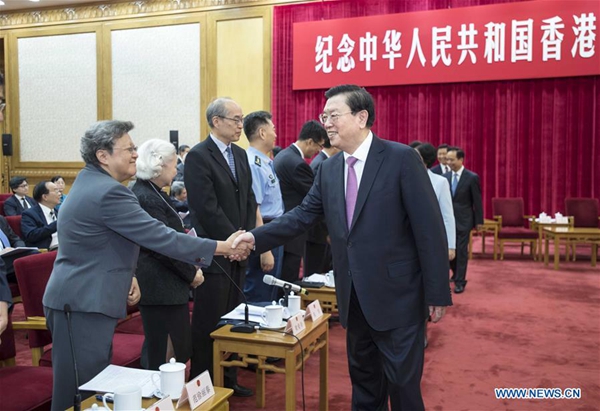
Zhang Dejiang (R, front), chairman of the Standing Committee of the National People’s Congress (NPC), attends a high-ranking symposium commemorating the 20th anniversary of implementing the Basic Law of the Hong Kong Special Administrative Region (HKSAR), at the Great Hall of the People in Beijing, capital of China, May 27, 2017. [Xinhua/Li Tao]

China held a high-ranking symposium on Saturday to commemorate the 20th anniversary of implementing the Basic Law of the Hong Kong Special Administrative Region (HKSAR).

Addressing the symposium, which was held at the Great Hall of the People in Beijing, top legislator Zhang Dejiang called for comprehensive and precise implementation of the principle of “one country, two systems” and the Basic Law.

Zhang, chairman of the Standing Committee of the National People’s Congress (NPC), called the HKSAR Basic Law “a product of ingenuity of a great era,” which fully embodies the shared desire of all Chinese including Hong Kong compatriots and has demonstrated great vitality.

SUCCESSFUL IMPLEMENTATION

Enacted in accordance with China’s Constitution, the Basic Law specifies the guidelines of “one country, two systems”, and “Hong Kong people administering Hong Kong” with a high degree of autonomy.

The Basic Law is a good law which accords the actual conditions of the nation and the HKSAR and is able to provide a fundamental guarantee for the great cause of “one country, two systems” and withstand the test of practice, Zhang said.

The practice of the Basic Law over the past 20 years shows that the fundamental purposes of safeguarding national sovereignty, security and development interests as well as maintaining Hong Kong’s long-term prosperity and stability must be adhered to in order to advance the cause of “one country, two systems,” Zhang noted.

BEST ARRANGEMENTS

HKSAR Chief Executive Leung Chun-ying said at the symposium that the principle of “one country, two systems” and the Basic Law are the best constitutional arrangements for both the HKSAR and the country.

With the combined advantages of “one country, two systems”, Hong Kong can participate in the country’s major development strategies including the national 13th Five-Year Plan and the Belt and Road Initiative, while serving as a “super-connector” between the mainland and the rest of the world at the same time, Leung said.

The coordinated and joint development of the HKSAR and the mainland would not only improve their overall competitiveness, but provide the world new experiences of cooperation between regions of different systems, thus enriching “one country, two systems,” he said.

Elsie Leung, deputy director of the Commission for the HKSAR Basic Law of the NPC Standing Committee, said the implementation of the Basic Law has helped realize the “one country, two systems” concept, stabilize the relationship between the central government and Hong Kong, and clarify the legal status of the HKSAR.

As the Basic Law was well received by Hong Kong citizens, a seamless and stable transition has been achieved with Hong Kong’s capitalist system and life styles unchanged, its legal system improved, judicial independence ensured, democracy developing step by step, and external affairs in sound shape, she said.

TO CORRECT MISINTERPRETATIONS

Noting that some people have developed misunderstanding of the policy of “one country, two systems” and the Basic Law, Zhang called for efforts in raising public awareness and correcting deliberate misinterpretation of the Basic Law.

“We should resolutely oppose statements and deeds that distort, challenge or even violate the Basic Law to uphold its unshakable authority,” said Zhang.

Zhang also stressed that power exercised by the HKSAR is delegated by but not separated from the central government and under no circumstances should anyone be allowed to challenge the power of the central government in the name of a high degree of autonomy.

The political system of the HKSAR is neither one of separation of powers nor a legislative-led or judiciary-led system, but an executive-led system with the chief executive at its core, Zhang explained.

Hong Kong’s long-term prosperity and stability can only be based on accurate understanding and strict and full implementation of the Basic Law, according to Song Zhe, deputy head of the Hong Kong and Macao Affairs Office of the State Council.

DEFENDING THE CONSTITUTION

National identity based on the Constitution is the core value for making and enforcing the Basic Law, said Han Dayuan, a law professor of Renmin University of China, urging efforts to promote the Constitution and make it a powerful guarantee for the prosperity, stability and sustainable development of Hong Kong.

Zhang also called for special attention on strengthening education of the young people in Hong Kong about the country’s national conditions and the rule of law to instill in them a strong sense of national identity, of being Chinese and the rule of law.