Nutritional program benefits over 36 million rural students

More than 36 million Chinese rural students have benefited from a national nutritional improvement program launched in 2011, a foundation said Thursday.

The central government has allocated 159.1 billion yuan (23.4 billion U.S. dollars) for improving the nutrition of rural students since the end of 2011, according to a report released by China Development Research Foundation on International Children’s Day.

The report showed that the physical health of students in poor regions has improved remarkably in recent years.

The central government will expand the program, which is part of the country’s poverty relief campaign, and continue its reward and subsidy policies, said Liu Xin’an, an official with the Ministry of Finance.

In November 2011, the nutritional improvement plan for elementary and middle school students in rural areas was launched. It offered schools a subsidy of four yuan per student per day to build canteens or outsource breakfast and lunch from catering companies.

The program also provided free nutritional packages for infants aged six to 24 months and provided information on healthy nutrition for their caregivers.

A total of 1,590 counties in 29 provinces, autonomous regions or municipalities have taken part in the program, covering 134,000 schools, the report said.

A separate nutritional program was implemented in Beijing and Tianjin, and Shandong Province.

At the end of 2016, China had more than 43 million rural residents living below the poverty line. Malnutrition is a concern amongst those in the remote countryside.

The central government has vowed to lift the rural population out of poverty by 2020 to build a moderately prosperous society.

Since the country began the reform and opening-up drive more than 30 years ago, over 700 million Chinese have been helped out of poverty, accounting for over 70 percent of the global poverty reduction during that period.


Top court to boost child protection

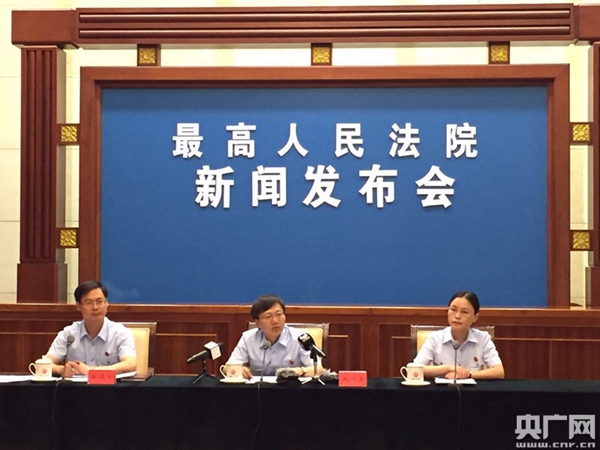
Supreme People’s Court holds a press conference on June 1. [Photo/cnr.cn]

A system to connect courts and other authorities to better protect children from serious harm is expected to be expanded across the country, China’s top court said on Thursday.

The system improves communication between courts and governmental departments such as civil affairs bureaus and public security authorities. Its aim is “to speed up the process of handling cases involving children age 17 or under and to increase protection when juveniles are attacked”, said Ran Rong, a judge at the No. 1 Criminal Tribunal of the Supreme People’s Court.

Ran said a test program has been conducted in more than 10 intermediate or district people’s courts in the country, including in Shandong and Sichuan provinces.

“We’ve got lots of experience in solving domestic violence and sexual abuse under the joint force,” she said. “We’ve decided to expand the system to all courts nationwide as quickly as we can.”

Under the system, for example, schools and hospitals in Qingdao, Shandong, have been ordered to report evidence or information to public security departments when it appears children have been sexually assaulted, according to a statement from the top court.

“Police officers must file and investigate a case in line with the evidence without hesitation. This is to ensure it becomes a part of judicial procedures and keeps the children involved from being attacked again,” Ran said.

A similar system to protect children at risk is also undergoing improvements in Beijing. In May, the capital’s top procuratorate signed a framework agreement with several departments and agencies, such as schools and social security organs, to create a network to identify minors in danger.

The top court is also trying to establish databases in Sichuan Province of left-behind children and people with criminal records involving sexual abuse of children, “hoping to give juveniles more effective and targeted protection,” Ran said.

Between 2013 and 2016, the nation’s courts heard 10,782 cases involving adults accused of sexually assaulting children, according to the top court.

“We’ve also given stricter punishment to offenders who sexually abused girls under the age of 12 in line with the revised Criminal Law,” said Guan Yingshi, the top tribunal’s deputy chief judge.

Li Yi, a repeat offender in Hunan Province, was recently executed after the court sentenced him to death for raping and sexually abusing 14 girls of 6 or 7 years old, some of them multiple times.

“Li Yi lured the girls to an apartment of his father’s, to stairwells or hilly areas in the countryside and committed the crime 26 times from 2009 to 2011,” Guan said.


Jiaolong completes 20th dive in Mariana Trench

China’s manned submersible “Jiaolong” surfaces after its dive in the Mariana Trench, June 1, 2017. [Photo/Xinhua]

China’s manned submersible “Jiaolong” Thursday conducted its 20th dive in the Mariana Trench, the world’s deepest-known trench, since 2012.

The dive began at 4:43 p.m. local time, with three crew onboard working underwater for half an hour.

During the mission, the crew studied deep-sea biotic communities and distribution of species in the trench. They also brought back sea water samples.

Observations and sampling were carried out along the sedimentary area and rock-fracture zone of the trench.

Jiaolong has completed the highest number of dives in the trench by a manned submersible, and has reached a depth over 6,500 meters on 12 dives.

This mission is the third and final stage of China’s 38th oceanic scientific expedition.

“It provides us with the first-hand data and samples for the country’s research in deep-sea science,” said Wu Changbin, commander of the expedition’s third stage.


HIV students to get a separate Gaokao

HIV-positive students to sit college entrance test

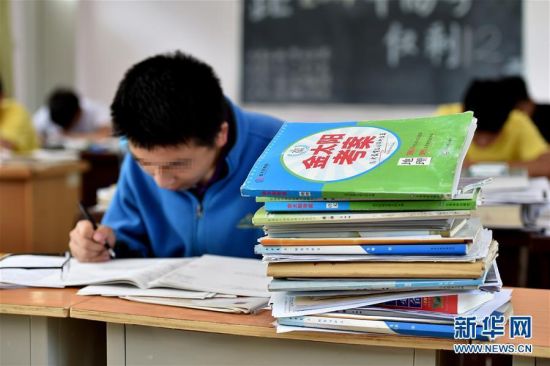
Students in Linfen Red Ribbon School prepare for the national college entrance exam, May 25, 2017. [Photo/Xinhua] 

A school for children infected with HIV in north China has been given permission to hold the national college entrance examination in its classrooms to prevent potential disruption for other students taking the test.

Sixteen of the 36 students enrolled at Linfen Red Ribbon School in Shanxi Province will take the exam, known as the Gaokao, on June 7 and 8.

The school, which opened in 2004, offers 12 years of elementary education to children who were infected with HIV-usually in their mothers’ wombs or through breastfeeding. It will be the first time any of its students have taken the exam.

The Shanxi Education Commission gave permission for the independent testing site shortly after the school held a commencement ceremony for its first high school graduates.

“I take that as a goodwill stance by the authorities,” said principal Guo Xiaoping. “We have to face the reality that discrimination is still rife against people living with HIV and AIDS.”

He said his students are allowed to take the exam at the regular examination site, which is 20 kilometers from the school, but that taking it in a familiar environment would help their performance.

Hu Zetao, 18, who is among the students who will take the exam, appeared in a public service announcement with China’s first lady, Peng Liyuan, to fight AIDS discrimination in 2012. In that widely circulated presentation, he showed his face and became familiar to the public. Guo said it made him a public figure in Linfen.

Hu said he and his fellow students were determined to attend universities in other parts of the country.

“Fewer people know us there and we are more likely to have a normal college life,” he said.

Chinese law safeguards the privacy of people with HIV and AIDS. Also, HIV is not tested during the routine health check for college entrance.

Guo said tolerance for HIV-positive people is much better at universities where students are adults, compared with primary and middle schools.

“I hope our children can lead a normal life after college,” he said. But for Hu, it’s much harder, as he became well known during many awareness-raising events.

With the Gaokao approaching, “I feel increasingly nervous”, Hu conceded.

“I don’t know whether any college will accept me, whether the college teachers will treat me like they do others or whether other college students will study beside me and live in the same dormitory with me,” Hu said.

But he said he was committed to a lifelong fight against AIDS and related discrimination. Guo said he would help communicate with the universities that students from Linfen Red Ribbon School strive for normal and happy study lives.

After Hu and his classmates leave for colleges following the Gaokao, Guo said, “We’ll have our next college entrance examination in six to seven years, and I am confident a more tolerant and well-informed society then will welcome the HIV-positive children to sit in the examination side by side with the HIV-free ones,” he said.

Without intervention, 30 percent of HIV-positive women will pass on the virus to their children. Currently, roughly 5.7 percent of infected mothers give birth to an HIV-positive baby, government statistics show.


Freedom of religious belief protected in Xinjiang

A white paper released on Thursday said China has fully implemented the policy of freedom of religious belief in Xinjiang Uygur Autonomous Region, protecting normal religious activities and ensuring the public’s freedom of religious belief.

Normal religious needs of local people have been satisfied, according to the white paper titled “Human Rights in Xinjiang – Development and Progress,” which was issued by the State Council Information Office.

Xinjiang has published translations of the religious classics of Islam, Buddhism, and Christianity in multiple languages, it said, adding 1.76 million copies of the Quran and Selections from Al-Sahih Muhammad Ibn-Ismail al-Bukhari have been printed and distributed.

Religious organizations have organized training courses on religious knowledge and etiquette for citizens with religious beliefs.

“Legitimate rights of religious organizations have been effectively safeguarded,” the white paper read.

Xinjiang has 112 religious organizations, which receive help from the government to improve their conditions and allow them to play a broader role, it said.

Steady improvements have been made in the training system to cultivate clerics, by offering them systemic training, enhancing their overall qualities, and raising religious organizations’ capacity of self-management, the white paper said.

It noted that overseas religious exchanges have been conducted in increasing depth. Xinjiang’s religious circles have sent delegations to international academic exchanges and seminars, and its clerics and students at religious institutes have won prizes in competitions for reciting the Quran.

Since 2001, Xinjiang has sent more than 70 clerics and students from the Islamic Institute to study at institutions of higher learning in Egypt, Pakistan, and other countries, and has set up scholarships to award those who achieve outstanding performance, said the white paper.

Moreover, the local government has implemented a policy for planning and organizing pilgrimages to Mecca, and has strengthened services to ensure that all such pilgrimages are safe and orderly, it said.