Former senior political advisor expelled from CPC, public office

Sun Huaishan, a former senior political advisor, was expelled from the Communist Party of China (CPC) and dismissed from public office for violating the Party’s code of conduct and corruption.

The CPC Central Commission for Discipline Inspection (CCDI) said in a statement Friday that an investigation found that Sun had “severely violated political discipline and rules.”

Sun was formerly a member of the Standing Committee of the Chinese People’s Political Consultative Conference (CPPCC) National Committee and head of the Committee for Hong Kong, Macao and Taiwan Compatriots and Overseas Chinese of the CPPCC National Committee.

The CCDI statement said Sun had spoken inappropriately of the Party’s key policies, formed cliques and obstructed the investigation into him.

He was found to have attended banquets paid for with public funds and asked other organizations to sponsor holidays for his relatives with public spending, acts that violate the Party’s “eight-point” frugality code, the statement said.

The statement also accused Sun of accepting money and gifts and abusing his power and influence to seek benefits for his son’s business operations.

Also, he took advantage of his posts to seek benefits for others and accepted cash or gifts in return.

The statement said Sun, as a member of the CPC Central Committee, was “politically disloyal” to the Party and greedy.

The qualification of Sun as a delegate to the 18th CPC National Congress will also be terminated and his ill gotten gains will be confiscated, the statement said.

The case will be transferred to judicial organs.

The statement said the decision to expel Sun from the CPC will be confirmed at a plenary meeting of the CPC Central Committee.



Driver starts school bus blaze, killing 13

A fatal school bus fire that killed 11 children and two adults in eastern China’s Shandong Province on May 9 was allegedly started by the bus driver, who also died, police said Friday.

The 11 children were aged between three and six, with five from the Republic of Korea and the rest from China.

The fire was started on the bus floor near the driver’s seat. A lighter cap was discovered nearby and gasoline residue found on multiple spots on the bus, according to a police officer with the Shandong provincial public security bureau.

Electricity faults and traffic accidents were ruled out as the cause of the fire, the police officer said.

The driver’s overtime and night shift allowance had been suspended, angering him, causing him to buy gasoline to set the fire, police said. Police received reports around 9 a.m. on May 9 about the fire inside Taojiakuang tunnel in Huancui District, Weihai city. The rented bus was delivering the children to a kindergarten, with 13 people onboard.

All were killed, including a female teacher.


Hong Kong named most competitive economy

Hong Kong named most competitive economy

Skyscrapers line the harbor in Hong Kong, on Feb 9, 2016. [Photo/Xinhua]

Hong Kong was rated as the most competitive economy for the second year in a row, while the Chinese mainland jumped up seven places on the 2017 World Competitiveness Yearbook released on Thursday.

The rankings published by the International Institute for Management Development in Lausanne, Switzerland consider 261 indices, including employment and trade statistics in 2016. It also uses the results of a survey of more than 6,250 executives in 2017.

Switzerland and Singapore ranked second and third respectively, while the U.S. dropped from third in 2016 to fourth in 2017, according to the 2017 World Competitiveness Yearbook.

As for the Yearbook’s four key measures, Hong Kong remains first in government efficiency and business efficiency, improved a bit on infrastructure while dropping from fifth in 2016 to eleventh on economic performance.

The drop is reported to reflect the economic growth slowed down in Hong Kong amid the global economic downturn.

Financial Secretary Paul Chan Mo-po said, “It’s great to see Hong Kong regains the most competitive economy in 2017, and this ranking highly praises Hong Kong SAR Government’s efforts on obeying the financial disciplines, opening new markets and assisting new industries.”

“Facing the increasingly competitive global economy, it needs to consolidate Hong Kong’s competitive strengths including free and open market principles, good law traditions, efficient public sectors and stable systems in a bid to improve the metropolitan city’s competence in the long run,” Chan said.

According to the Yearbook, the Chinese mainland moved up seven places to 18th on the list, showing it is the most competitive among economies with per capita GDP less than $20,000. Taiwan remained 14th.


US returns Chinese fugitive, a suspected rapist

US returns Chinese fugitive, a suspected rapist

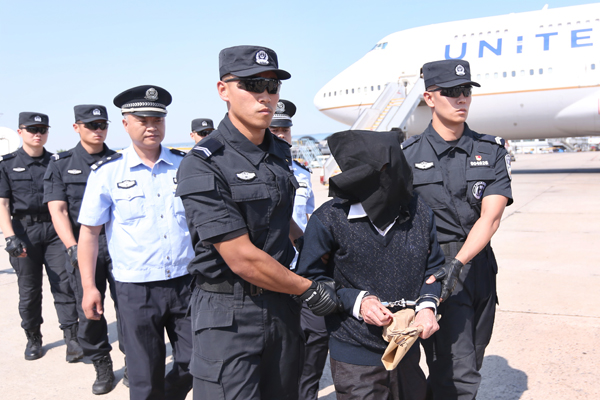
Police officers escort a fugitive who fled to the United States in April last year. The man, who is suspected of committing rape in China, was repatriated at Beijing Capital International Airport on Thursday. [Photo/China Daily]

A fugitive on China’s most-wanted list who is suspected of rape was repatriated to China from the United States on Thursday afternoon, according to the Ministry of Public Security.

A United Airlines flight carrying the suspect – surnamed Zhu – and two U.S. law enforcement officers arrived at Beijing Capital International Airport, where the officers handed him over to Chinese police.

The successful repatriation was considered “the latest achievement of law enforcement and network security cooperation between the two countries”, said a senior official at the ministry’s criminal investigation department, who asked that his name not be used.

According to the ministry, both countries have tried to put aside political and legal differences to enhance communication and mutual trust in the fight against transnational crimes.

Moreover, they will improve law enforcement and security dialogues, while strengthening intelligence sharing and conducting joint investigations in some cases.

In recent years, a number of Chinese suspects, including some suspected of major crimes, have fled China to the U.S. Lack of a bilateral extradition treaty, as well as legal obstacles, have helped them avoid prosecution.

In April 2016, the Fuyang police in Anhui Province received a report accusing Zhu of rape, and the suspect fled to the U.S.

The Ministry of Public Security attached great importance to the case and set up a special investigation team to go to the U.S. to hunt down the suspect. It asked Interpol to issue a red notice, which is close to an international arrest warrant.

In January, Zhu was captured by U.S. authorities for illegally overstaying his visa, and the U.S. immediately informed the ministry. Chinese officials then shared evidence of the rape with their U.S. counterparts and requested that Zhu be sent back to China.

In May, Zhu was convicted in a U.S. court of illegal immigration and was expelled from the country.

Huang Feng, a law professor from Beijing Normal University, said Chinese fugitives will pose a serious risk to local public security, and if U.S. law enforcement officers are aware of their crimes, they won’t allow foreign suspects to stay in the country.

“They will offer judicial assistance to their Chinese counterparts according to the laws in the U.S.,” he said.


Guideline helps county cut costs of weddings, funerals

Guideline helps county cut costs of weddings, funerals

A mausoleum is under construction in Huichang county’s Bingqiu village in Jiangxi province. [Photo/China Daily]

Huichang county in Jiangxi Province is taking measures to curb the soaring costs of betrothal gifts and extravagant wedding and funeral ceremonies, which have plagued its villages for years.

With the average cost of betrothal gifts in the county skyrocketing to 300,000 yuan ($44,000) this year, the old tradition of giving money to a bride’s parents has become a huge burden for a groom’s family. “Getting married is now one of the two major causes of poverty in the county – the other being illness,” said Xu Yongchun, a county official.

As part of a plan to reduce poverty and transform outdated tradition, the county government has issued a guideline, limiting dowries at 60,000 yuan and calling on villagers to scale down their wedding banquets to no more than 10 tables, according to Zeng Pengfei, director of the Huichang civil affairs department. He said the government is setting up village-level wedding and funeral councils to ensure implementation of the measures.

The measures were introduced in Wenwuba township’s Gufang village in March. “Our village has nine communities based on family names. The nine council members we elected, one from each community, are all highly respected and enlightened elders,” said Zou Zhulin, head of Gufang’s wedding and funeral council.

“The task of council members is to raise awareness of the guideline, which involves helping organize and supervise wedding ceremonies, making sure they don’t leave families penniless. But it’s not easy to change a deep-rooted tradition,” Zou said.

However, Huichang has made significant progress in simplifying funeral services and promoting green burials. Xijiang township’s Bingqiu village is a pioneer in terms of mausoleums.

Villagers discovered the benefits of mausoleums after the government built one for them. In fact, the 271 residents voluntarily raised funds to build a second one, according Wang Tianfa, vice-chairman of the village’s wedding and funeral council. They each contributed 2,500 yuan for the project, which is also the price of one niche in the mausoleum.

The two-story building, which is under construction, is situated on top of a hill.

“The mausoleum covers just 190 square meters, but will house more than 350 urns. It requires much less land than a cemetery,” Wang said. “It also eases the burden on younger generations. Traditional funeral services cost up to 50,000 yuan, while cremating a deceased person and storing their ashes in a mausoleum costs only a few thousand yuan.”

Bingqiu’s new practice has attracted the attention of neighboring townships and villages. “Since the beginning of this year, we have received more than 20 groups of visitors to our mausoleum,” Wang said.

The county government said it plans to expand the practice in all of its villages.