First China-designed experiment flies to space station

SpaceX on Saturday launched a shipment of supplies for the astronauts living at the International Space Station, carrying for the first time an experiment independently designed by China.

The SpaceX Dragon cargo spacecraft lifted off on the company’s Falcon 9 rocket at 5:07 p.m. EDT (2107 GMT) from the Kennedy Space Center in Florida.

About 10 minutes later, SpaceX successfully landed the rocket’s first stage at the company’s Landing Zone 1, just south of the launch site at Cape Canaveral Air Force Station, as part of its effort to develop fully reusable rockets.

On this trip, the Dragon will deliver almost 6,000 pounds (2,700 km) of supplies, including solar panels, tools for Earth-observation and equipment to study neutron stars. If all goes well, it will arrive at the space station on Monday.

Chinese experiment

Among the cargo is a 3.5-kilogram device from the Beijing Institute of Technology that sought to answer questions like “Does the space radiation and microgravity cause mutations among antibody-encoding genes and how does it happen?”

The Chinese payload was first reported in 2015, when an agreement was reached with NanoRacks, a Houston-based company that offers services for the commercial utilization of the space station.

Under the agreement, NanoRacks will deliver the device to the U.S. side of the space station and astronauts there will conduct studies using the device in about two weeks, data from which will be sent back to the Chinese researchers.

There is a U.S. law in place, known as the Wolf amendment, that bans cooperation between the U.S. space agency NASA and Chinese government entities, but this deal is purely commercial and therefore considered legal.

NASA spokesperson Kathryn Hambleton confirmed to Xinhua that there is a Chinese experiment that is launched on this mission, known as SpaceX CRS-11.

“NASA complied with all legal requirements to notify the Congress of this activity, and all of the ISS partners approved the inclusion of the experiment,” Hambleton said in an email.

“This is not the first Chinese experiment on the International Space Station (ISS),” the spokesperson said. “Chinese scientists have been investigators and co-investigators on international experiments conducted on the ISS, including for the Alpha Magnetic Spectrometer investigation on ISS.”

Good step

However, Professor Deng Yulin, who led the Chinese research, said that this is the first time an ISS experiment has been independently designed and fabricated in China.

“This cooperation does not violate any laws and regulations, including the Wolf amendment. We do it in an open and visible way,” Deng told Xinhua. “This is a new model of cooperation that we can follow in the future.”

“We think it’s really an important research and they have done a great job,” Mary Murphy, senior internal payloads manager of NanoRacks, told Xinhua, calling the cooperation between the two “a good example.”

Leroy Chiao, a former Chinese-American NASA astronaut and ISS commander, highlighted the significance of the Chinese project.

“I think this is a good step forward,” Chiao said. “I have always believed that cooperation is the best way forward for both the U.S. and China, particularly using civil space exploration as an avenue.”

Joan Johnson-Freese, a space policy analyst at the U.S. Naval War College, said that it evidences the growing importance of commercial space.

“Space is no longer just the purview of government activity,” Johnson-Freese said. “Space is developing as an area of commercial activity, much like cars and computers, which is a big change from the past.”

SpaceX CRS-11 was the 11th of up to 20 missions to the space station that the California-based company will fly for NASA. It also marked the first time that SpaceX has launched a spaceship that has been used on a previous mission to the space station.


First China-designed experiment flies to space station

SpaceX on Saturday launched a shipment of supplies for the astronauts living at the International Space Station, carrying for the first time an experiment independently designed by China.

The SpaceX Dragon cargo spacecraft lifted off on the company’s Falcon 9 rocket at 5:07 p.m. EDT (2107 GMT) from the Kennedy Space Center in Florida.

About 10 minutes later, SpaceX successfully landed the rocket’s first stage at the company’s Landing Zone 1, just south of the launch site at Cape Canaveral Air Force Station, as part of its effort to develop fully reusable rockets.

On this trip, the Dragon will deliver almost 6,000 pounds (2,700 km) of supplies, including solar panels, tools for Earth-observation and equipment to study neutron stars. If all goes well, it will arrive at the space station on Monday.

Chinese experiment

Among the cargo is a 3.5-kilogram device from the Beijing Institute of Technology that sought to answer questions like “Does the space radiation and microgravity cause mutations among antibody-encoding genes and how does it happen?”

The Chinese payload was first reported in 2015, when an agreement was reached with NanoRacks, a Houston-based company that offers services for the commercial utilization of the space station.

Under the agreement, NanoRacks will deliver the device to the U.S. side of the space station and astronauts there will conduct studies using the device in about two weeks, data from which will be sent back to the Chinese researchers.

There is a U.S. law in place, known as the Wolf amendment, that bans cooperation between the U.S. space agency NASA and Chinese government entities, but this deal is purely commercial and therefore considered legal.

NASA spokesperson Kathryn Hambleton confirmed to Xinhua that there is a Chinese experiment that is launched on this mission, known as SpaceX CRS-11.

“NASA complied with all legal requirements to notify the Congress of this activity, and all of the ISS partners approved the inclusion of the experiment,” Hambleton said in an email.

“This is not the first Chinese experiment on the International Space Station (ISS),” the spokesperson said. “Chinese scientists have been investigators and co-investigators on international experiments conducted on the ISS, including for the Alpha Magnetic Spectrometer investigation on ISS.”

Good step

However, Professor Deng Yulin, who led the Chinese research, said that this is the first time an ISS experiment has been independently designed and fabricated in China.

“This cooperation does not violate any laws and regulations, including the Wolf amendment. We do it in an open and visible way,” Deng told Xinhua. “This is a new model of cooperation that we can follow in the future.”

“We think it’s really an important research and they have done a great job,” Mary Murphy, senior internal payloads manager of NanoRacks, told Xinhua, calling the cooperation between the two “a good example.”

Leroy Chiao, a former Chinese-American NASA astronaut and ISS commander, highlighted the significance of the Chinese project.

“I think this is a good step forward,” Chiao said. “I have always believed that cooperation is the best way forward for both the U.S. and China, particularly using civil space exploration as an avenue.”

Joan Johnson-Freese, a space policy analyst at the U.S. Naval War College, said that it evidences the growing importance of commercial space.

“Space is no longer just the purview of government activity,” Johnson-Freese said. “Space is developing as an area of commercial activity, much like cars and computers, which is a big change from the past.”

SpaceX CRS-11 was the 11th of up to 20 missions to the space station that the California-based company will fly for NASA. It also marked the first time that SpaceX has launched a spaceship that has been used on a previous mission to the space station.


70 pct of Beijing tap water comes from Yangtze

More than 70 percent of the tap water in Beijing’s main urban areas comes from the Yangtze River, thanks to a huge water diversion project that was designed to ease water shortages in the north.

Beijing has received 2.28 billion cubic meters of Yangtze water since the south-to-north water diversion project began pumping water into the city in December 2014, Beijing Waterworks Group said in a report Saturday.

It said the project had increased Beijing’s water supply capacity to 3.72 million cubic meters a day, ending the water shortage the capital experienced every every summer.

Before Yangtze water diverted to Beijing, the city’s daily supply capacity was 3.2 million cubic meters at most and water sources, mainly from underground, were susceptible to calcium and magnesium salts.

At least 11 million people in Beijing have benefited from the water diversion project so far, according to Beijing Waterworks Group.

“Residents in high-rise apartment buildings used to suffer water crunches in summer. On some of the worst days, there was no water for cooking or washing,” said Fang Yajun, chief of the water authority in Tongzhou District, east Beijing.

“Their problems will soon be solved, with a new waterworks that will open this summer to supply 200,000 cubic meters of water daily,” he said.

The new waterworks in Tongzhou District, the city’s “subsidiary administrative center,” is fed by Yangtze water and will double Tongzhou’s daily supply capacity, said Fang.

Among the 2.28 billion cubic meters of Yangtze water pumped to Beijing since the end of 2014, about 1.58 billion cubic meters has gone to water supply companies. The rest is stored in reservoirs or used as groundwater, river and lake supplies.


World’s 1st driverless rail transit system unveiled in Hunan

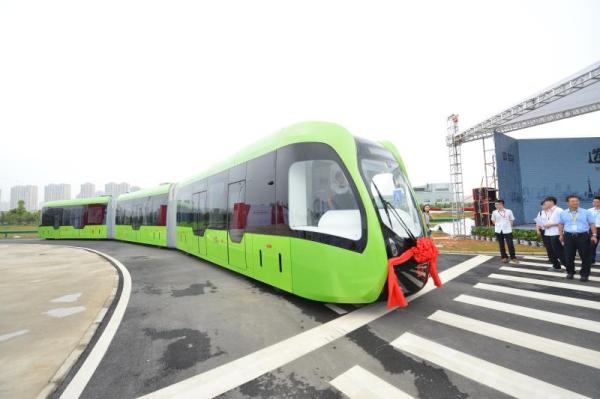
Chinese railcar-maker CRRC unveiles a new product called Autonomous Rail Transit (ART) in Zhuzhou, Hunan province, June 2, 2017. [Photo: Thepaper.cn]

Chinese railcar-maker CRRC on Jun. 2 unveiled a new product called Autonomous Rail Transit (ART) in Zhuzhou, Hunan province, and the bus-rail combo rapid transit system is expected to speed up city’s public transportation.

According to CRRC, ART uses rubber wheels on a plastic core instead of steel wheels. It’s also equipped with the company’s copyrighted technology to automatically guide the vehicles. It carries the advantages of both rail and bus transit systems and is agile and non-polluting, Thepaper.cn reported.

ART is much cheaper than ordinary subway, which cost about 400-700 million RMB per kilometer in China. And compared with electric streetcars, which cost 150-200 million RMB per Kilometer, ART is only about one-fifth the investment.

CRRC began designing the ART system in 2013. The first ART car is 31 meters in length, with a maximum passenger load of 307 people or 48 tons. Its top speed is 70 kilometers per hour, and it can travel 25 kilometers in distance after 10 minutes of charging.

The world’s first ART line will be launched in Zhuzhou, with a total length of 6.5 kilometers. Upon completion, it will be able to dock with the city’s mid-low speed maglev train.


Driver starts school bus blaze, killing 13

A bus catches on fire inside a tunnel in Weihai city, east China’s Shandong Province, on Tuesday, May 9, 2017. [Photo: thepaper.cn]

A fatal school bus fire that killed 11 children and two adults in eastern China’s Shandong Province on May 9 was allegedly started by the bus driver, who also died, police said Friday.

The 11 children were aged between three and six, with five from the Republic of Korea and the rest from China.

The fire was started on the bus floor near the driver’s seat. A lighter cap was discovered nearby and gasoline residue found on multiple spots on the bus, according to a police officer with the Shandong provincial public security bureau.

Electricity faults and traffic accidents were ruled out as the cause of the fire, the police officer said.

The driver’s overtime and night shift allowance had been suspended, angering him, causing him to buy gasoline to set the fire, police said. Police received reports around 9 a.m. on May 9 about the fire inside Taojiakuang tunnel in Huancui District, Weihai city. The rented bus was delivering the children to a kindergarten, with 13 people onboard.

All were killed, including a female teacher.