Lost temple discovered after 1,000 years in Chengdu

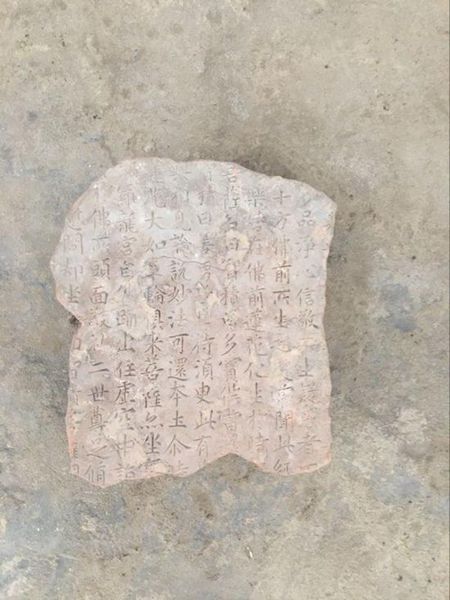
Archaeologists unearthed more than 1,000 tablets inscribed with Buddhist scriptures and over 500 pieces of stone sculpture as well as glazed tiles with inscriptions at the site of the lost temple. [Photo/Western China Metropolis Daily]

 Archaeologists have spent months excavating a lost temple that disappeared for nearly a millennium in downtown Chengdu, capital of southwest China’s Sichuan Province.

The Fugan Temple was a famous temple that lasted from the Eastern Jin Dynasty (317-420) to the Southern Song Dynasty (1127-1279).

Daoxuan, a famous Tang Dynasty (618-907) monk, once wrote that an official rite to pray for rain to end a persistent drought was held in front of the temple, and it rained as if the prayers had been heard in heaven.

The story was the record of how the temple got its name, Fugan, which means “perceive the blessing.”

Famous Tang Dynasty poet Liu Yuxi left a poem to commemorate the temple’s renovation, describing its heavenly appearance. The poem further noted the temple’s important role at that time.

However, the building was worn down during the later period of the Tang and Song dynasties, with all traces of the temple disappearing during wars.

Archaeologists unearthed more than 1,000 tablets inscribed with Buddhist scriptures and over 500 pieces of stone sculpture as well as glazed tiles with inscriptions.

“We have only excavated a part of the temple’s area, but already have a glimpse of its past glory,” said Yi Li, who led the excavation project.

He said they have found the temple’s foundation, ruins of surrounding buildings, wells, roads and ditches.

During the excavation, archaeologists found some 80 ancient tombs scattered near the temple, dating back to Shang and Zhou dynasties (1600-256 BC). In the temple’s surroundings, they have unearthed large amounts of household tools and utensils and building materials dating back to various periods from the Song to Ming dynasties.

Chengdu became an economic and cultural center in western China during the Sui and Tang dynasties. The temple’s discovery could greatly contribute to the study of the spread of Buddhism in China during that time, said Wang Yi, director of the Chengdu Cultural Relic Research Institute.


BRICS Media Forum to be held in Beijing next week

The BRICS Media Forum, to be held in Beijing from June 7 to 8, will be attended by the leaders of 25 media groups from Brazil, Russia, India, China and South Africa.

The attendees will discuss topics including multimedia innovation for media development, as well as media outlets’ duty and social responsibility.

The forum next week aims to improve the high-end dialogue platform for the mainstream media of BRICS countries, as well as advance innovation and promote fairness and justice of international public opinion.

During the forum, there will be a BRICS Media Joint Photo Exhibition to show the development and cooperation achievements of BRICS.

Proposed by Xinhua, the forum is jointly organized by the mainstream media groups of BRICS countries.

China, which took over the BRICS presidency this year, will host the Ninth BRICS Summit in September in Xiamen, Fujian Province.


Largest Asian cruise ship starts maiden voyage in China

Norwegian Joy, the largest cruise ship in Asia and custom-built for Chinese market, began its maiden voyage from east China’s Qingdao City Saturday.

Norwegian Joy is capable of accommodating nearly 5,000 passengers and 1,900 crew members. A total of 28 restaurants onboard offer international dining. A two-level Kart racing track, virtual reality games, and Broadway musical shows are provided for entertainment.

Qingdao international cruise homeport has three exclusive berths for cruise ships, with a maximum customs clearance capacity of 3,000 to 4,000 people per hour.

A total of 171 ships with 300,000 passengers onboard have been received so far, according to Liu Min, spokesperson of Qingdao Port Group.

The port is currently operating 15 routes in cooperation with seven cruise companies across the globe. Over 100 ships are expected to berth and depart the port in 2017.


Automotive vehicles major source for air pollution

Automotive vehicles have emerged as a major source of China’s air pollution, according to a report released by the Ministry of Environmental Protection (MEP) on Saturday.

China had 295 million automotive vehicles on its roads as of the end of last year, emitting pollutants weighing about 44.725 million tonnes, down 1.3 percent year on year, the report showed.

Analysis of air pollutants of 15 major Chinese cities showed that local mobile emitters, a category that includes vehicles, contributed to about 13.5 percent to 41 percent of total fine particle concentration, according to Liu Bingjiang, a senior official with MEP.

The MEP will enhance supervision on the production, use and elimination of automotive vehicles to reduce air pollution, Liu added.


Air, water quality continues to improve in Beijing

Air pollutant density was lowered in Beijing while its surface water environment also improved in 2016, according to a report released by Beijing Municipal Environment Protection Bureau Friday.

The city’s drinking water reserves were expanded to over 1,300 square kilometers. The discharge of two key water pollutants, chemical oxygen demand (COD) and ammonia nitrogen, were reduced by 7.7 and 8.1 percent respectively, the report said.

More sewage treatment plants and water recycling facilities were put into operation last year, bringing its sewage treatment capacity to 6.72 million cubic meters per day, said Qiao Shufang, director of the bureau’s environmental monitoring department.

The average density of PM2.5, airborne particles smaller than 2.5 microns in diameter, was 73 micrograms per cubic meter last year, down 9.9 percent year on year.

Densities of other air pollutants including sulfur dioxide, nitrogen dioxide, PM10, carbon monoxide and ozone all saw year-on-year decreases, said the report.

In 2016, Beijing had 198 days with good air quality, an increase of 12 days from 2015. The number of “heavy air pollution” days stood at 39, seven days fewer than that of 2015.