China’s efforts to strengthen implementation of reform

The Chinese leadership has stressed the role of supervision in implementing reform on various occasions, especially at meetings of the Central Leading Group for Deepening Overall Reform.

In the public reports of all 35 meetings of the group, the word “implement” has appeared 219 times, and the word “supervision” showed up 69 times.

All departments and localities should attach greater importance to delivering reforms and devote more efforts to examining reform effects, President Xi Jinping said on April 18, 2017 during the 34th meeting of the leading group, which he heads.

“We need to gather enough people to strengthen the supervision force in order to supervise the implementation of major reform programs. Supervision goes wherever reform goes,” said Xi on the fifth meeting of the Central Leading Group for Deepening Overall Reform on Sept. 29, 2014.

Over the past three years, the Communist Party of China (CPC) Central Committee has regarded supervision as a key part of work that should constantly be improved.

— During the group’s 21st meeting on Feb. 23, 2016, the leadership highlighted improved supervision and evaluation of reform, stressing that all departments should ensure plans are well documented, and any mistakes or deadline breaches are dealt with accordingly.

It noted that only truly effective reform will boost social and economic development and give people real benefits.

— On July 22, 2016, a report on supervision of reform efforts in all departments was approved at the 26th meeting of the leading group.

Supervision should target major reform tasks, progress and effectiveness. It should also supervise officials’ awareness of reform, their division of duties and work styles, said a statement issued after the meeting.

— On March 24, 2017, the leadership emphasized the importance of implementation, urging leading officials to keep in mind the overall situation while pushing forward with reform at the group’s 33rd meeting.

At the meeting, senior officials reported on the progress made in reforms in environmental protection, the judicial system, poverty relief, rural affairs, the Shanghai FTZ, state-owned enterprises and others.

Leading officials must refine the implementation process to ensure results, improve coordination between various reforms and focus on the most important and difficult issues, according to the meeting.

— At the group’s 34th meeting, the leadership stressed the role of supervision in implementing reform, demanding such work be carried out with a wider and deeper scope to detect and solve problems.

Authorities should review the results regarding major reforms and “intricate matters,” according to a statement issued after the meeting.

The group called for timely corrections to problems uncovered during supervision, and those found to be making insufficient efforts should be called to account.

Leading departments and local authorities were also ordered to regularly track reform implementation and report the effects.
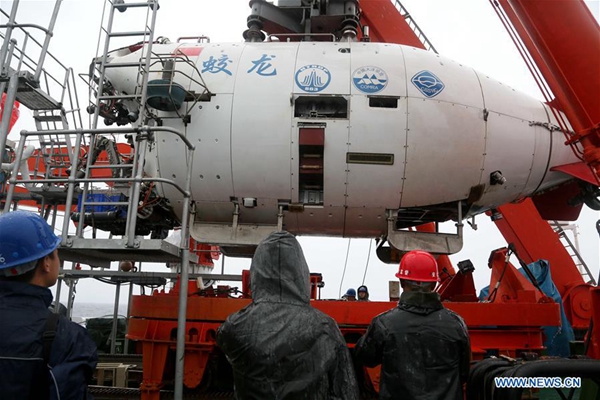


Chinese submersible Jiaolong dives in Yap Trench

Manned submersible Jiaolong is put into the sea to conduct its first dive in Yap Trench, June 4, 2017. [Photo/Xinhua]

On Sunday, China’s manned submersible Jiaolong conducted its first dive in the Yap Trench of the year.

Jiaolong began diving at 8:43 a.m. local time on a rainy day, reaching a depth of 4,177 meters.

Jiaolong was not afraid of the bad weather, but the rain did make it a bit more difficult for the dive, said Wang Xiangxin, a staff member on board.

“We cannot hear each other clearly due to the rain, so we have to be extra careful during the operation,” Wang said.

There will be five dives for Jiaolong in the Yap Trench, and the last dive is planned for June 12.

The dives will focus on research in deep-sea biotic communities and gene resources, according to scientists on the ship.

Jiaolong completed a series of dives in the Mariana Trench on June 1 and was transferred aboard Xiangyanghong to the Yap Trench afterward.

The Mariana and Yap trenches are located in the west Pacific Ocean. The Yap Trench has a depth of 8,527 meters, and the Mariana Trench, the deepest known point of Earth’s oceans, has a depth of 11,034 meters.

This is the third and final stage of China’s 38th oceanic scientific expedition, which started Feb. 6 and is scheduled to finish on June 18. The two previous stages were successfully completed in the Indian Ocean and the South China Sea.

Sunday’s operation was Jiaolong’s 148th dive.

Named after a mythical dragon, Jiaolong reached its deepest point of 7,062 meters in the Mariana Trench in June 2012.


Explosion rocks petrochemical plant in east China

An explosion hit a petrochemical firm in east China’s Shandong Province Monday morning, casualties unknown, according to local authorities.

The explosion occurred at 1 a.m. Monday and triggered fires at the loading area of Linyi Jinyu Petrochemical Co. Ltd. in the Linyi Lingang Economic Development Zone. Casualties and economic losses remained unknown.

The investigation on the cause of the accident is underway.


China’s efforts to strengthen implementation of reform

The Chinese leadership has stressed the role of supervision in implementing reform on various occasions, especially at meetings of the Central Leading Group for Deepening Overall Reform.

In the public reports of all 35 meetings of the group, the word “implement” has appeared 219 times, and the word “supervision” showed up 69 times.

All departments and localities should attach greater importance to delivering reforms and devote more efforts to examining reform effects, President Xi Jinping said on April 18, 2017 during the 34th meeting of the leading group, which he heads.

“We need to gather enough people to strengthen the supervision force in order to supervise the implementation of major reform programs. Supervision goes wherever reform goes,” said Xi on the fifth meeting of the Central Leading Group for Deepening Overall Reform on Sept. 29, 2014.

Over the past three years, the Communist Party of China (CPC) Central Committee has regarded supervision as a key part of work that should constantly be improved.

— During the group’s 21st meeting on Feb. 23, 2016, the leadership highlighted improved supervision and evaluation of reform, stressing that all departments should ensure plans are well documented, and any mistakes or deadline breaches are dealt with accordingly.

It noted that only truly effective reform will boost social and economic development and give people real benefits.

— On July 22, 2016, a report on supervision of reform efforts in all departments was approved at the 26th meeting of the leading group.

Supervision should target major reform tasks, progress and effectiveness. It should also supervise officials’ awareness of reform, their division of duties and work styles, said a statement issued after the meeting.

— On March 24, 2017, the leadership emphasized the importance of implementation, urging leading officials to keep in mind the overall situation while pushing forward with reform at the group’s 33rd meeting.

At the meeting, senior officials reported on the progress made in reforms in environmental protection, the judicial system, poverty relief, rural affairs, the Shanghai FTZ, state-owned enterprises and others.

Leading officials must refine the implementation process to ensure results, improve coordination between various reforms and focus on the most important and difficult issues, according to the meeting.

— At the group’s 34th meeting, the leadership stressed the role of supervision in implementing reform, demanding such work be carried out with a wider and deeper scope to detect and solve problems.

Authorities should review the results regarding major reforms and “intricate matters,” according to a statement issued after the meeting.

The group called for timely corrections to problems uncovered during supervision, and those found to be making insufficient efforts should be called to account.

Leading departments and local authorities were also ordered to regularly track reform implementation and report the effects.


Chinese shipbuilder delivers world’s 1st semi-submersible aquaculture support vessel

A China shipbuilding firm on Saturday delivered the world’s first semi-submersible aquaculture support vessel to Norwegian fish farming company SalMar ASA.

The Wuchang Shipbuilding Industry Group Co. Ltd. of the China Shipbuilding Industry Corporation delivered the vessel at its dock in Qingdao in east China’s Shandong Province.

The vessel, 110 meters in diameter and 69 meters in total height, weighs 7,700 tonnes and can resist powerful typhoons of up to 36 meters per second in speed. It can accommodate water for farming 1.5 million fish while maintaining a death rate of less than 2 percent.

SalMar is one of the world’s largest companies for producing and processing salmon.

Yan Jun, deputy chief engineer of Wuchang Shipbuilding Industry Group Co. Ltd., said the vessel is the world’s first fully automated aquaculture support vessel. Its smart aquaculture system can release fish fry and perform feeding, environmental monitoring, cleaning and removal of dead fish.

The ship maker signed a contract in April with SalMar to add another five of the smart aquaculture support vessels.