FTC-2000 aircraft export-version rolls off production line

Photo taken on June 5, 2017 shows the FTC-2000 aircraft in Anshun, southwest China’s Guizhou Province. [Photo/Xinhua]

The export version of the China-developed light versatile FTC-2000 aircraft rolled off the production line of the state-owned aircraft developer in Anshun in southwest China’s Guizhou Province Monday.

With its desert-camouflage paint appearance, the FTC-2000 was developed by the Guizhou Aviation Industry Corporation under the state-owned Aviation Industry Corporation of China (AVIC).

As one of the first batch of its model in the global-military trade market, it will be delivered to overseas clients after necessary procedures and tests, according to AVIC.

The FTC-2000, also named Mountain Eagle, or Shanying in Chinese, is a supersonic advanced fighter trainer.

The single-engine light versatile aircraft is a new generation of advanced-fighter trainer designed for advanced training and lead-in fighter training for modern fighters. It is also capable of performing combat missions.

The supersonic aircraft has a mach number of 1.5, and a maximum service ceiling of 16,000 meters.

“It can be used for senior training, elementary combat training and tactical countermeasure training for fighter pilots. And it also has the ability to perform air-to-air and air-to-ground combat,” according to Hu Jianxing, deputy manager and chief designer with the AVIC Guizhou Aviation Industry Corporation.

“It completed the ‘Stall and Spin Flight Test’ within two seconds at the research stage. The FTC-2000 has high safety characteristics,” said Hu, adding the model was highly efficient and reliable.

The FTC-2000 maiden flight was on Dec. 13, 2003. And the model has made two public aerobatic flight displays, at the 2006 and 2016 China Airshow in Zhuhai.

In China, the FTC-2000 is the the main advanced trainer used by the PLA Air Force and the PLA Navy.

“The domestic version and export version have the same flying platform. And both are installed with China’s home-developed WP-13 turbojet engine, which has been tested for high performance,” Hu said. “The export version will be installed with various avionics systems, navigation guidance systems or external stores tailored for overseas client’s demand for multiple missions.”



CPC stresses internal supervision, inspection

The Communist Party of China (CPC) Central Committee has issued a circular on internal supervision and inspection.

The major task of the supervision and inspection is to ensure implementation of Party’s theory, line and policy as well as the CPC Central Committee’s decisions, according to the circular published on Monday.

Local Party committees should organize genuinely effective supervision and inspection and ensure the thorough implementation of CPC Central Committee’s decisions and policies, it said.

They should improve on-the-spot inspections and conduct investigations in private, the circular said.

The inspection results may be publicized on news media and leading officials of departments and work units where prominent problems are found will be given verbal warning.

Those who interfere in supervision and inspection will be punished, and supervisors and inspectors themselves will be held accountable for negligence of duty, according to the circular.


Three pandas return from Japan to China

Giant pandas Yang Bang and Hai Bang at the Adventure World amusement park in Shirahama, Wakayama prefecture, Japan, June 4, 2017. [Photo/Xinhua]

Three giant pandas born and raised in Japan arrived in Chengdu in southwest China on Monday night, where they will begin a new life, and, hopefully, have offspring.

The panda twins and their younger sister had been living at Adventure World in Shirahama, Wakayama Prefecture.

The male-female twins, called Hai Bang and Yang Bang, were born on August 11, 2010, while their younger sister You Bang was born on August 10, 2012. The names are translated from Japanese names to Chinese, said Chengdu Research Base of Giant Panda Breeding, their new home.

The three pandas will return to the base on Tuesday. They will undergo a month-long quarantine and orientation period before meeting the public.

“They are expected to adapt to changes in food, environment, language, and even the taste of bamboo. We will perform health checks on the pandas,” said Yang Zhi, a disease prevention expert with the base.

In 1994, the Chengdu base and the Japanese park started a panda breeding research program. Over the years, 15 pandas have been bred. Among them, eight have returned to China.

Cubs born to pandas that are “on loan” from China must be returned to China after they reach sexual maturity or when the cooperative agreement ends


1 dead, 6 injured in petrochemical plant explosion

One person has been confirmed dead, six are injured and another seven missing after an explosion at a petrochemical company in east China’s Shandong Province Monday morning, according to local authorities.

A liquefied gas tanker exploded at around 1 a.m. Monday, triggering a fire in the loading area of Linyi Jinyu Petrochemical Co. Ltd., which is located in the Lingang Economic Development Zone in the city of Linyi.

According to a press release given by the economic zone, the owner of the company is in police custody.

Firefighters are currently fighting the fire.

Rescue teams have evacuated workers, except for the seven still missing, and continue to monitor poisonous and combustible chemicals stored at the plant.


Chinese experiment heading for ISS

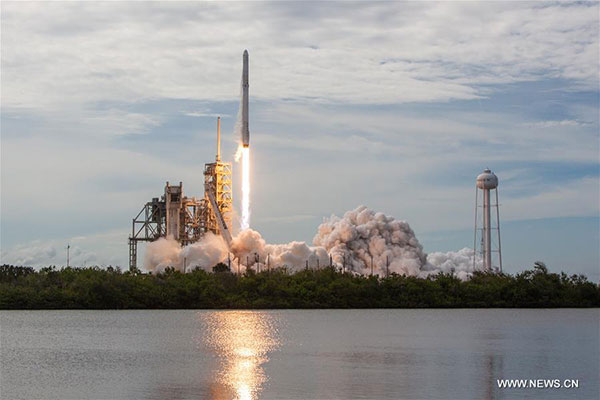
The photo made available by U.S. space firm SpaceX on June 3, 2017 shows the company’s Falcon 9 rocket launching at the Kennedy Space Center in Florida, the United States. [Photo/Xinhua]

When the SpaceX Dragon capsule docks with the International Space Station tomorrow, it will be carrying equipment for the first experiment to have been independently designed by China.

A research project by the Beijing Institute of Technology aims to investigate how the space environment affects DNA, said Deng Yulin, a life sciences professor with the institute.

It will study gene mutation, one of the biggest risks to astronauts working in space, as they are exposed to 10 times the radiation than on earth, he said.

PrevioU.S.ly, equipment for space experiments was sent via China’s 2011 launch of the Shenzhou-8 spacecraft, its 2016 lift by a Long March-7 rocket and via China’s cargo spacecraft Tianzhou-1 this year.

“The research team caught evidence of the gene mutation after the first experiment via Shenzhou-8, which proves the space environment can caU.S.e DNA mutation and biomolecular changes,” Deng said.

The project on the ISS will continue to study whether gene mutation follows any rules in a space radiation and microgravity environment, he said.

The Chinese payload was first reported in 2015, when an agreement was reached with NanoRacks, a HoU.S.ton-based company that offers services for the commercial utilization of the space station.

Under the agreement, NanoRacks will deliver the device to the U.S. side of the space station and astronauts there will conduct studies using the device, data from which will be sent back to the Chinese researchers.

There is a U.S. law, known as the Wolf amendment, banning cooperation between U.S. space agency NASA and Chinese government entities, but this deal is purely commercial and therefore considered legal.

NASA spokeswoman Kathryn Hambleton said, “NASA complied with all legal requirements to notify the Congress of this activity, and all of the ISS partners approved the inclU.S.ion of the experiment.

Professor Deng said, “This is a new model of cooperation that we can follow in the future.”

Leroy Chiao, a former Chinese-American NASA astronaut and ISS commander, highlighted the significance of the Chinese project.

“I think this is a good step forward,” Chiao said. “I have always believed that cooperation is the best way forward for both the U.S. and China, particularly using civil space exploration as an avenue.”

Joan Johnson-Freese, a space policy analyst at the U.S. Naval War College, said that it evidences the growing importance of commercial space.

“Space is no longer just the purview of government activity,” Johnson-Freese said. “Space is developing as an area of commercial activity, much like cars and computers, which is a big change from the past.”

The SpaceX mission is the 11th of up to 20 trips to the space station the California-based company will fly for NASA.

The Dragon spacecraft lifted off on SpaceX’s Falcon 9 rocket from the Kennedy Space Center in Florida at 5:07pm on Saturday.

About 10 minutes later, SpaceX successfully landed the rocket’s first stage at the company’s Landing Zone 1, jU.S.t south of the launch site at Cape Canaveral Air Force Station, as part of its effort to develop fully reU.S.able rockets.