Blast at kindergarten gate wreaks havoc
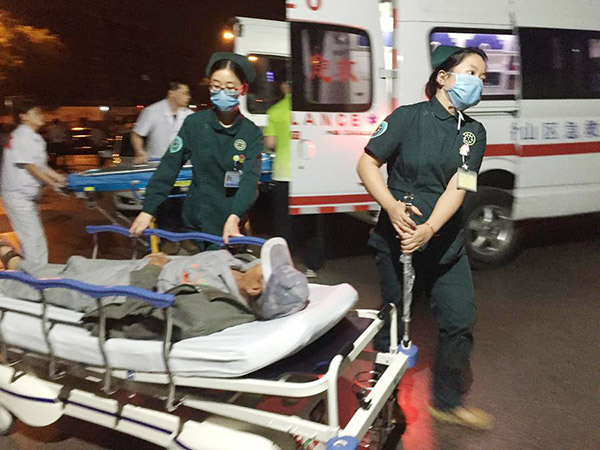
Medical workers transfer an injured man to hospital after an explosion at the gate of a kindergarten in Fengxian county, Jiangsu province on June 15, 2017. At least seven people were killed and 66 others injured. [Photo/Xinhua] 

An explosion at the gate of a kindergarten in Fengxian county, Jiangsu province, at 4:50 pm on Thursday left at least seven people dead and 66 injured, nine of them seriously.

Two people were killed at the scene, and the five others died after being taken to a hospital, the Xuzhou city publicity office said in a statement. Xuzhou administers Fengxian county.

It was not yet known late Thursday what caused the blast and there was no clear information on the identities of the dead and injured, the statement said. Neither was there information on how many of the dead and injured were adults and how many were children.

Officials and police officers rushed to the scene and a preliminary investigation of the incident had been completed, the statement said.

The Fengxian county government posted online that no teachers or students were injured or killed during lessons inside the kindergarten. Photos and videos online showed many people lying outside the kindergarten gate after the blast, some of them covered in blood and burned.

A businessman near the kindergarten said he heard the explosion and that many parents were standing outside the gate waiting for their children when it occurred, Beijing Youth Daily reported online.

The newspaper also posted a video showing some injured parents holding their children and sitting on the ground after the blast.

The injured were sent to hospitals in Fengxian and Xuzhou, the Xuzhou publicity office said, adding that medical workers assisted in the rescue work.


At least 8 dead in China kindergarten blast

At least eight people have died after an explosion near a kindergarten in Fengxian County in east China’s Jiangsu Province Thursday afternoon, local authorities said.

The blast occurred around 4:48 p.m. at the gate of the kindergarten. Two people died at the scene, and another six died later in hospital, according to the county government.

The police have preliminarily identified the blast as a criminal offense and have targeted the suspect.

As of 11 p.m., 65 people were injured in the blast and eight of them remained in critical condition.

More than 10 senior doctors from Nanjing and Wuxi cities of Jiangsu have rushed to the site of the blast.

No children or teachers were among the casualties.

A working team led by Huang Ming, deputy minister of public security, has been sent to investigate the blast.

The provincial government has ordered checks of possible safety risks at production sites.


180 caught in Guangdong over campus loan scams

Police in south China’s Guangdong Province Thursday announced the capture of 180 people involved in campus loan scams, to which more than 350 students have fallen victim.

Touting Internet finance, the suspects sent mobile phone ads about low-interest loans as bait to lure students into borrowing. Some borrowers were then required to pay fees. After they paid the money online, the fake lenders stopped contacting them.

Others demanded students hand over photos, videos or contact details of their relatives as collateral. When students failed to repay their loans, the lenders made personal threats.

Police were alerted in March when a student in the city of Guangzhou reported that he was cheated out 3,000 yuan (441 U.S. dollars) by one of the online campus loan platforms. Police received subsequent reports from other students in Guangzhou and Foshan.

A special task-force was formed. In May, police raided 20 locations and arrested 180 suspects belonging to different crime groups. They confiscated computers, phones, bank cards, sim cards and account books. Police discovered students in several provinces outside Guangdong had also been targeted.

Campus loan sharks caught the public’s attention last year when a college student committed suicide due to the pressure of exorbitant interest. It was also reported that some loan sharks held nude pictures of female college students as a collateral for their debt.

Life on Chinese college campuses is not expensive as students generally have access to subsidized tuition fees and boarding. But college students are increasingly tempted with more excessive lifestyles — owning fancy handbags and phones, eating out, or getting plastic surgery.

Guangdong police said they will continue the crackdown on campus loan scams, which have caused great psychological trauma to students, resulting in drop-outs or suicides.


Beijing drivers to face fines for not giving way to pedestrians

Beijing traffic police Thursday began enforcing a fine of 200 yuan (29 U.S. dollars) for motorists who fail to give way to pedestrians on crosswalks.

The violation will also result in a loss of three demerit points. When motorists loose all 12 points they must retake the driver’s license test.

Traffic police and volunteer civilian assistants will be stationed at the first batch of 46 crossings within the city to enforce the rule. It has been made clear that even if a right turn on a red light is generally permitted, drivers must stop for pedestrians.

The enforcement of the fine comes days after surveillance camera footage went viral showing a woman in central China’s Henan Province being hit by a taxi while on a crosswalk. Lying on the crosswalk, she was run over by a second car.

Traffic police records show that in the capital last year, 18 people were killed, and another 21 injured in 37 accidents that involved motorists failing to give way to pedestrians on crosswalks.


China launches first X-ray space telescope

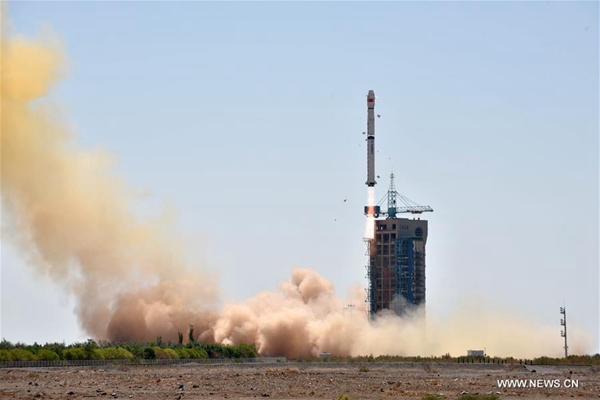
A Long March-4B rocket carrying X-ray space telescope to observe black holes, pulsars and gamma-ray bursts blasts off from Jiuquan Satellite Launch Center in northwest China’s Gobi Desert, June 15, 2017. [Photo/Xinhua]

China launched its first X-ray space telescope to observe black holes, pulsars and gamma-ray bursts, via a Long March-4B rocket from Jiuquan Satellite Launch Center in northwest China’s Gobi Desert at 11 a.m. Thursday.

The 2.5-tonne Hard X-ray Modulation Telescope (HXMT), dubbed Insight, was sent into an orbit of 550 kilometers above the earth to help scientists better understand the evolution of black holes, and the strong magnetic fields and the interiors of pulsars.

Through the telescope, scientists will also study how to use pulsars for spacecraft navigation, and search for gamma-ray bursts corresponding to gravitational waves.

The result of the wisdom and efforts of several generations of Chinese scientists, Insight is expected to push forward the development of space astronomy and improve space X-ray detection technology in China.