CIPG, BFSU to boost cross-cultural communication

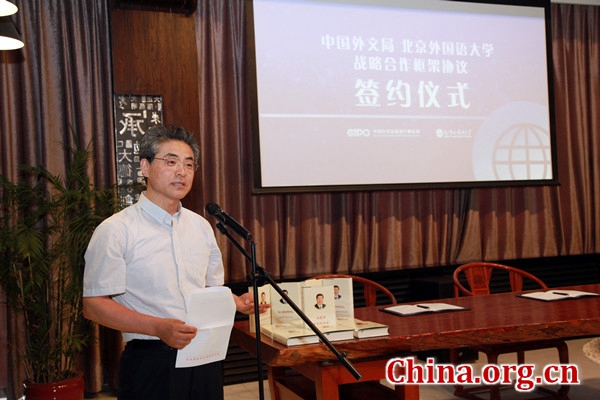
Zhang Fuhai, president of CIPG, addresses the signing ceremony for cooperation between CIPG and BFSU. [Photo by Zhao Na/China.org.cn]

China International Publishing Group (CIPG) is seeking to extend its influence in the international cultural arena in partnership with Beijing Foreign Studies University (BFSU), one of China’s most prestigious linguistic schools.

The two sides, hoping to develop a close relationship designed to enhance China’s voice in the international community, signed an agreement in Beijing on July 16.

According to Zhang Fuhai, president of CIPG, the two organizations may have more to cooperate.

He said that CIPG is the oldest and largest professional cross-cultural communication institute in the country, while BFSU is an eminent school with a long history and rich language resources among domestic universities.

“Despite their different functions, the two organizations should make full use of their advantages to jointly assume responsibility to present China’s stories, voices and images and enhance China’s discourse power and influence in the international community,” Zhang said.

With courses covering 84 foreign languages, BFSU enjoys high prestige rarely surpassed by domestic universities in terms of size and diversity of linguistic education, particularly those of less-widely used languages, said Peng Long, president of BFSU.

Regarding cooperation with CIPG, Peng said, “It is an historic moment [in which] we are both inspired and encouraged.”

In addition to conventional language education, BFSU has explored multi-disciplinary majors, such as international journalism, business and law. Besides, it has set up 22 Confucius Institutes abroad.

CIPG Vice President Wang Gangyi said, “We are confident in pressing ahead with cooperative programs one after another through a pragmatic approach.” Wang is also one of the initiators of the cooperation.

The two sides are dedicated to building personnel pools of those with a good command of foreign languages as well as competent in journalism and new media technologies.

The exchange, focusing on faculty, students and CIPG staff in the form of internships, continued education and symposiums, such as research for handling diverse cultures under the Belt and Road Initiative, will complement the first-hand experience of translation via the China Academy of Translation.

Six killed, one injured in north China factory blaze

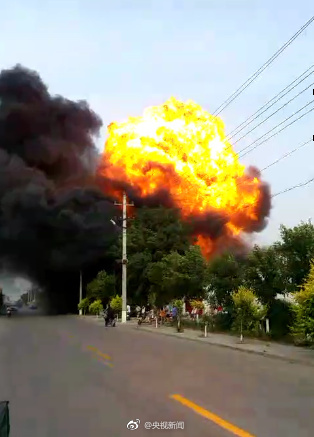
The fire ripped through a plastic factory in Huanghua City at about 5:40 p.m. Sunday. [Photo/Weibo.com]

Six people were confirmed dead after a fire broke out in a factory in north China’s Hebei Province Sunday afternoon.

The fire ripped through a plastic factory in Huanghua City at about 5:40 p.m. while seven workers were in the factory, the city government said on Monday.

Two of them were killed at the scene, while four others died in the hospital. The seventh worker was receiving medical treatment and his condition was described as serious.

No environmental pollution was reported following the accident.

The factory was ordered to suspend production in April for failing to meet pollution-control requirements. But it resumed operations against the order.

The head of the factory has been detained while the cause of the accident is being investigated.


Expats in Beijing enjoy annual tea party

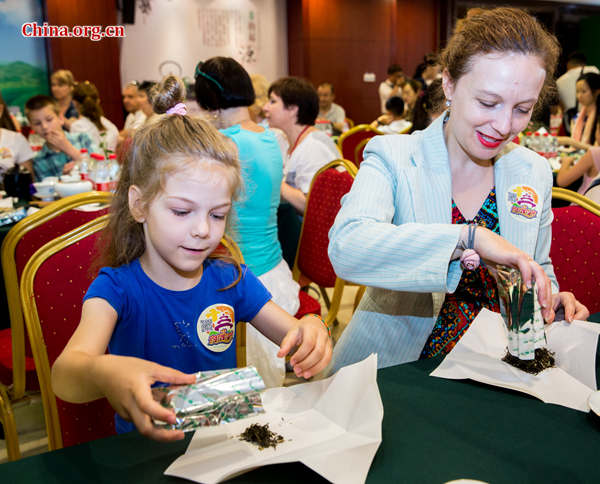
An expat and her child mix tea leaves with jasmine flowers at the latest session of the “Beijing Salon – Experience Beijing” on June 17, 2017. [Photo/This Month magazine]

Up to 100 expats working in Beijing attended an annual tea party at the city’s well-known Maliandao “tea street” on June 17, despite the sweltering heat that had lingered for days.

This tea party was the fourth to be held by the Beijing municipal government and also the latest in the “Beijing Salon – Experience Beijing” series of activities, which also feature Peking opera, martial arts, Chinese kites, and the sampling of Beijing’s local tourism resources, among others.

It highlighted scented tea and floral art, which locals insist is a good match with traditional tea culture. In comparison, previous three tea parties focused more on the various types of tea grown in China, the appreciation of tea sets and the traditional process of brewing different teas.

Tea is a very important part of Chinese culture, so that holding a tea party each year can help popularize it among expats, according to the organizer.

Most attendees were glad to learn how tea is the most popular drink across China, as well as being widely consumed elsewhere in the world, although with different traditions.

The expats agreed that jasmine tea, which is the most popular type in Beijing, was the tastiest. During the activity, they had a chance to make it by mixing jasmine buds and petals with green tea leaves in a 3-10 ratio.

The Ukrainian Embassy in Beijing sent a handful of people, including the diplomats’ children, to the tea party. Among them was Consul Lilia Somoilova. She said she had long been interested in Chinese culture. In her understanding, Chinese tea, especially green tea, tends to be plainer, but purer than that produced in Western style.

This simplicity and purity, she said, could also be found in Chinese floral arrangements and traditional Chinese music.


26 injured as China Eastern plane hits turbulence

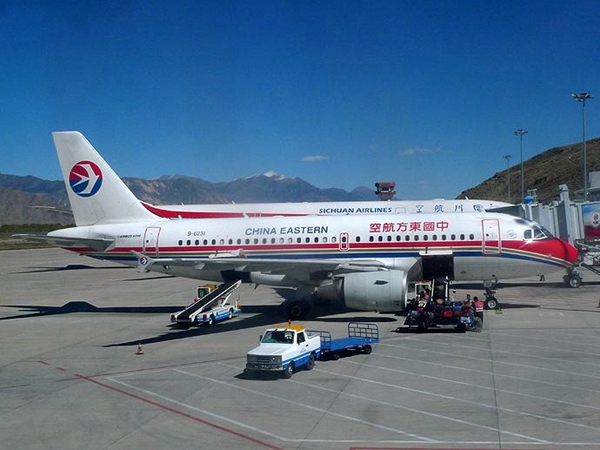
A plane of China Eastern Airlines [File Photo]

At least 26 people were injured on a China Eastern Airlines flight, including four in serious condition, after the plane hit strong turbulence en route from Paris to Kunming Sunday.

The injured are being treated in two hospitals in Kunming, capital of southwest China’s Yunnan Province after the plane, light MU774, landed safely at 8:50 a.m. Sunday at Kunming Changshui International Airport.

“We felt strong turbulence twice and minor turbulence three times. The process lasted about 10 minutes,” said a passenger surnamed Zhang, who suffered a minor injury and is receiving treatment at Yunnan First People’s Hospital.

A number of passengers were thrown from their seats and some were hurt by falling luggage, causing bone fractures, scalp lacerations, soft tissue injuries and other light wounds, according to the passengers and hospitals.

“We applauded when the plane landed safely. We feel lucky the plane did not crash,” said an injured passenger surnamed Shang.


Chinese naval fleet departs for joint drill in Russia

A Chinese naval fleet sailed out of a port in south China’s Hainan Province Sunday for a scheduled military exercise with the Russian navy in St. Petersburg and Kaliningrad.

The fleet consists of one destroyer, one frigate, one comprehensive supply ship, ship-borne helicopters and marines.

The drill is part of an annual program which aims to consolidate and advance the Sino-Russian comprehensive strategic partnership of coordination, and deepen friendly and practical cooperation between the two militaries.

Code-named the “Joint Sea 2017” drill, it will also improve coordination between the two navies on joint defense operations at sea.

According to consensus reached by the two countries, the two navies are scheduled to hold military drill in waters of the Baltic Sea in late July and then the Sea of Japan and Okhotsk in middle September.

This year’s drill aims to jointly carry out rescue missions and protect the safety of economic activities at sea.