Draft aims to preserve respect for national anthem

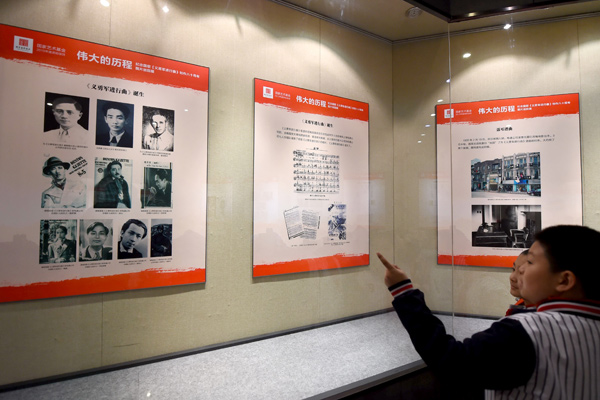
Students look at exhibits about the history of China’s national anthem at an exhibition in Shenyang, Liaoning Province, in April last year. [Photo/Xinhua] 

People who distort or disrespect China’s national anthem, such as maliciously changing the lyrics, could face up to 15 days in detention if a new law is approved.

A draft of the country’s national anthem law, which was submitted to the Standing Committee of the National People’s Congress on Thursday for first reading, also bans the use of the song in advertisements, as background music and at private funerals.

It states that the song should be played during important diplomatic or sporting events, and that people should stand and face the national flag when the song is played, and military officials should salute.

March of the Volunteers was composed in 1935 by Nie Er, with lyrics from poet Tian Han.

“It’s a key symbol in the Constitution,” said Shen Chunyao, director of the committee’s Legislative Affairs Committee, who introduced the draft law. “It’s good to regulate its use, as it will increase citizens’ awareness of patriotism and uphold national dignity.”

The draft is being discussed at the bimonthly session of the Standing Committee of the National People’s Congress, which lasts until Tuesday. It follows similar laws on China’s national flag and national emblem.

Zhang Wenxian, deputy director of the China Law Society, applauded the draft, saying it is necessary to regulate how to play the song “because some people sang or recomposed it, I think, in an entertainment-oriented fashion”.

“I also felt uncomfortable when I saw some people running back and forth while the song was being broadcast. They were not serious enough about it,” he said.

In addition to regulating the use of the national anthem, he added that popularizing it is also important. The draft says the official version of the song should be on the website of the State Council, and that it should be taught in primary school.


China’s cabinet eyes lowering corporate burdens in inspection

The State Council, China’s cabinet, said Thursday its upcoming nationwide inspection would focus on the implementation of measures to reduce corporate burden.

The central government will review efforts to reduce or scrap businesses administrative fees, and whether arbitrary administrative charges were imposed on enterprises, it said in a statement.

The central government has pledged to reduce corporate costs by 1 trillion yuan (about 147 billion U.S. dollars) this year.

Recent measures to cut administrative fees and lower the financial burden of companies have supported stable economic growth, but the efforts of some local governments and departments have been lax, noted the statement.

The State Council last month decided to start a new round of reform inspections to ensure tasks for this year’s economic and social work will be achieved on schedule.

This is the fourth such nationwide inspection since it began in 2014.


Draft intelligence law highlights legal rights protection

Lawmakers Thursday deliberated a draft national intelligence law that contains measures to protect the legal rights and interests of individuals and organizations.

The draft was submitted to the Standing Committee of the National People’s Congress for the second reading at the start of its bi-monthly session.

China will protect and honor individuals and organizations who support or coordinate with national intelligence staff, and award those who have made “great contributions” to national intelligence work, it stated.

The draft stipulated that national intelligence agencies and their staff are not allowed to take advantage of their positions to seek personal benefits, and anyone found to have done so will be held accountable in accordance with the law.

In addition, national intelligence agencies should help individuals and organizations report information to intelligence authorities, while those who attempt to deceive (the public) in the name of national intelligence interest may face criminal charges, it said.

A national intelligence law is needed to improve national intelligence work and safeguard national security, lawmakers agreed.

The law was first read and deliberated at the top legislature’s bi-monthly session in December 2016.


Xi calls for unholding ‘Lyuliang spirit’ in poverty relief

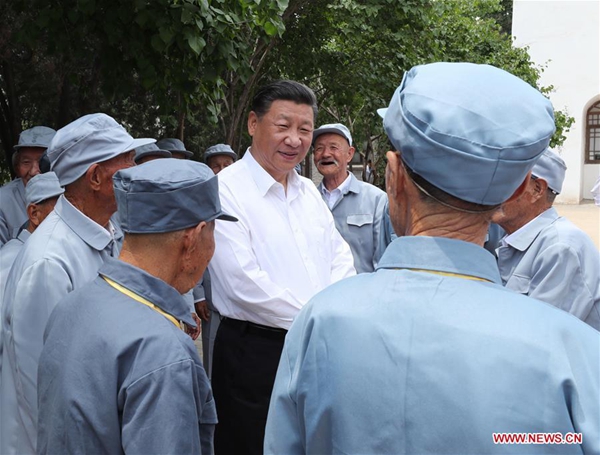
Chinese President Xi Jinping (C) talks with veterans at the former site of a military region command in Xing County of north China’s Shanxi Province, June 21, 2017. Xi had an inspection tour in Shanxi Wednesday. [Photo/Xinhua]

President Xi Jinping said more should be done to end poverty and improve the standard of living in revolutionary base areas.

Xi, who is also general secretary of the Communist Party of China (CPC) Central Committee, made the remarks during a tour Wednesday of Lyuliang and Xinzhou, two revolutionary base areas in Shanxi Province.

On Wednesday morning, Xi visited Lyuliang revolutionary memorial museum in Xing County of Lyuliang City and left a basket of flowers in a mark of respect for the country’s martyrs, the term used for war heros.

Xi spoke highly of the “Lyuliang spirit” and said it should be used as motivation to “improve people’s lives and to achieve the great rejuvenation of the nation.”

During the tour, Xi spoke about how the poverty relief campaign related to the target of achieving a “moderately prosperous society in an all-round way” by 2020.

Also on Wednesday, Xi visited the village of Zhaojiawa, an impoverished area in Xinzhou City, where he talked with villagers and officials.

Xi spoke of improving living conditions through relocation and called for better supporting measures that would ensure income sources for residents.

The president also met with poverty-relief work teams, and praised their efforts.

Xi said sending officials to serve as first Party committee secretaries at the local level was not only conducive to the poverty eradication campaign, but also improved the competence of officials. He proposed that promising officials at this level should be considered for promotions.

The president vowed continued efforts to improve people’s lives and asked everyone to “roll up sleeves and work harder together with the CPC Central Committee.”


Draft intelligence law highlights citizen’s legal rights protection

Lawmakers Thursday deliberated a draft national intelligence law that contains measures to protect the legal rights and interests of individuals and organizations.

The draft was submitted to the Standing Committee of the National People’s Congress for the second reading at the start of its bi-monthly session.

China will protect and honor individuals and organizations who support or coordinate with national intelligence staff, and award those who have made “great contributions” to national intelligence work, it stated.

The draft stipulated that national intelligence agencies and their staff are not allowed to take advantage of their positions to seek personal benefits, and anyone found to have done so will be held accountable in accordance with the law.

In addition, national intelligence agencies should help individuals and organizations report information to intelligence authorities, while those who attempt to deceive (the public) in the name of national intelligence interest may face criminal charges, it said.

A national intelligence law is needed to improve national intelligence work and safeguard national security, lawmakers agreed.

The law was first read and deliberated at the top legislature’s bi-monthly session in December 2016.