Xi inspects PLA garrison in Hong Kong

President Xi Jinping on Friday inspected the Chinese People’s Liberation Army (PLA) Garrison in the Hong Kong Special Administrative Region (HKSAR) at Shek Kong barracks, on the eve of the 20th anniversary of Hong Kong’s return to China.

Xi, also general secretary of the Central Committee of the Communist Party of China and chairman of the Central Military Commission, reviewed the troops in the company of Tan Benhong, commander of the PLA Garrison in the HKSAR.

More than 3,100 officers and soldiers took part in the review, and over 100 pieces of military equipment including air defense missiles and helicopters were displayed.

About 4,000 spectators from all walks of life in Hong Kong were present.

Xi arrived here Thursday to attend celebrations for Hong Kong’s 20th return anniversary and the inauguration of the HKSAR’s fifth-term government. He will also inspect the HKSAR during his three-day stay.


Panda gives birth to first pigeon pair of the year

A pigeon pair of pandas were born on Tuesday in Chengdu. [Photo/China Daily]

A female panda called Chengda gave birth on Tuesday to the first pigeon pair this year in Chengdu, capital of Sichuan Province.

The female cub weighed 128.2 grams and was born at 10:57 pm, while the male cub followed at 11:35 pm, weighing 160.2 grams, the Chengdu Research Base of Giant Panda Breeding announced.

According to workers at the base, Chengda had been showing signs of pregnancy since June 5, such as a loss of appetite. On Tuesday, she was restless and her waters broke in the afternoon, they said, adding that the cubs are in good health and Chengda is able to feed them.

Pandas are an endangered species due to extremely low reproductive rates in the wild. In captivity, they often give birth to twins and sometimes even triplets.


Carrier battle group will call on HK

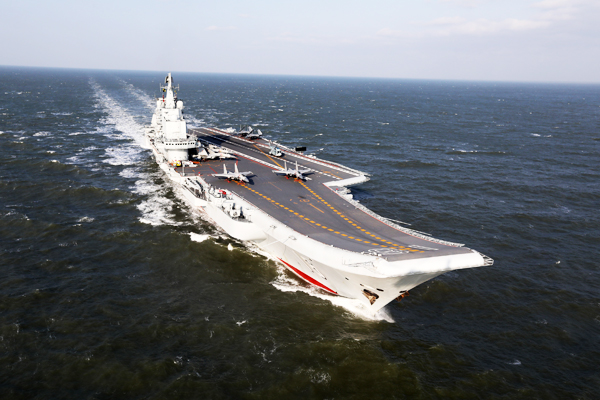
The PLA Navy’s CNS Liaoning will visit Hong Kong to mark the 20th anniversary of the special administrative region. [Photo/China Daily]

The People’s Liberation Army Navy aircraft carrier CNS Liaoning and its battle group will make their first visit to Hong Kong amid celebrations marking the 20th anniversary of the special administrative region’s return to the motherland, a Defense Ministry spokesman said.

Senior Colonel Wu Qian said at a news conference in Beijing on Thursday that Saturday will mark not only the 20th anniversary of Hong Kong’s return but also the 20th year of the PLA’s presence there.

A detailed schedule for the visit will be released later.

The carrier battle group, which consists of the Liaoning, the guided-missile destroyers CNS Jinan and CNS Yinchuan, the guided-missile frigate CNS Yantai and several J-15 carrier-borne fighter jets and helicopters, embarked from its home port in Qingdao, Shandong province, on Sunday. It is conducting routine training listed in the Navy’s annual plan, Navy officials said.

During the training, ships drill in formation and perform combat maneuvers and aircraft hone aerial tactics, the Navy said. The operation is aimed at improving coordination among ships in the battle group and boosting the capabilities of pilots and sailors.

Li Jie, a senior expert at the PLA Naval Military Studies Research Institute, said ships in the group including the Liaoning are likely to hold open houses for Hong Kong residents, and their commanders and sailors are likely to participate in parties with local communities.

A performance by shipborne helicopters also is possible to display the Navy’s operational capability, he said.

The Liaoning, a refitted Soviet-era vessel, was commissioned by the Navy in 2012. Its battle group carried out a live-fire exercise in the South China Sea and western Pacific Ocean in December and January.

China launched its first domestically developed aircraft carrier in April in Dalian, Liaoning province. Like the Liaoning, the new ship has a displacement of around 50,000 metric tons and a conventional propulsion system, and will also carry J-15 fighter jets.


Award ceremony recognizes 30 new masters of TCM

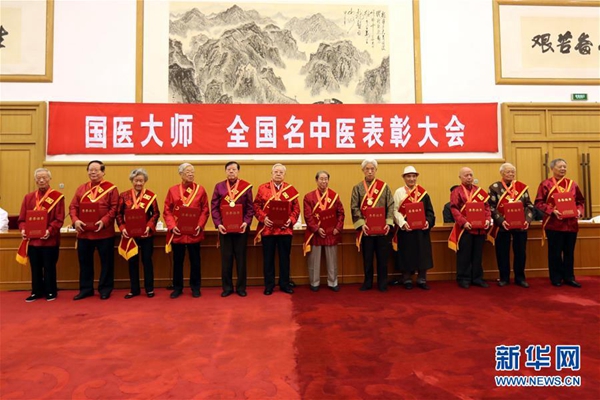
China recognized 30 new national masters of traditional Chinese medicine during a ceremony in Beijing on Thursday. [Photo/Xinhua]

China recognized 30 new national masters of traditional Chinese medicine during a ceremony in Beijing on Thursday.

Of the new masters, 25 are men and five are women, and all have practiced TCM for at least 50 years, according to the State Administration of Traditional Chinese Medicine.

They range in age from 66 to 96.

The award ceremony was held by the administration, the National Health and Family Planning Commission, and Ministry of Human Resources and Social Security.

“The masters should serve as role models for the country’s TCM practitioners to wholeheartedly serve their patients, promote TCM, and help pass down the oriental medical science via education and training,” Wang Guoqiang, head of the administration, said while addressing the ceremony.

According to Wang, it is the third time the Chinese government has recognized national TCM masters, bringing the total to 90.

Together with the 30 masters, another 99 TCM practitioners from across the country were awarded the title of “famous veteran TCM doctor”.

Qi Xuan, a division director of human resources at the China-Japan Friendship Hospital, said that such high-level recognition encourages young TCM doctors.

Xu Runsan, 91, a TCM doctor at the hospital who specializes in gynecology, is one of the newly recognized masters.

“He’s in good health and still sees patients every week,” Qi said.

TCM is a medical science largely based on clinical experience and it requires lifelong dedication to become a good TCM doctor, she added.

Nationwide, Western medicine has become the mainstream and shoulders the lion’s share of the overall supply of medical care services.

But the government has introduced a slew of measures and policies to facilitate TCM development.

China’s top legislature late last year adopted a law on TCM, allowing it a bigger role in the country’s medical system.



7 dead, 2 missing in east China floods

Rainstorm have battered east China’s Jiangxi Province from June 20 to 29.

As of 4 p.m. on Thursday, floods had left seven people dead and two others missing, according to the provincial flood control headquarters.

Nearly 440,000 people in the province were forced to relocate to safe places.

Rivers and lakes across the province have swollen as a result of the rainstorm.

The provincial meteorological station forecast that some northern areas in Jiangxi will see more storms over the weekend.