Seven-year-old stirs up internet with his ‘six-pack’

7-year old Chen Yi boasts amazing physique. [Photo: xdkb.net]

The internet is buzzing about pictures of a 7-year old who is sporting the physique of a world-class athlete.

Local internet site xdkb.net interviewed Chen Yi after he dominated a gymnastics meet in Zhejiang’s capital, Hangzhou, recently.

While Chen Yi won six gold medals and one silver, what have made the headlines are the pictures of him posing!

The boy’s mother, Zhang Hongyu, said that her son was born with innate athletic talent. She claims that when Chen Yi was just 2 years old, he could do a pull-up with just one arm. “He started walking when he was just 11-months old, and he learned to ride a bicycle before kindergarten,” Zhang recalled with a proud smile on her face.

Chen Yi was accepted into the local gymnastics school at the age of five. He now lives at school and only goes home during the weekends. Although his training is tough and intensive, his mother says he never considers giving up.

Asked how he was able to develop his physique, Zhang credits the training her son is going through. “There is nothing special about his diet,” says Zhang “Just like other normal kids, Chen Yi eats around a dozen dumplings for a meal. He also enjoys vegetables, such as cucumber and lettuce.”


World’s first robotic pig cloning successful in Tianjin

Test results now appear to show an attempt at robot-involved pig cloning at a university in Tianjin has been a success, reports the China News.

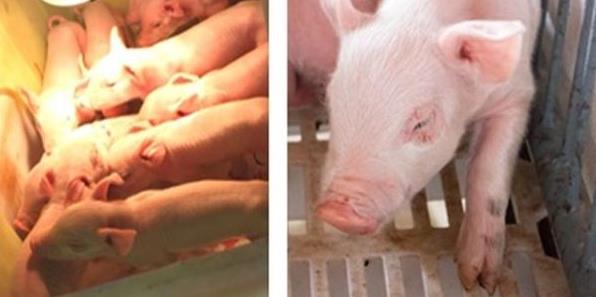
The world’s first case of robot-involved pig cloning hailed a success at Nankai University in Tianjin, July 3, 2017. [Photo: sina.com.cn] 

According to the report, 13 cloned pigs delivered by two separate females in April are unrelated to their “surrogate mothers,” but do have kinship with their DNA donors.

While surrogate cloning is not a new technique, this case involves the entire somatic cell nuclear transfer (SCNT) process being completed robotically, said the research group from Nankai University (NKU).

Somatic cell nuclear transfer (SCNT), involves taking an enucleated oocyte, or egg cell, and implanting a donor nucleus from the soma, or the body, of another cell. It’s the standard technique used in reproductive cloning.

But because the technique is very precise, the cloning process is considered one of the most complicated in micro-medicine.

Due to the manual failure rates, SCNT done by human hands has led to a bottleneck of the development of cloning technology, according to Nankai University researchers.

To overcome this, the research team from Nankai University has developed the robotic process which it says can significantly reduce the damage done to cells, which should significantly increase the ability of researchers to test new theories in the cloning process.


China starts emergency flood response in Guangxi

China issued a grade-IV emergency response on Monday for rain and floods that have left 16 people dead and 10 missing in south China’s Guangxi Zhuang Autonomous Region.

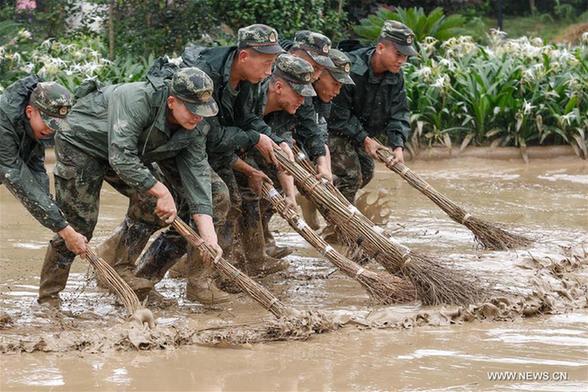
Soldiers clear away mud after a flood at Riverside Park in Liucheng County of Liuzhou City, south China’s Guangxi Zhuang Autonomous Region, July 3, 2017. Works of epidemic prevention and mud-cleaning are underway as floods subsided in central China’s Hunan Province and south China’s Guangxi Zhuang Autonomous Region. (Xinhua/Deng Keyi)

Heavy rain started in parts of Guangxi on Saturday, forcing the relocation of 92,000 residents, according to the regional civil affairs department.

The disaster has caused around 2.9 billion yuan (430 million U.S. dollars) in direct economic losses.

The Ministry of Civil Affairs (MCA) and the China National Commission for Disaster Reduction have sent teams to assist relief work on the scene.

A grade-IV response, the lowest in China’s emergency response system, requires a 24-hour alerts, daily damage reports, and funds and relief delivered within 48 hours.

Guangxi disaster response and civil affairs authorities have delivered relief supplies and fund of 3.6 million yuan to affected areas.


Thousands battle floods along Yangtze River

Thousands of soldiers, armed police, civil servants and members of the public are battling floods in several provinces along the Yangtze River.

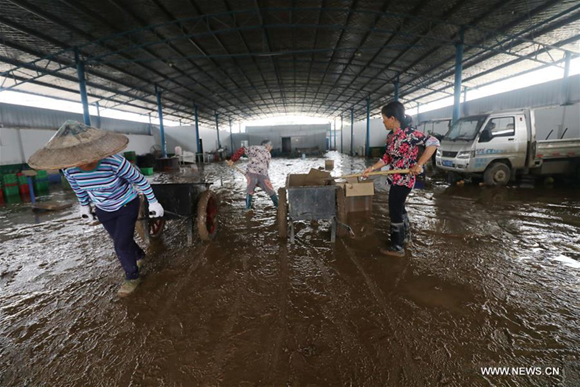
Staff members clear away mud after a flood at a vegetable base in Lianyuan City, central China's Hunan Province, July 3, 2017. Works of epidemic prevention and mud-cleaning are underway as floods subsided in central China's Hunan Province and south China's Guangxi Zhuang Autonomous Region. (Xinhua/Zhang Yang)

Staff members clear away mud after a flood at a vegetable base in Lianyuan City, central China’s Hunan Province, July 3, 2017. Works of epidemic prevention and mud-cleaning are underway as floods subsided in central China’s Hunan Province and south China’s Guangxi Zhuang Autonomous Region. (Xinhua/Zhang Yang) 

In Hunan Province, the water level at the Changsha monitoring station in the Xiangjiang River, a major Yangtze tributary, reached a record high of 39.51 meters early Monday, higher than the previous record of 39.18 meters set by a massive flood in 1998.

Floods have inundated houses, uprooted trees, damaged cars and sabotaged roads in Changsha, capital of Hunan.

The public, even elementary school students who are on summer vacation, volunteered to help fill sandbags to prevent the water from overflowing. Fourth grader Yang Shan, who lives in downtown Changsha, distributed ropes and filled sandbags for soldiers to carry to the riverbank.

Intermittent rain is forecast to last in Changsha until Wednesday, and the city is under heavy pressure to battle flooding.

In neighboring Hubei Province, the Three Gorges Dam on the upper Yangtze has reduced water discharge by 70 percent in the last three days.

Its flow was 27,000 cubic meters per second before July 1, but has now been reduced to 8,000 cubic meters per second, according to the Yangtze River Flood Prevention Headquarters.

The reduction stopped 3 billion cubic meters of water and lowered the water level by up to 1.5 meters, the headquarters said.

“We hope the reduction of outflow will give soldiers and the people enough time to evacuate and stack up sand bags to battle the flood,” said Wu Zhaohui, an official with the water resources bureau in Hubei Province.

In Hubei alone, 16,000 people are on high alert for flooding.

In eastern Jiangxi Province, 28,100 people are battling against the floods, as water levels in the Jiangxi section of the Yangtze and Poyang Lake, China’s largest fresh water lake, have risen above warning levels.

Heavy downpours also hit Sichuan Province on the upper reaches of the Yangtze. Chengdu Shuangliu International Airport in the provincial capital of Chengdu was forced to close down for over an hour on Monday afternoon.

Nearly 8,000 passengers were affected and 40 outbound flights were delayed.

Besides provinces along the Yangtze, other southern areas of China have also been plagued by heavy rain.

Rain-triggered floods have killed 16 people and left 10 missing in Guangxi Zhuang Autonomous Region, with 91,600 local residents relocated so far, according to the regional civil affairs department.

According to the Ministry of Finance, a total of 1.88 billion yuan (276.8 million U.S. dollars) was allocated to 20 provinces and regions Monday to aid disaster relief.


Shanxi builds clean government

Shanxi Province has adopted rigorous rules and transparent systems to regulate local governance and Party organizations in response to the country’s stringent anti-corruption campaign.

During a conference hosted by the International Department of the Central Committee of the Communist Party of China (IDCPC) last Friday, the provincial government showcased their procedures in selecting and appointing officials while committing to build a clean government.

According to Sun Dajun, the executive vice chairman of the Organization Department, CPC Shanxi Provincial Committee, there are 10 procedures, including, qualification checking, deliberation, inspection, and public polls which are to be considered when deciding on promotion.

Candidates competing for higher posts should reveal their true financial conditions, including their accounts of assets, equities and other properties as the government launches a zero tolerance to corruption. Furthermore, their official status is closely related to the views of the public that they have served.

“What we need are committed, clean and responsible officials,” said Sun, adding that the government officials who qualify for promotion should have sufficient experience obtained while working in different positions.

“The essential value of our democratic system is generally the same as the rest of the world, even though we take different paths. I don’t think all countries must have democracy only in the form of direct elections,” Sun continued.

He said the government needs to learn from the public to consider the candidate and consider their competence through shared public views to finally select the most qualified official. This costs immensely less than direct elections.

Hu Yuting, the secretary of CPC Jinzhong Municipal Committee said that selection is open and transparent as the qualifications of the candidates including their education backgrounds, work experience, lawful accreditations and health conditions will all be publicized for supervision.

Shanxi Province is transforming from a natural-energy (especially coal mine)-centered economy to a new economic model driven increasingly by innovation and conservation, with the growth of non-coal sectors reaching 9.8 percent in the first five months, this year.

Daniel A. Bell, the dean and professor of the School of Political Science and Public Administration of Shandong University, said, Shanxi needs to protect its environment and ancient architectures to carry on its distinctive cultural legacy.

“Knowledge of local history and culture may not matter as much as in the new cities, such as, Shanghai or Shenzhen, but it is important for a historic city as Ping Yao (an ancient town in the province),” he said.