China makes key breakthrough in artificial sun research

Scientists in China announced they have set a world record by achieving 101.2 seconds of steady-state H-mode operation of the tokamak, an experimental device designed to harness the energy of fusion.

The milestone meant China’s Experimental Advanced Superconducting Tokamak(EAST), dubbed “artificial sun,” became the world’s first tokamak device to achieve the 100-second-level, Hefei Institute of Physical Science under the Chinese Academy of Sciences said Wednesday.

Last year, the EAST team in Hefei, capital of Anhui Province, created a record by achieving over 60 seconds of steady-state long-pulse H-mode discharge of the device.

EAST’s steady-state H-mode operation has provided important experimental support for the operation of International Thermonuclear Experimental Reactor (ITER), a large international scientific cooperation project.

More than 30 countries are participating in ITER to build the world’s largest tokamak, a magnetic fusion device designed to prove the feasibility of fusion as a large-scale and carbon-free source of energy based on the same principle that powers the Sun and the stars.


China to build world’s most challenging railway

Breathtaking scenery and breathtaking dangers — both will face Chinese engineers as they embark on building the world’s most difficult railway.

The Sichuan-Tibet Railway will be the second railway into southwest China’s Tibet Autonomous Region after the Qinghai-Tibet Railway. The line will go through the southeast of the Qinghai-Tibet Plateau, one of the world’s most geologically active areas.

“The construction and operation of the Sichuan-Tibet Railway must overcome the biggest risks in the world,” said You Yong, chief engineer of the Institute of Mountain Hazards and Environment of the Chinese Academy of Sciences (CAS), who is leading a scientific and technological support team to avoid disasters in the mountains.

China Railway Eryuan Engineering Group Co. Ltd., which is designing the line, said it will run from Chengdu, capital of southwest China’s Sichuan Province, through Ya’an and Kangding, and enter Tibet via Qamdo. It will then go through Nyingchi and Shannan prefectures before arriving at Lhasa, capital of Tibet. The total construction length will be about 1,700 kilometers and it will cost 250 billion yuan (about 36.88 billion U.S. dollars)

Xia Lie, a senior engineer at China Railway Eryuan Engineering Group, described it as a huge “roller coaster” through risky terrain of mountains and canyons.

It will go through eight ascents and descents, and more than 80 percent of the line will be tunnels and bridges.

“The cumulative ascent of the Sichuan-Tibet Railway will exceed 16,000 meters, which is equivalent to double the height of Qomolangma, the world’ s highest mountain,” said Xia.

“It will be the most difficult super project in railway construction history.”

Construction has begun on the two ends of the railway. The section between Chengdu and Ya’an is expected to open in June 2018. The feasibility study on the section between Ya’an and Kangding has been completed. The section between Lhasa and Nyingchi is under construction.

However, the section from Kangding to Nyingchi — the most difficult and the longest section — is still under design. Its construction is expected to begin in 2019 and could take about seven years, said Xia.

The Sichuan-Tibet Railway will be a major line in the western China rail network, connecting Tibet and more developed central and eastern regions. The design speed is from 160 kilometers per hour to 200 kilometers per hour. On completion, the travel time by train from Chengdu to Lhasa will be cut from 48 hours to about 13 hours.

You Yong, who has spent almost 30 years studying mountain hazards, said the line will traverse the eastern Qinghai-Tibet Plateau, which has sharp changes in terrain.

It will go over 21 snow-capped mountains more than 4,000 meters high and cross 14 major rivers. The region is full of steep slopes and deep valleys, You said.

The active geological structure of the region causes strong earthquakes. The railway will go through earthquake zones such as the Longmen Mountain and Yarlung Zangbo River seismic belts, You said.

You said the Sichuan-Tibet Railway has four major environmental characteristics: significant terrain elevation differences, strong plate activities, frequent mountain disasters, and a sensitive ecological environment.

Mountain hazards were a major challenge. “The regions along the Sichuan-Tibet Railway have the most developed, most active, most diverse and most serious mountain hazards in China,” You said.

Scientists point out that the dangers along the railway route include landslides, debris flows, and snow and ice damage. The landslides mainly happen in the alpine gorges of the Hengduan Mountains and southeastern Tibet.

Southeastern Tibet and western Sichuan have many glaciers, which are sensitive to global climate change. Melting ice and snow causes devastating bursts of glacier lakes and debris flows, said Chen Xiaoqing, deputy director of the Institute of Mountain Hazards and Environment of the CAS.

“Constructing a railway in such a complicated geological environment will face a lot of scientific and technological difficulties. And the prevention and control of mountain hazards will be key to its success,” said You.

The CAS began in 2014 to analyze the mountain hazard distribution patterns and risks, and experiment on disaster prevention along the route.

To date, scientists have identified the basic distribution and activities of mountain hazards, and set up a data bank for the hazards along the route.

Based on analysis of the risks, researchers offered their advice on the route selection and technologies to prevent and control the landslides and debris flows.

The government is also planning to build an expressway connecting Sichuan and Tibet. The scientific findings will also be applied in that construction.

Experts say the railway and expressway will push forward the opening up and economic development of Tibet.


Beijing increases Green Space

0 Comment(s)PrintE-mail China.org.cn, July 5, 2017
Adjust font size:

视频播放位置

下载安装Flash播放器


Follow China.org.cn on Twitter and Facebook to join the conversation.
ChinaNews App Download

No comments.

  • User Name Required
  • Your Comment
  • Enter the words you see:   
    Racist, abusive and off-topic comments may be removed by the moderator.
Send your storiesGet more from China.org.cnMobileRSSNewsletter


Firefighters called on to rescue ‘lady of the rings’

The seven rings that needed to be cut free by firefighters. [Photo/Shanghai Daily]

A woman in her 70s who wears nine rings found she couldn’t remove them from her fingers and firefighters were needed to end the pain she was suffering.

One of the rings had cut into the flesh, Huangpu District’s fire department said yesterday.

Last Friday, two fire brigades received reports from Shanghai General Hospital that the woman was in pain. The hospital had already managed to take off two of the rings, but couldn’t remove the other seven.

Like many elderly people, the woman whose name wasn’t disclosed, had worn ill-fitting rings for a long time, causing her fingers to become swollen. She ignored the problem until one of the rings tore into her finger, bringing with it “unbearable pain.”

To avoid hurting her, the firefighters first removed the easiest-to-get-at rings, and then used a special set of tools to take off another three.

Removing the six rings took firefighters two hours.

But that still left one ring — the one that had bitten into the flesh.

The firefighters worked with doctors to finally finish the job.

The “lady of rings,” as her helpers called her, is said to have called on Hongkou’s fire brigade to help to remove rings on three other occasions, but every time she had later put the rings back on.


Archeologists find 5,000-year-old giants

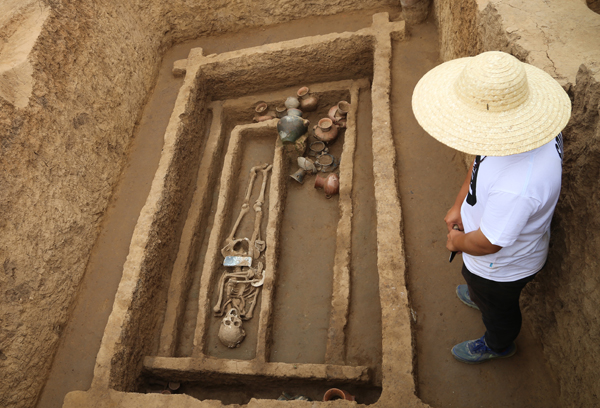
The archaeological site in Jinan, Shandong Province, where the skeleton of an unusually tall man was found. [Photo/China Daily] 

Archeologists have found some people in East China 5,000 years ago to be unusually tall and strong.

Measurements of bones from graves in Shandong Province show the height of at least one man to have reached 1.9 meters with quite a few at 1.8 meters or taller.

“This is just based on the bone structure. If he was a living person, his height would certainly exceed 1.9 meters,” said Fang Hui, head of Shandong University’s school of history and culture.

From 2016, archeologists have been excavating the ruins of 104 houses, 205 graves and 20 sacrificial pits at Jiaojia village in Zhangqiu district, Jinan city, capital of Shandong.

The relics are from the Longshan Culture, a late Neolithic civilization in the middle and lower reaches of the Yellow River, named after Mount Longshan in Zhangqiu.

“Already agricultural at that time, people had diverse and rich food resources and thus their physique changed, “said Fang.

Millet was the major crop and people raised pigs, according to Fang. Pig bones and teeth were found in some graves.

According to the findings, taller men were found in larger tombs, possibly because such people had a high status and were able to acquire better food.

Shandong locals believe height to be one of their defining characteristics. Confucius (551-479 BC), a native of the region, was said to be about 1.9 meters tall.

Official statistics back up the claim. In 2015, the average height of men aged 18 in Shandong was 1.753 meters, compared with a national average of 1.72 meters.

Ruins of rows of houses in the area indicate that people lived quite comfortable lives, with separate bedrooms and kitchens, according to the excavations.

Colorful pottery and jade articles have also been found, said Wang Fen, head of the Jiaojia excavation team.

The area was believed to the political, economic and cultural center of northern Shandong 5,000 years ago. Ruins of ditches and clay embankments were also found.

The Jiaojia ruins fill a cultural blank 4,500 to 5,000 years ago in the lower reaches of the Yellow River, said Wang Yongbo of the Shandong Provincial Institute of Archeology.

Archaeologists found obvious damage to the head and leg bones of some of the bodies and to pottery and jade articles in six large tombs. The damage may have been done not long after the burials and may be due to power struggles among high-ranking people.

Li Boqian, an archaeologist with Peking University, said the excavations showed Jiaojia in a transition phase, but proved the existence of ancient states 5,000 years ago in the basin of lower Yellow River.

The range of the Jiaojia site has been enlarged from an initial 240,000 square meters to 1 sq km. Currently, only 2,000 square meters has been excavated.

“Further study and excavation of the site is of great value to our understanding of the origin of culture in east China,” said Zhou Xiaobo, deputy head of Shandong provincial bureau of cultural heritage.