First Taiwan-born panda cub celebrates birthday

A birthday party was held Thursday at Taipei Zoo as Yuan Zai, the first panda cub born in Taiwan, turned four. [Photo/Xinhua]

A birthday party was held Thursday at Taipei Zoo as Yuan Zai, the first panda cub born in Taiwan, turned four.

Numerous visitors and panda lovers waited in a long queue before the zoo opened to public at 9 a.m., hoping to send their best wishes to the female cub.

Sixty members from a local panda lovers’ club joined the celebration by wearing T-shirts printed with images of “Yuan Zai”. They handed out panda-shaped stickers and notebooks to visitors to mark the day.

“Our club has more than 1,000 members and we have taken turns to visit Yuan Zai since she was born,” Chou Yu-Ru, a member of the club said. “We are so happy to see how she has grown from a little pink meatball.”

Keepers prepared a birthday cake decorated with the panda’s favorite food including bamboo shoots, pineapple, grapes and carrots.

Wong Yi-Man, chief of the Panda House at Taipei Zoo, said Yuan Zai is doing well and shows signs of maturity.

“We will work with the giant panda breeding center in Sichuan to find Yuan Zai a suitable mate when she is mature enough,” Wong said, explaining six and twelve are the pandas prime years of reproduction.

Born on July 6, 2013, Yuan Zai was the first baby of giant pandas Tuan Tuan and Yuan Yuan, who were gifted to Taiwan by Chinese mainland in 2008.

The panda family are major attractions at Taipei Zoo. Around 8,000 to 10,000 people visit the pandas each day during holidays.


New solid-fuel carrier rocket to be ready by 2018

China is developing a carrier rocket that can be launched from ships at sea, according to a rocket scientist.

Tang Yagang, deputy director of carrier rocket development at the China Academy of Launch Vehicle Technology in Beijing, told reporters on Thursday that the rocket is being developed based on the academy’s existing solid-fuel rocket and will be capable of sending a 500-kilogram satellite to a sun-synchronous orbit about 500 kilometers above Earth.

The academy only has one type of solid-fuel rocket-the Long March 11-which conducted its first mission in September 2015 and a second in November 2016.

“We plan to conduct some tests this year to verify the new rocket’s design and technologies, and will put it on the market in 2018,” he said on the sidelines of a conference in Beijing for users of China’s Long March carrier rockets, held by China Great Wall Industry Corp, the nation’s only authorized firm for international space collaboration.

Tang said that the new solid-fuel rocket will be launched from ships and will mainly carry out space launches for nations near the equator.

“This is especially suitable for those countries because a satellite launched near the equator will orbit above that line, so users along the equator will have more time each day to receive its data,” Tang said. “Another advantage is that a sea-based launch involves fewer risks compared with launching over populated regions. Moreover, there is less chance of conflict with air traffic, increasing safety.”

He added that compared with liquid-fuel rockets, a solid-fuel rocket requires less support from the launch facility. “Therefore we only need to refit a conventional cargo ship that has a displacement of 10,000 metric tons, which basically means installing a launchpad on it.”

In addition, Tang said the Long March 8 medium-lift carrier rocket that is under development at his academy will conduct its first flight in around 2019.

Designers at the academy previously said the Long March 8 would satisfy the needs of commercial launches in domestic and international markets. It will be capable of sending about 4.5 metric tons of payload to a sun-synchronous orbit or 2.5 tons to a geosynchronous transfer orbit, according to researchers.

Fu Zhiheng, vice-president of China Great Wall Industry Corp, said his company has been sparing no efforts to promote the country’s new-generation rockets.

“Our new-generation Long March 6 and Long March 11 can carry out a launch after a short time of preparation so are attractive to many clients,” he said. “The sea-based launch service will also have good prospects because it meets some clients’ requirements, and currently, there is no such service on the international market.”


Cambodia deports 74 Chinese fraud suspects

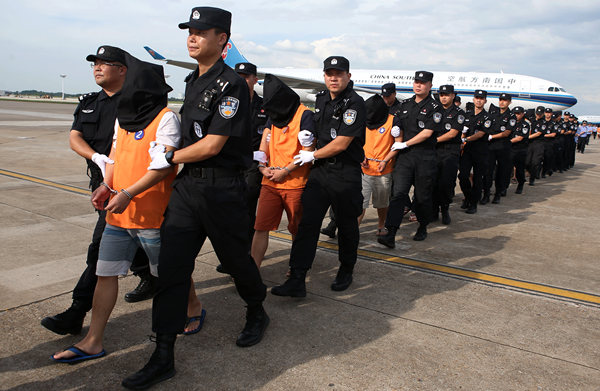
Chinese suspects arrive in Hunan Province from Cambodia on Thursday. [Photo/China Daily]

Cambodia deported 74 Chinese nationals suspected of involvement in telecom fraud, and they were taken to Hunan Province on Thursday afternoon, a senior Cambodian police official said.

“The Chinese police sent a plane to pick them up after we decided to deport them,” said Major General Ouk Hai Seila, chief of the investigation and procedure department at the General Department of Immigration, in an interview with Xinhua.

The deportees, including 21 women, were arrested on Saturday by Cambodian authorities in simultaneous raids on 12 locations in the capital, Phnom Penh, and Kandal and Kampot provinces, he said, adding that they would face legal action in China.

The 74 were suspected of using internet phones from Cambodia to extort money from victims in China, he said, adding that a number of phones and laptops were seized.

Seila said the raids came at the request of the Chinese embassy.

Scammers often use overseas internet servers to make scam calls to their victims, claiming to be court or police officials. They typically tell their targets that their bank accounts have been breached, so they need to transfer the money to a separate safe account, which is provided to the victim.


19 killed in south China road accident

Photo taken on July 6, 2017 shows the site of a road accident in Longmen, south China's Guangdong Province. Nineteen people died, and many others were injured after a coach overturned on an expressway Thursday afternoon in south China's Guangdong Province. [Photo/Xinhua]

Photo taken on July 6, 2017 shows the site of a road accident in Longmen, south China’s Guangdong Province. Nineteen people died, and many others were injured after a coach overturned on an expressway Thursday afternoon in south China’s Guangdong Province. [Photo/Xinhua]

Nineteen people died and 25 were injured, after a coach overturned on an expressway Thursday afternoon in southern China’s Guangdong Province.

The accident occurred around 1 p.m. on an expressway section in Longmen county under Huizhou city, according to Huizhou authorities. There were 44 people onboard the coach when it overturned.

All the injured are being treated in hospital.

Traffic on the expressway section has been resumed.


Over 100 trains suspended over downpour in C. China

Over 100 trains have been suspended after heavy rain flooded a tunnel on a key railway line through central China, according to railway authorities.

Water flowed into Liuyanghe Tunnel along the high speed railway between Beijing and Guangzhou early Thursday. The tunnel has been closed and maintenance crews are using equipment to pump out the water, Guangzhou Railway (Group) Corporation said.

Trains that pass through Hunan and Hubei provinces have been affected. As of 10 a.m. Thursday, 104 trains had been suspended.

Railway authorities have reminded passengers to stay up to date with information regarding the suspension.

In Hunan, heavy rain since on June 22 has killed 27 people with 8 still missing.