Gulangyu island enters world heritage list

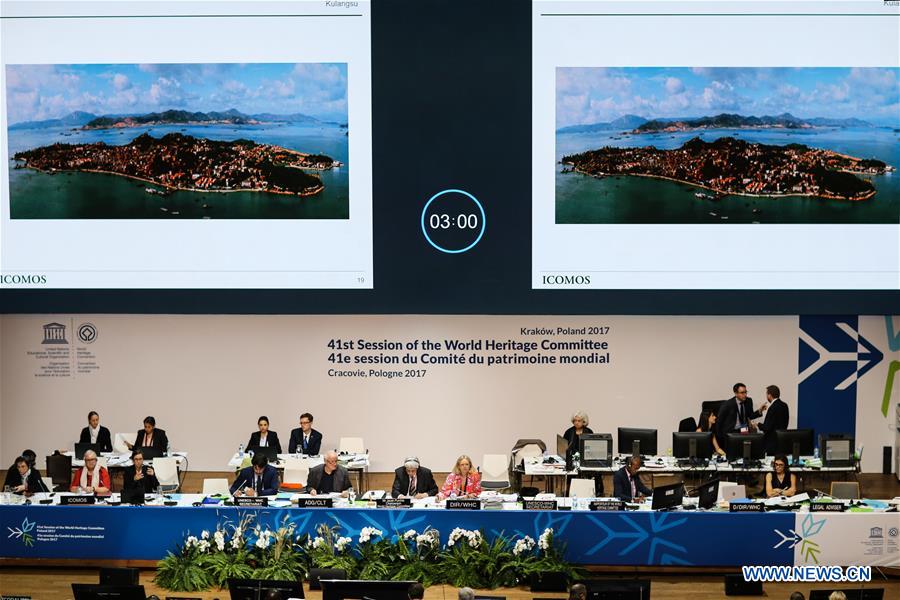
Photo taken on July 8, 2017 shows the session of the World Heritage Committee in Krakow, Poland. The 41st session of the World Heritage Committee on Saturday decided to put China's Gulangyu historic international settlement on the prestigious World Heritage List as a cultural site. So far, China has 52 sites inscribed to the List. (Xinhua/Chen Xu)

Photo taken on July 8, 2017 shows the session of the World Heritage Committee in Krakow, Poland. The 41st session of the World Heritage Committee on Saturday decided to put China’s Gulangyu historic international settlement on the prestigious World Heritage List as a cultural site. So far, China has 52 sites inscribed to the List. (Xinhua/Chen Xu)

Gulangyu island in east China’s Fujian Province, famous for its varied architecture and multicultural history, was included on the UNESCO World Heritage list Saturday.

The 41st session of the World Heritage Committee on Saturday decided to put China’s Gulangyu historic international settlement on the prestigious World Heritage List as a cultural site. So far, China has 52 sites inscribed to the List.

Only a six-minute ferry ride from Xiamen, Fujian’s dynamic economic and culture hub, Gulangyu has an area of about two square kilometers and is home to 20,000 residents.

A former international settlement, the island features 13 consulates, churches, hospitals, schools, and police stations, built by foreign communities from the middle to late 19th century.

In the early 20th century, the island attracted overseas Chinese elites, who returned and built private residences on the island, often with a mixture of eastern and western architectural styles.

Gulangyu has more than 2,000 intact historical buildings, making it one of the best-preserved international settlements in China.

Wu Yongqi, a historian on Gulangyu, said the styles developed here affected the architecture in southern Fujian and were brought to east and southeast Asia by Chinese immigrants.

“The island was home to an international community made up of local people, overseas Chinese and foreigners,” Wu said. “It was a distinct combination and the integration of their cultures made the island unique.”

A popular tourist destination, the island receives more than 10 million visitors per year.

“People often come to the island for its beautiful gardens, winding alleyways, pristine beaches and quiet lifestyle,” Wu said. “However, the island’s status as a world cultural heritage tells another story.”

In its bid, Gulangyu listed 53 groups of representative historical buildings, four historical roads and seven representative natural landscapes.

“Better protection is what we want to achieve through the world heritage inscription,” said Zheng Yilin, director of Gulangyu island management committee.

According to UNESCO, the inscription serves as a “magnet for international cooperation” and financial assistance for heritage conservation projects.

In preparation for the bid, Xiamen municipal government rolled out protection laws and regulations for Gulangyu, repaired damaged historic buildings, opened more cultural museums, and limited tourist numbers to the island.

“With the successful inscription, we are going to keep up with these efforts,” Zheng said.

Island of music

Gulangyu has one of the highest pianos ownership ratios in China, with nearly 600 pianos on an island that is less than two square kilometers.

Many of China’s most celebrated musicians have come from Gulangyu, and the island is nicknamed “piano island.”

“When I was a child, the sound of piano could be heard everywhere on the island,” said Fang Site, a 34-year-old local pianist. Her family was among the overseas Chinese who moved to the island in the early 1900s.

Fang said she grew up in a place with strong music traditions. At about six years old, she and many of her peers were sent to music schools on the island.

Her family, like many others on Gulangyu, gather weekly to hold a family concert, a tradition that persists to this day.

“The concert is a part of our lives, through which we connect with our families and express our love for music and life,” Fang said.

Gulangyu has the first piano museum and only organ museum in China, both established by Hu Youyi, an Australian Chinese pianist and collector. The museums host important music festivals and contests regularly.

Fang is the curator of the organ museum and has received UNESCO inspectors to the museum, a landmark on Gulangyu and one of the 53 historical buildings.

“Music is an important part of Gulangyu’s culture and my life. With the inscription, our music has a wider audience,” she said. “Gulangyu’s inscription provides a great opportunity for the preservation and promotion of music culture,” Fang said.


Suspect identified as policeman in east China hit-and-run

The suspect behind a string of hit-and-runs in east China has been identified as a local policeman, authorities said Saturday.

Four people were killed while nine others were injured by a car in Jiangsu Province, local police said.

Police received a report about a car ploughing into several pedestrians in a neighborhood in Jingjiang City at 8:27 p.m. Friday. The victims were rushed to hospital where four died despite medical treatment, while the nine injured are believed to be in stable condition.

The suspect, 57, was caught in nearby Taixing City, where he serves in a local police bureau. Police found that he had taken poison in an attempt to commit suicide. He is still in a coma and is receiving emergency treatment.

Further investigation is under way.


Hoh Xil enters world heritage list

A Tibetan antelope at the Hoh Xil Nature Reserve. [Photo/Xinhua]

A Tibetan antelope at the Hoh Xil Nature Reserve. [Photo/Xinhua] 

Hoh Xil in Northwest China’s Qinghai province was approved as a new world heritage site at the 41st session of the UNESCO World Heritage Committee in Krakow, Poland, on Friday.

As the 51st world heritage site in China, Hoh Xil is home to the country’s largest world natural heritage site, covering an area of 45,000 square kilometres.

The natural heritage site encompasses the largest uninhabited area in China. With an average elevation of 4,600 meters above sea level on the Qinghai-Tibet Plateau, Hoh Xil is home to more than 200 wildlife species including the Tibetan antelope, which take up nearly 40 percent of the species alive in the wild around the world.

According to the International Union for Conservation of Nature, Hoh Xil not only meets two criterions of any natural heritage, but also boasts a relatively high completeness and authenticity, as well as a sound protection and management.

The high-altitude region received the qualification of representing China to apply for a world heritage site in January 2016.


Heat wave, torrential rain to hit China

China’s meteorological agency Saturday issued warnings for a heat wave and torrential rains, calling for precautionary measures.

The National Meteorological Center (NMC) issued an orange alert for the heat wave, as temperatures in areas including in parts of Inner Mongolia Autonomous Region, Hebei, Henan, Shanxi, Shaanxi, Hubei and Shandong, rise above 35 degrees centigrade Saturday.

Parts of those regions could see temperatures surpass 40 degrees.

The agency also issued a blue alert for torrential rain Saturday and Sunday in parts of Chongqing, Hubei, Hunan, Henan, Guizhou, Yunnan, Guangdong and Guangxi Zhuang Autonomous Region.

Southwest Hubei will receive precipitation of 100-120 millimeters.

The agency asked relevant departments to take precautionary measures to prepare for potential landslides and floods.


44 dead or missing in flood-stricken Chinese county

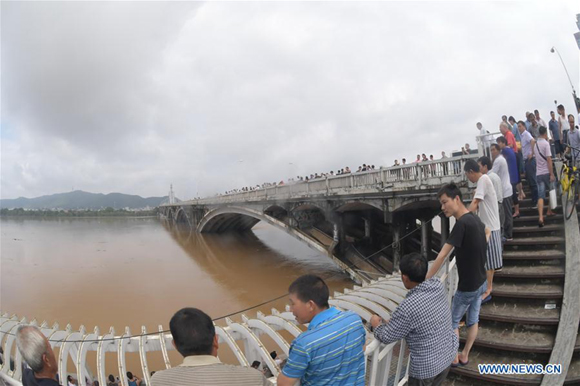
Citizens watch the flood on a bridge in Changsha, capital of central China's Hunan Province, July 2, 2017. Days of torrential rain in Hunan Province raised the water level of the Xiangjiang River, a major tributary of Yangtze River, to exceed its record flood level Sunday morning. (Xinhua/Long Hongtao)

Citizens watch the flood on a bridge in Changsha, capital of central China’s Hunan Province, July 2, 2017. Days of torrential rain in Hunan Province raised the water level of the Xiangjiang River, a major tributary of Yangtze River, to exceed its record flood level Sunday morning. (Xinhua/Long Hongtao)

A total of 44 people have died or are missing after floods hit Ningxiang County in central China’s Hunan Province, local flood control headquarters said Friday.

Heavy downpours since June 22 have led to the area’s worst natural disaster in 60 years.

About 815,000 people, or 56 percent of the county’s population, suffered property damage in the floods, it said.

In south China’s Guangxi Zhuang Autonomous Region, floods have left 26 dead and 8 missing since heavy rain started on July 1, according to the regional civil affairs department. More than 1.88 million people suffered losses in the disaster, which damaged 108,000 hectares of crops and flattened 6,102 houses. Direct economic losses have exceeded 7.8 billion yuan (1.15 billion U.S. dollars).

Torrential rain since late June has caused flooding along several tributaries of the Yangtze, China’s longest river.

The level of the Xiangjiang River, a major tributary of the Yangtze, exceeded its record level Sunday morning.

Since Saturday, reservoirs in the upper and middle reaches of the Yangtze have managed to control the flood, holding back more than 10 billion cubic meters of water, according to the Yangtze flood control and drought relief headquarters.

The efforts made by the Three Gorges Reservoir and upper reservoirs on the Jinsha River in the upper reaches of the Yangtze, and Yalong River, Jinsha’s tributary, have greatly reduced water levels of rivers and lakes in the middle and lower reaches of the Yangtze, the headquarters said.

According to the headquarters, local water authorities have spent 100 million yuan repairing 42 sections of bank along the middle and lower reaches of the Yangtze, which collapsed due to floods last year, the most severe since 1998.