Xi receives credentials of 8 ambassadors

Chinese President Xi Jinping received the credentials presented by eight new ambassadors to China at the Great Hall of the People in Beijing Wednesday.

The ambassadors are Selim Belortaja from Albania, Jose Bernal from Mexico, Usenov Azamat from Kyrgyzstan, Mothusi Palai from Botswana, Edward Boateng from Ghana, Terry Branstad from the United States, Jean-Maurice Ripert from France, and Patricia Rodriguez Holkemeyer from Costa Rica.

Xi welcomed the ambassadors to China and asked them to convey his sincere greetings and good wishes to the leaders and people of their countries.

The Chinese government will provide convenience and support for the work of the ambassadors and hopes that they will actively contribute to bilateral relations between China and their countries, Xi said.

Xi spoke positively of traditional friendship and sound relations with the eight countries, and said China will enhance mutual trust, promote pragmatic cooperation, and deepen people-to-people exchanges to boost bilateral ties.

The ambassadors conveyed greetings from their state leaders to Xi. They said their countries highly value the relations with China, as well as the friendship between the peoples, and expect to participate in the China-proposed Belt and Road Initiative.

They said they feel greatly honored to serve as ambassadors to China, and will devote their best efforts to promoting cooperation between their countries and China, as well as deepening mutual understanding and friendship between the peoples.


Special treat to cool off animals at Beijing Zoo

A large part of China is sweltering in intolerable heat as temperatures in central and eastern regions have soared to 40 degrees Celsius.

A panda sits with an ice cube in Beijing Zoo in Beijing, capital of China, July 12, 2017. [Photo/Xinhua]

Not only humans are suffering, so are the animals.

With its mouth wide open, a rhino at the Beijing Zoo greedily enjoyed a spray of water. Not far away, others swallowed watermelons prepared by their feeders.

Li Dongrui, a member of the zoo’s feeding team, told Xinhua they sprayed water at least twice a day to cool down the overheated animals.

“We also set up paddling pools for the pandas and elephants, and air conditioners for the polar bears,” he said. “This year, we even created a 10-square meter mud pool for the rhinos.”

When the temperature hits 35 degrees Celsius, giant ice cubes are delivered to the enclosures of polar bears, red pandas, golden monkeys, and chimpanzees.

The ice cubes, weighing 15 kilos each, are prepared three days in advance. Eight to ten ice cubes are needed each time.

The giant pandas receive a special treat — a dessert of mung bean soup, a traditional Chinese summer soup believed to be beneficial to human body, and in this case animal body, to reduce heat.

“Giant pandas cannot handle the heat, so we must keep the indoor temperature between 24 to 26 degrees Celsius,” Li said. “They eat eight meals every day to maintain strength, including bamboo shoots, carrots, and mung bean soup. Each panda consumes almost 50 kilos of bamboo a day.”

This summer, the Beijing Zoo has served 12 kinds of fruit, 28 kinds of vegetable, three kinds of green fodder as well as sugar and beverages daily to keep the animals healthy under the baking sun.

It is estimated over 48,000 kilos of fruit, 450,000 kilos of vegetables and 256,000 kilos of green fodder will be consumed during the summer.

To guarantee the freshness, all the green fodder is delivered at night and given to the animals within 15 hours. Bamboo leaves have been transported refrigerated since June, so that the giant pandas can have the best quality of their favorite food.


Special treat to cool off animals at Beijing Zoo

A large part of China is sweltering in intolerable heat as temperatures in central and eastern regions have soared to 40 degrees Celsius.

Not only humans are suffering, so are the animals.

With its mouth wide open, a rhino at the Beijing Zoo greedily enjoyed a spray of water. Not far away, others swallowed watermelons prepared by their feeders.

Li Dongrui, a member of the zoo’s feeding team, told Xinhua they sprayed water at least twice a day to cool down the overheated animals.

“We also set up paddling pools for the pandas and elephants, and air conditioners for the polar bears,” he said. “This year, we even created a 10-square meter mud pool for the rhinos.”

When the temperature hits 35 degrees Celsius, giant ice cubes are delivered to the enclosures of polar bears, red pandas, golden monkeys, and chimpanzees.

The ice cubes, weighing 15 kilos each, are prepared three days in advance. Eight to ten ice cubes are needed each time.

The giant pandas receive a special treat — a dessert of mung bean soup, a traditional Chinese summer soup believed to be beneficial to human body, and in this case animal body, to reduce heat.

“Giant pandas cannot handle the heat, so we must keep the indoor temperature between 24 to 26 degrees Celsius,” Li said. “They eat eight meals every day to maintain strength, including bamboo shoots, carrots, and mung bean soup. Each panda consumes almost 50 kilos of bamboo a day.”

This summer, the Beijing Zoo has served 12 kinds of fruit, 28 kinds of vegetable, three kinds of green fodder as well as sugar and beverages daily to keep the animals healthy under the baking sun.

It is estimated over 48,000 kilos of fruit, 450,000 kilos of vegetables and 256,000 kilos of green fodder will be consumed during the summer.

To guarantee the freshness, all the green fodder is delivered at night and given to the animals within 15 hours. Bamboo leaves have been transported refrigerated since June, so that the giant pandas can have the best quality of their favorite food.


8 killed, 2 injured in N. China construction site collapse

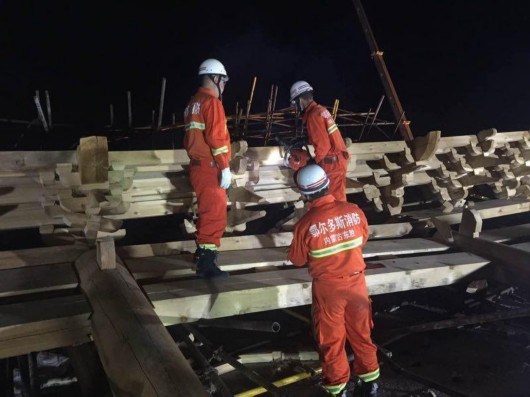
Rescuers work at the scene after a construction site collapse in Inner Mongolia. [Photo/Shanghai Daily]

Eight people were killed and two others injured after a collapse at a construction site in northern China’s Inner Mongolia Autonomous Region Tuesday.

The accident, which happened at 5:20 p.m. in Ejin Horo Banner, Ordos city, initially left eight severely injured and two slightly injured.

They were all sent to a local hospital, but the eight severely injured died Wednesday morning, according to the emergency rescue headquarters.

An investigation is underway.


GVCs give developing countries opportunities – report

China’s University of International Business and Economics released the Global Value Chain Development Report 2017 in Beijing on Monday, identifying GVCs as providing new opportunities for developing countries.

“The Global Value Chain Development Report 2017: Measuring and Analyzing the Impact of GVCs on Economic Development” is released by the University of International Business and Economics in Beijing, July 10, 2017. [Photo/China.org.cn] 

“Global Value Chain Development Report 2017: Measuring and Analyzing the Impact of GVCs on Economic Development” is co-published by the World Bank Group, World Trade Organization (WTO), Organization for Economic Cooperation and Development (OECD), the Japan’s Institute of Developing Economies (IDE-JETRO) and the Research Center of Global Value Chains of the University of International Business and Economics (UIBE), providing comprehensive analysis of the global economy. Social Sciences Academic Press (China) will translate and publish a Chinese edition.

Global value chains (GVCs), breaking up production processes so that different steps can be carried out in different countries, have transformed world trade. The report says GVCs create new opportunities for developing countries, increasing their participation in global markets and enabling them to diversify exports.

Without them, a developing country would have to be able to produce a complete product in order to expand into a new line of business. While GVCs have helped many developing countries advance, the benefits are not even.

Witnessing the potential benefits, stakeholders in developing countries typically want to see their country more involved in value chains and moving to higher value-added activities over time. However, only a few developing economies, most notably China, are deeply involved in this approach.

The report released on Monday examines ways in which developing countries can deepen their involvement in GVCs and move up the value chain.

It suggests the key to expanding the concept lies in cutting trade costs. Although they have declined over the past decades, non-tariff trade costs related to infrastructure, transportation, and uncertainty remain a barrier to wider GVC participation. In some complex value chains, such as motor vehicles, computers or machinery, non-tariff trade costs are more than four times higher than tariffs.

Participating in deep trade and investment agreements can advance this agenda, and these will be most powerful if they encompass several neighboring countries. Preferential trade agreements are increasing in number and deepening in content, surging from 50 in 1990 to 279 in 2015. However, further growth depends on preservation of an open trading system.

Small firms and the informal sector also need to be included. Poor infrastructure, corruption, and red tape tend to hamstring smaller companies more than larger ones as the latter can often finance their own infrastructure and finds ways to operate in a complex environment. Much of job creation in the world is through small and medium-size firms and their involvement in GVCs is crucial for maximizing the positive impact from trade.

The report also says China provides some interesting lessons. It is known for having started its process of economic reform by establishing four special economic zones fitting the model of export processing zones, with favorable infrastructure and customs clearance.

What is less known is that, within a short time, China had expanded these benefits to more than other 30 cities nationwide. Competition then enabled quite a few to emerge as locations with low trade costs and deepened participation in GVCs.

Research into trade added value shows private domestic firms are biggest contributors. Foreign firms are often processing exporters from China, but the successful expansion of value chains to domestic firms within the country resulted in most of the added value coming from the domestic private sector, the report states.

It also finds that proximity to the world’s three major production hubs — the United States, Asia, and Europe — is highly important. It also matters who a country’s trading partners are, how far the country is from high-income markets, and the degree to which partners are integrated within regional global value chains.

“How economies are linked, specialize, and grow (or not) is captured in the way global value chains (GVCs) are put together,” Michael Spence, Nobel Laureate in Economics, wrote in a foreword to the report. “This report is a huge contribution to our deepening understanding of what the global economy really means and how it is changing.”

Professor Zhao Zhongxiu, vice president of the University of International Business and Economics, hosted the launch event in Beijing on Monday, declaring the report was a very significant flagship achievement for the university’s GVC research center.

Liu Shijin, former vice president of Development Research Center of the State Council and vice-chairman of China Development Research Foundation, said in his address that, in the new international situation, China should speed up the fundamental transformation in its economic growth mode, elevate comprehensively its industrial competitiveness, and accelerate the advance to the medium and even high end of global value chains.