China to curb student obesity

People do exercise at a gym. [File Photo]

China plans to slow the growing rate of obesity among its citizens, especially students, according to a national nutrition plan released Thursday.

The national nutrition plan for 2017 to 2030, was published by the general office of the State Council, China’s cabinet, to improve the country’s health condition.

It paid special attention to various at risk groups, including students, patients, pregnant women, infants, and the elderly.

According to the plan, the growing rate of obesity among Chinese students needs to slowed down by 2020, and to be under “effective” control by 2030, and the rate of overweight and obese Chinese needs to drop significantly by 2030.

Thirty percent of Chinese adults are overweight, and 11.9 percent are obese, the Chinese Center for Disease Control and Prevention said in May.

Among Chinese children aged six to 17, 9.6 percent are overweight and 6.4 percent are obese.

The plan urged the schools nationwide to structure meal plans based on the age of students and the school’s location, and to launch an educational campaign on nutrition to students.

It also called for schools to add more sport activities into the curriculum.

Other than the state of obesity in developed area of the country, the plan highlighted the need to take care of malnourished people as well.

It required local governments and schools in poorer areas to improve the nutritional content of meal plans and monitor food safety more strictly.

Local authorities in underdeveloped areas should strengthen the supervision and prevention of foodborne illnesses, according to the plan.

It also proposed the combination of traditional Chinese medicine with Western nutrition and physical training to better serve the people.


Thai-born giant panda Lin Bing gives birth to twins

Lin Bing, a giant panda born in Thailand and returned to China in 2013, gave birth to twins last week, the Chinese Giant Panda Protection and Research Center announced Thursday.

The cubs arrived about seven hours apart last Saturday. The female cub, weighing 170 grams, was born at 8:17 a.m.; her brother, weighing 159 grams, arrived at 3:08 p.m.

Both of the cubs and their mother are in a healthy condition.

According to base staff, Lin Bing had mated with two male pandas before showing signs of pregnancy. The father of the cubs has yet to be confirmed.

The twins are the first pandas born at Sichuan’s Shenshuping protection base in the reconstructed Wolong National Nature Reserve after the habitat were severely damaged in the 2008 Sichuan earthquake.

The earthquake left one panda dead and another missing.

Born in May 2009, Lin Bing is the daughter of giant panda couple “Lin Hui” and “Chuang Chuang”.

As the first giant panda born in Thailand, Lin Bing has become one of the most popular animals in the country. In 2015, she also gave birth to twins.


Chinese aircraft carrier formation conducts coordination training

A flotilla including China’s aircraft carrier Liaoning embarked on a new training mission upon arrival at an unidentified sea area Thursday.

The training, a latest effort to explore the oceangoing combat training practice, is expected to strengthen coordination among the vessels in the naval formation, improve the skills of crew and pilots in different marine conditions, and enhance the command capability.

The aircraft carrier has just concluded a five-day visit to the Hong Kong Special Administrative Region (HKSAR) to celebrate the 20th anniversary of the People’s Liberation Army (PLA) being stationed in the HKSAR.

The PLA Hong Kong Garrison has been responsible for the defense of Hong Kong since its return to the motherland in 1997.


13,895 environmental resource cases solved in past year

A total of 13,895 criminal cases related to environmental resources were solved from July 2016 to June 2017 in China, the Supreme People’s Court (SPC) said in a white paper Thursday.

Up to 27,384 people were sentenced, while the number of such criminal cases accepted stood at 16,373, according to the SPC.

Courts at all levels strengthened civil trials of environment-related cases. As many as 151,152 civil cases about environmental resources were solved in the same period out of the 187,753 accepted, the white paper showed.

Another 29,232 administrative cases on environmental resources were solved in the past 12 months, with 39,746 accepted.

As of April 2017, the number of judicial organs for such cases increased by 398 on a yearly basis, which marked a 71.3-percent rise, according to the white paper.

Also, a judicial research center on environmental resources at the SPC issued a development report on China’s environmental justice Thursday, which called for legislation on environmental accountability and improvements of the system for administrative litigation.


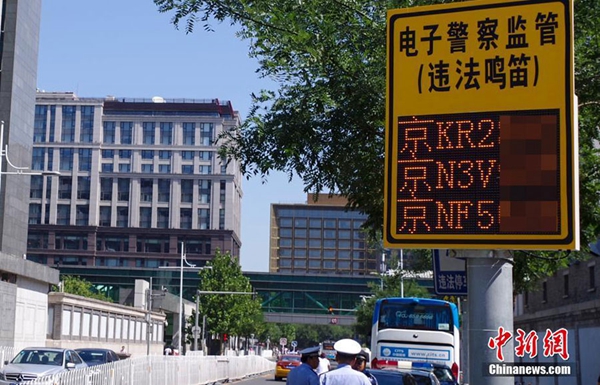
Beijing pilots illegal-honking detectors

A system of detectors is installed along the road near Peking Union Medical College Hospital in Beijing. [Photo/chinanews.com]

Drivers who indiscriminately use their car horns in future could find themselves being booked thanks to a system of detectors being installed along the Chinese capital’s key areas by the Beijing Traffic Management Bureau, according to Beijing Youth Daily.

“The detectors consist of three parts, namely, a microphone array acquisition device, an electronic capture and a LED prompt system. Combining the three systems, we can distinguish between the sounds of horns, brakes and engine noise, etc.,” said Li Jianfeng, deputy director of the Scientific and Technical Information Department of the bureau.

“The detectors can accurately collect honks.” Li said. “Even parallel vehicles can also be identified based on their position in each lane; the recognition locator feature can reflect the direction the honks are coming from, so there will be no misjudgment.”

The system photographs the number plate of the offending vehicle so that the driver can be tracked down and prosecuted.

Honking horns have long been an irritating contributor to Beijing’s noise pollution levels.

According to The Measures of Beijing on the Implementation of the Law of the People’s Republic of China on Road Traffic Safety, violation of the provisions in regard to indiscriminate honking will incur a fine of 100 yuan (US$14.76).