
‘China’s Jack the Ripper’ stands trial

Police detained suspected serial killer Gao Chengyong in the city of Baiyin, Gansu Province, on August 26, 2016. [Photo/thepaper.cn]

A high-profile criminal case has been heard at the Baiyin Municipal Intermediate People’s Court in Gansu Province on Tuesday.

Alleged serial killer Gao Chengyong, detained in the city of Baiyin last year, is on trial for intentional killing, rape, robbery and desecrating a human corpse.

If convicted, the 53-year old Gao could face the death penalty. A verdict is expected later this week.

Gao Chengyong is accused of raping and murdering 11 people from 1988 to 2002. He was arrested in August, 2016, after a lengthy investigation in the city of Baiyin, where 9 of the 11 killings took place.

Prosecutors have alleged Gao would target young women dressed in red, then follow them home, where he would subsequently rape and kill them, normally by cutting their throats. The victims’ bodies were also mutilated after their deaths, leading to the killer being dubbed ‘China’s Jack the Ripper’ in Chinese media.


8th Soong Ching Ling Int’l Summer Camp opens in Beijing

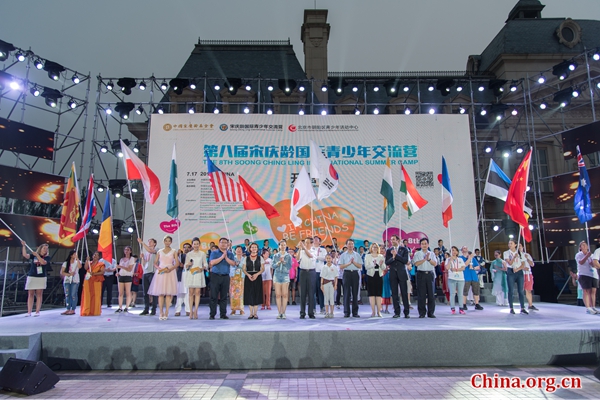
An international summer camp opens in Beijing on July 17, bringing over 200 children from 16 countries. [Photo provided to China.org.cn]

An international summer camp opened in Beijing on July 17, bringing over 200 children from 16 countries.

Under the theme of “In China, Be Friends,” the camp is sponsored by the China Soong Ching Ling Foundation (CSCLF), a Beijing-based NGO named after the late wife of Dr. Sun Yat-sen.

The week-long event, already in its 8th year, aims to further promote the consensus achieved during last May’s Belt and Road Forum (BRF) to enhance communication between the younger generation of various countries and strengthen people-to-people exchanges through various group activities, exhibitions, talent shows, cultural carnivals as well as sightseeing around China, the foundation stated.

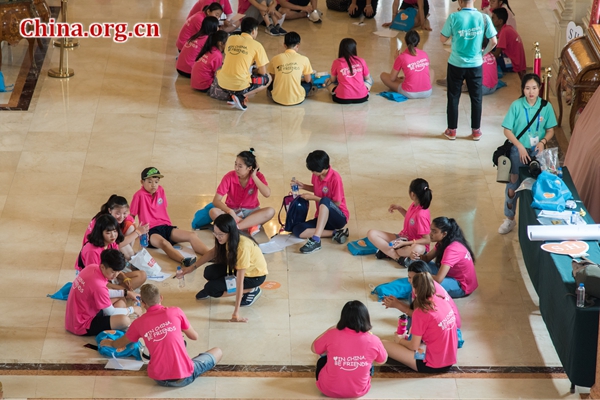
Young people from different countries play games during an ice-breaking session of the 8th Soong Ching Ling International Summer Camp in Beijing on July 17. [Photo provided to China.org.cn]

Hang Yuanxiang, CSCLF’s standing vice chairman, speaking at the camp’s opening ceremony, declared: “Through this event, we hope young people could get closer, promote exchanges of different civilizations and contribute to a better and peaceful world when they grow up.”

Aimar Poom, a team manager of four Estonian teenagers, said it would be a very exciting experience for youngsters being in China along with peers of different skin colors and cultural backgrounds.

Beside their stay in Beijing, participants will go on separate trips to north China’s Inner Mongolia Autonomous Region, Jiangsu Province and Shanghai to experience the country’s traditional culture and development.


China’s first crawfish college to add more taste to industry

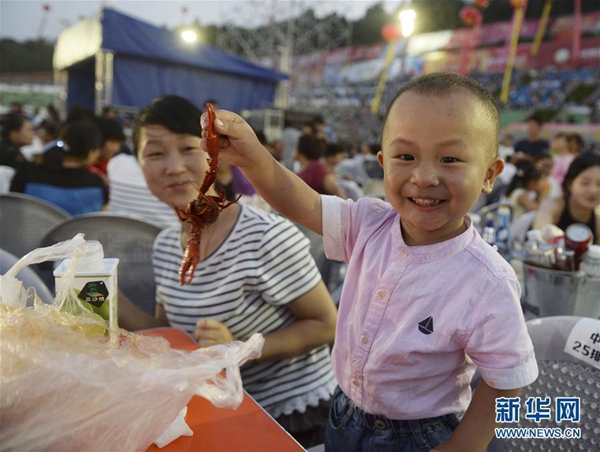
People enjoy themselves at a crawfish banquet during a crawfish festival in Xuyi county, east China’s Jiangsu Province, June 13, 2017. Over 30,000 people attend the event and eat 35 tons of crayfishes provided by 47 local shops. [Photo/Xinhua]

A popular snack in China, crawfish has spawned a new professional industry with an occupational school in Hubei Province set to train students in all aspects of the crustacean, reported thepaper.cn.

The Jianghan Art Vocational College in Qianjiang city has enrolled 86 students in crawfish-related majors. From the fall semester, students will study 2-3 year courses on catering management, marketing, and cooking and nutrition.

The city is one of the major producers of crawfish in China. Cooking and exporting the freshwater crustacean is a main income source for local farmers.

In May 2016, the college set up a crawfish school, the only one of its kind in China, as the city aimed to boost the industry by cultivating more crawfish breeders, cooks and opening more crawfish restaurants.

“Despite the rapid growth of the crawfish industry, managerial professionals are still in shortage,” Xia Zhizhong, a recruitment officer at the school, said.

China is the world’s largest crawfish producer. By mid-2016, the number of restaurants selling crawfish was triple the number of KFC outlets in China.


More details emerge in deadly apartment fire set by nanny

An apartment catches fire on June 22 in the eastern Chinese city of Hangzhou, leaving four people dead. [File Photo]

Hangzhou authorities have released more details in the case of a nanny accused of setting fire to an apartment in Hangzhou, Zhejiang Province, China News Service reported on Monday.

At a news conference, the authorities said the nanny had used her mobile phone to learn how to set a fire. They also said the property management company failed to maintain safe facilities and to provide emergency response.

The police said Mo Huanjing, 34, confessed after her arrest, and was charged on July 1 with arson and theft in connection with the blaze that swept through an apartment in a residential building on June 22. The fire killed a mother and her three children, aged 6 to 11 years, Li Bing, deputy director of the Shangcheng district public security bureau, said at the news conference.

Mo was addicted to online gambling, Li said. She had worked as a babysitter since 2015 in Shaoxing, Zhejiang Province, and in Shanghai, but was fired three times after being accused of theft.

She had worked for the family caught in the fire since September and had stolen items she subsequently pawned for 130,000 yuan (US$19,000) to pay off gambling debts. Mo also borrowed 114,000 yuan from her employer, claiming she needed to buy a house for her parents. During the investigation, the police discovered that Mo had searched such key words as “lighter”, “sofa fire” and “curtain fire” from 2 a.m. to 4 a.m. on the day of the blaze, the news service reported.

Later, at 4:55 a.m., Mo used a lighter to set fire to a book on a tea table. The fire spread to the sofa, got out of control and frightened Mo, who fled, leaving the mother and three children to die.

Firefighters arrived at the scene at 5:11 a.m., but the fire engine was blocked. Firemen rescued seven people but failed to reach the blazing room. Insufficient fire hydrant pressure prevented fire suppression and delayed the rescue effort, the report said.

According to Chen, the property management company had many problems with its emergency preparedness, including staff members who didn’t know how to switch on a fire hydrant pump manually.

Flight delayed 5 hours after kid ‘sneaks’ on board

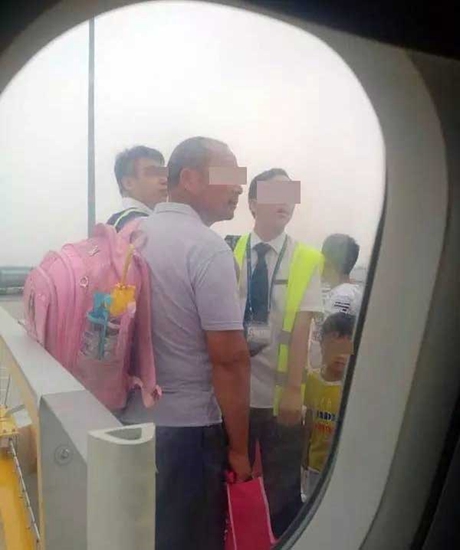
A Juneyao Airlines flight from Beijing to Shanghai was delayed five hours after a child was found in the aircraft without a ticket, the airline said yesterday. [Photo/Shanghai Daily]

A Juneyao Airlines flight from Beijing to Shanghai was delayed five hours after a child was found in the aircraft without a ticket, the airline said yesterday.

Crew on Flight HO1252, which was scheduled to take off at 6:55 a.m. on Sunday, found the child on board without a ticket.

The child passed the security check, the boarding gate and a final check before boarding the plane with the help of his family. He was accompanied by two adults and another two children, according to the Beijing Capital International Airport.

The five were asked to get off the aircraft, while all other passengers on the flight were asked to go through the security check again.

The flight eventually took off around noon after being delayed for nearly five hours. The child’s age and gender were not given.

According to civil aviation regulations, the security check authority should inspect the certificates of passengers along with other safety checks. If the authority failed to perform the duty, the civil aviation authority can face fines up to 30,000 yuan (US$4,433).

The airline has reported the incident to the Civil Aviation Administration of China, which has launched an investigation and will publicize the outcome, the airline told Shanghai Daily.

The Shanghai-based airline issued a statement yesterday to remind passengers that children aged 2 and over need a ticket and must be accompanied by an adult. Even an infant who does not occupy a seat needs an infant ticket.

The airline said it was also investigating the incident with the Beijing airport authority and the agent company which manages passengers.

The parents of the child should take the main responsibility, while the ground service company and airport authority should take minor responsibility, said Li Xiaojin, a civil aviation expert with the Civil Aviation University of China.

“Other passengers on the flight can sue them and ask for compensation for the five-hour delay,” Li said.