Telecom fraudsters sentenced in student death case

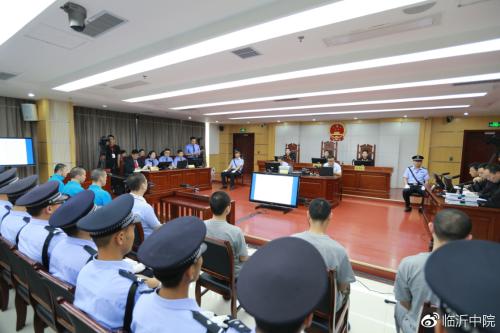
The principal criminal, Chen Wenhui, was sentenced to life in prison on charges of fraud and illegally obtaining personal information at the Linyi Intermediate People’s Court. [Photo/Weibo.com] 

Seven people involved in a high-profile telecom fraud case that led to the death of a university candidate were sentenced to prison at a court in Shandong Province on Wednesday.

The principal criminal, Chen Wenhui, was sentenced to life in prison on charges of fraud and illegally obtaining personal information at the Linyi Intermediate People’s Court. The other six criminals were sentenced to prison between three to 15 years.

The seven people cheated people out of money by posing as officers of educational, financial and real estate institutions in telephone calls made between November 2015 and August 2016.

One of the victims, Xu Yuyu, an 18-year-old student from Linyi, was called on Aug 19. She had applied for financial aid from a local educational authority two days before she received the phone call.

During the call, Zheng Xiancong, one of the criminals, told Xu that he was an educational authority officer and would provide her with about 2,600 yuan (US$385) in student aid. Zheng asked her to contact the local financial authority to find out how to receive the aid.

Xu was given a number to call that connected her to Chen. Chen said he asked Xu to transfer 9,900 yuan in tuition fees into a bank account, adding that the student aid would appear in her student account.

After discovering the money was stolen, Xu and her father reported the theft to local police on the same evening. On her way back home, she died of cardiac arrest. Forensic experts said Xu’s death was linked to the great anxiety caused by the telecom fraud.

Chen Wenhui said he obtained more than 10,000 pieces of personal information, including that of Xu, through QQ, an instant messaging tool.


‘Belt and Road’ among top media buzzwords: report

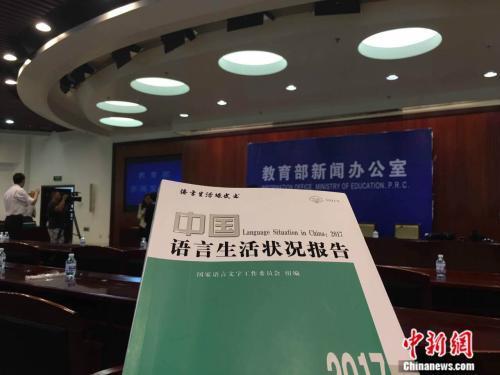
“Belt and Road”, “AlphaGo” and “emoji package” are among the most frequently used new words in Chinese media in 2016. [Photo/ Chinanews.com]

“Mobike,” “AlphaGo” and “emoji package” were among the most frequently used new words in Chinese media in 2016, according to a report released Tuesday.

Other popular terms included “Long March spirit,” “South China Sea” and “Tiangong-2,” said the report released by China’s Ministry of Education and the State Language Commission.

The annual report, which was the 12th of its kind, was compiled based on information from the language database of the National Language Resource Monitoring and Research Center.

According to the report, “rule,” “small goal,” “change” and “Belt and Road” were the most popular terms of the year.

Linguists noted that media frequently used the word “rule” to express the citizens’ increasing awareness of abiding by regulations under changing circumstances.

The popularity of “small goal” was a demonstration that the Chinese people are positive and practical. “Change” and “Belt and Road” represented citizen’s common aspirations for interconnectivity and win-win cooperation, said linguists.

Widely used terms in “bullet screens” and car stickers were also included in the report. Terms such as “baby onboard” reflected changing values and sentiments of the public, the report said.

Experts noted the emergence of low-brow terms in “bullet screens” and car stickers, calling for stronger guidance and supervision.


Snow Dragon to assess acidification of Arctic Ocean

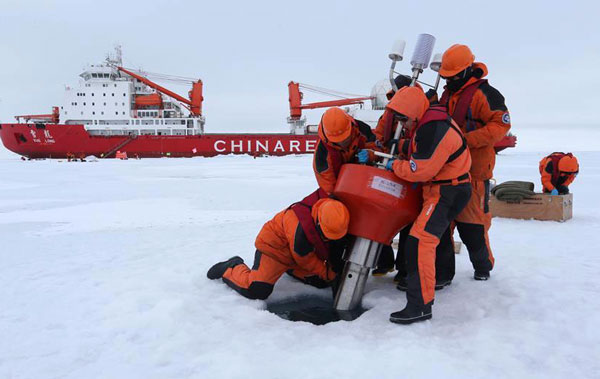
Members of China’s research team set up an ocean profiling float at a short-term data acquisition location near the icebreaker Xuelong, or Snow Dragon, in the Arctic Ocean, Aug 18, 2016. [Photo/Xinhua] 

The Chinese icebreaker Xuelong, or Snow Dragon, will set sail on Thursday for a research mission to discover the extent of acidification in the Arctic Ocean.

It is internationally acknowledged that acidification — mainly caused by carbon dioxide emissions into the sea — is rising in the ocean and already covers a larger area, according to Xu Ren, deputy director of the Polar Research Institute of China.

“It may trigger environmental disasters and affect marine biodiversity,” he said at a media briefing on Tuesday. “Ocean acidification is a major issue facing the international community, along with global warming and marine pollution.

“Although the situation in the Arctic Ocean is not as bad as other oceans, it will deteriorate with global warming and the decrease of sea ice in the Arctic,” added Xu, who is team leader of this year’s 83-day expedition.

China has pledged to conduct an annual Arctic expedition to make long-term and systematic scientific observations, and strengthen its position on the world stage regarding international governance of the Arctic region.


China tightens regulation of private museums

China has issued new rules to strengthen the management of non-state-owned museums, forbidding private museums to distribute property among founders and sponsors when they are shut down.

According to the regulation issued by the State Administration of Cultural Heritage, the residual property should be used for the public interest. Other museums with similar services have priority to receive remaining collections.

Non-state-owned museums are required to make public information about their collections, exhibitions, the management and use of assets and donations, according to the rules.

China’s non-state-owned museums have undergone what insiders called “unchecked, barbaric growth.”

In 2015, the State Council issued a regulation to address problems in private museums, including slack management and supervision, weak infrastructure, improper preservation and the illegal trade of ancient relics.


China supports two-state solution on Palestinian issue

China supports the political settlement of the Palestinian issue on the basis of the two-state solution, President Xi Jinping said on Tuesday.

China supports Palestine to build an independent, full sovereignty state along the 1967 borders with East Jerusalem as its capital, Xi said in his talks with visiting Palestinian President Mahmoud Abbas.