Shop blast leaves 2 dead, 55 injured in east China city

Two people have been confirmed dead and 55 others were injured after a blast occurred in a shop near West Lake in Hangzhou, capital of east China’s Zhejiang Province, on Friday morning, according to sources with local authorities.

Among the injured, 12 people sustained severe injuries.` The blast happened at around 8:40 a.m. Billowing flames and strong heat shattered the glass of passing vehicles, including a bus, causing most of the injuries.

The fire has been put out, and all the injured have been sent for treatment in hospitals, according to the city’s fire department.

The cause of the explosion is still under investigation.

The shop is located in the West Lake District, a well-known scenic area. The lake was used as the backdrop of a performance directed by Zhang Yimou as part of the G20 summit last year.


Shanghai Airlines brings back local dialect

Shanghai Airlines has reintroduced cabin announcements in the Shanghai dialect on selected flights, following suggestions from passengers.

The prerecorded messages will initially be played only on flights from Taipei and Kunming, Yunnan province, to Shanghai’s Pudong and Hongqiao international airports.

“We’ll test the Shanghai dialect on these two services until the end of August,” said Xu Mei, a manager in the carrier’s passenger cabin services department. “If the feedback is positive, we may expand it to other flights.”

The 60-second messages will be broadcast before takeoff and landing, she added.

Shanghai Airlines, a subsidiary of China Eastern Airlines, operates about 350 flights a day to domestic and international destinations. It first introduced local dialect announcements in January 2012 but halted the practice without explanation a few years later. The return of the local language service appears to be an attempt by the airline to build its Shanghai brand, as well as to promote the city’s image and its culture.

To make sure the dialect is spoken with genuine flavor and fluency, the airline invited Huju Opera performer Mao Shanyu to record the messages along with Lin Jiaqing from the airline’s passenger cabin services department, both of whom are Shanghai natives.

“I have played quite a few characters, but this is the first time for me to be a chief flight attendant,” Mao said.

“I always think the promotion of the Shanghai dialect is the responsibility of people from all walks of life. The decision to use it on Shanghai Airlines flights is helpful in displaying the city’s enthusiasm and charm, and I am willing to be part of it,” she added.

Questionnaires will be gathered from passengers after the flights, and their feedback will be reviewed before fine-tuning the service.

Broadcasts in the local dialect have been part of Shanghai’s public transportation system for years. According to a staff member at Shanghai Ba-shi Public Transportation (Group) Co, passenger feedback has been positive.


Deepest subway station in works

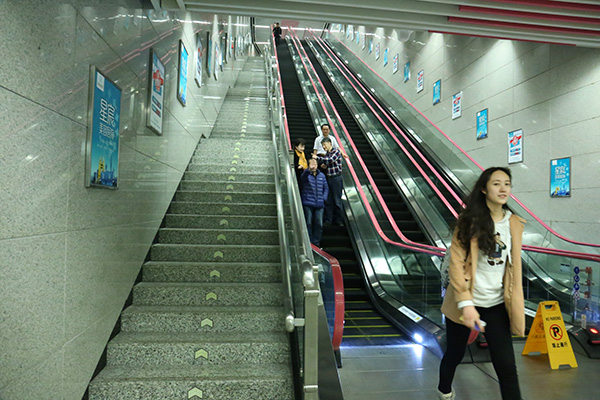
Passengers take long escalators to descend to Hongtudi station of Line 6 of the Chongqing Metro, which is about 60 meters beneath the ground. [Provided/China Daily]

Chongqing is about to break its own record for the deepest subway station in China.

The southwestern city, located in an area crisscrossed by rivers and mountains, is building train platforms 94.46 meters underground as part of the ongoing extension of the Chongqing Metro network.

Hongtudi station, which opened on Line 6 in December 2014, was already the country’s deepest station at 60 meters below ground. Now, it is being pushed even deeper to connect with Line 10, which is under construction.

The extension, which is scheduled to open by the end of the year, will have high-speed elevators that drop 78.8 meters-about 26 stories-another national record, according to the city’s transportation authorities.

Ninety-one escalators, China’s largest escalator network, will be installed to move passengers between lines 6 and 10 and the surface.

To enter or leave Hongtudi station now, people need to take escalators with a 30-degree incline on a journey lasting three minutes and 15 seconds. The alternative is a stairwell with 354 steps.

Chen Limei, 30, a tourist from Hunan Province, said she finds the station “magical”.

“It’s the first time I’ve taken such a long escalator, and it seems never-ending, one after another,” she said. “It would be very interesting if we could take a slide from the top.”

Some passengers complained that it wastes time to take such a long journey.

“These escalators are too long and slow, and the trip takes too much time,” said a man surnamed Liu, 24.

The expansion of Hongtudi station will make it one of the deepest in the world. The world’s deepest subway system is said to be the Pyongyang Metro in Democratic People’s Republic of Korea, which has tracks more than 110 meters underground.

Arsenalna station on the Kiev Metro’s Sviatoshynsko-Brovarska Line in Ukraine is 105.5 meters below the surface. Commuters have to take two escalators to the bottom, which takes up to five minutes.

The Admiralteyskaya station in Russia’s St. Petersburg Metro system is 86 meters below ground.

Chongqing also boasts the highest overpass in the country, at 72 meters. From windows on the 22nd floor of a nearby building, people can look across at the overpass and see the traffic.


China man arrested for killing 4 over family dispute

A man has been arrested for allegedly killing four people, including his wife and son, over a family dispute in northwest China’s Gansu Province, local police said Thursday.

Following a dispute with his wife, the suspect, Zhang Xiaojun, killed his son, father-in-law and nephew at his father-in-law’s home in a village in the city of Jiuquan at about 12:50 a.m. Tuesday, according to police.

Zhang, 37, also injured his wife, mother-in-law and sister-in-law, and his wife later died due to severe injuries.

The suspect then fled the scene.

Police arrested him on Wednesday in a nearby township.

Zhang, a native of Xuzhou, Jiangsu Province, lived with his family in a village in Suzhou District, Jiuquan.

A police investigation is under way.


85 on trial for cross-border telecom fraud

A total of 85 suspects stood trial in Beijing from Tuesday to Thursday, in a cross-border telecom fraud case.

More than 70 suspects, including 44 Taiwan residents, were arrested in Kenya and extradited to China in April 2016, according to Beijing No. 2 Intermediate People’s Court.

The suspects pleaded guilty to cheating 185 victims on the Chinese mainland out of more than 29 million yuan (4.3 million U.S. dollars), the court said.

Thirty-five suspects were accused of carrying out fraud in Indonesia from June to November 2014 and the other 50 in Kenya from June 2015 to April 2016.

The suspects claimed to work for police, procuratorates or express delivery firms and called Chinese citizens, telling them their personal information had been stolen and they should pay money to protect their assets and prove they had not committed any crimes.

The court will announce the verdicts at a later date.