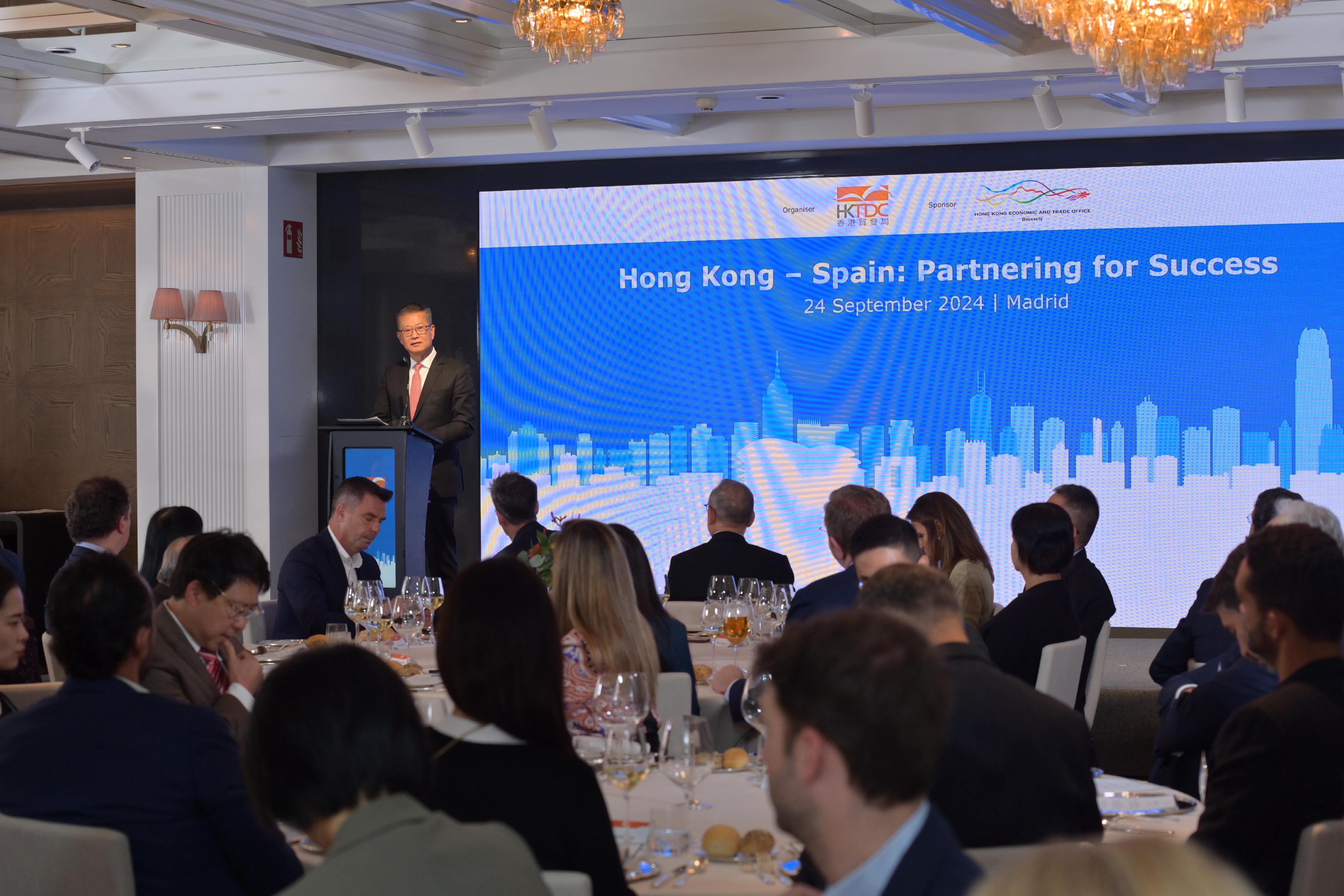
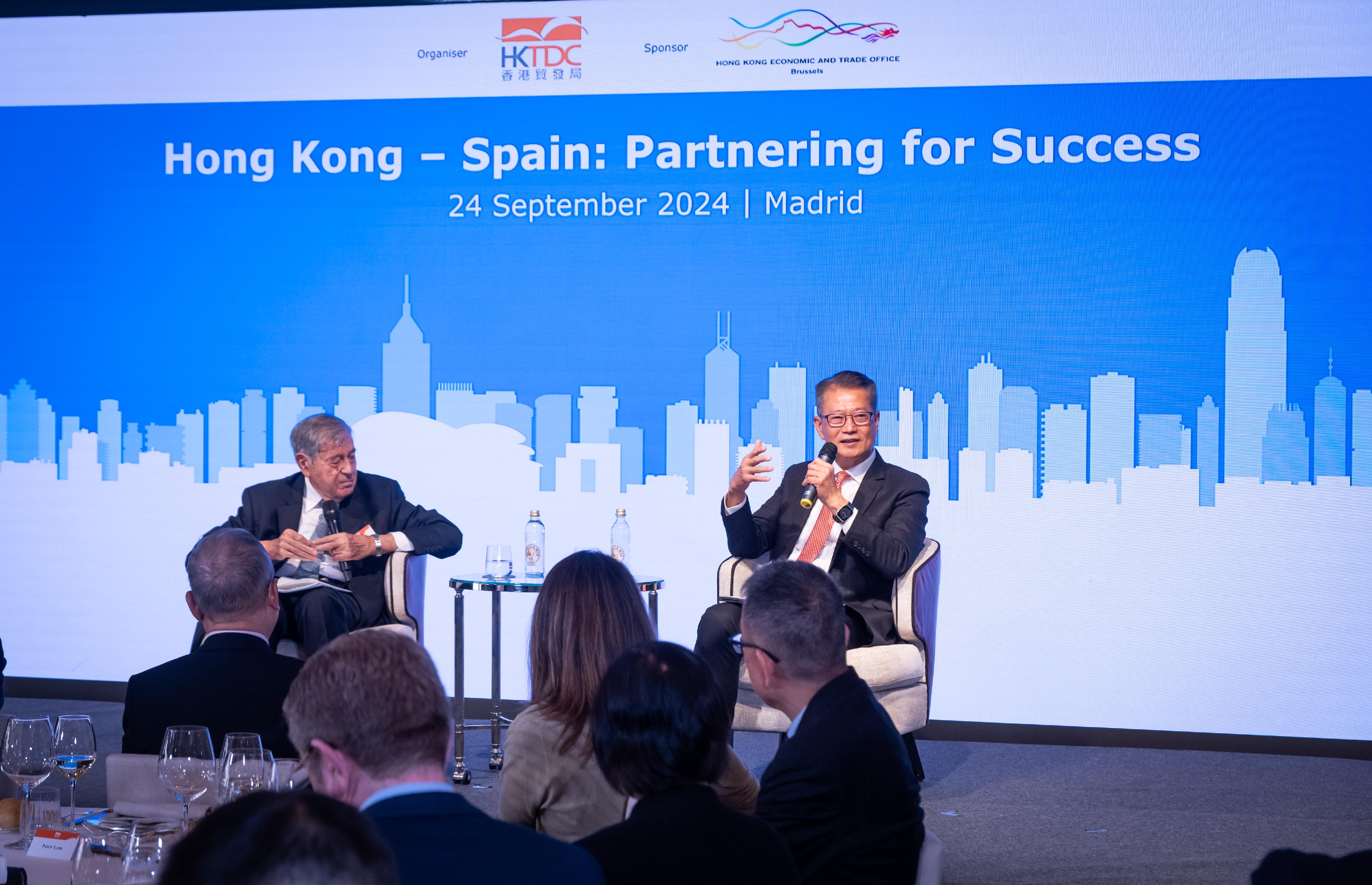
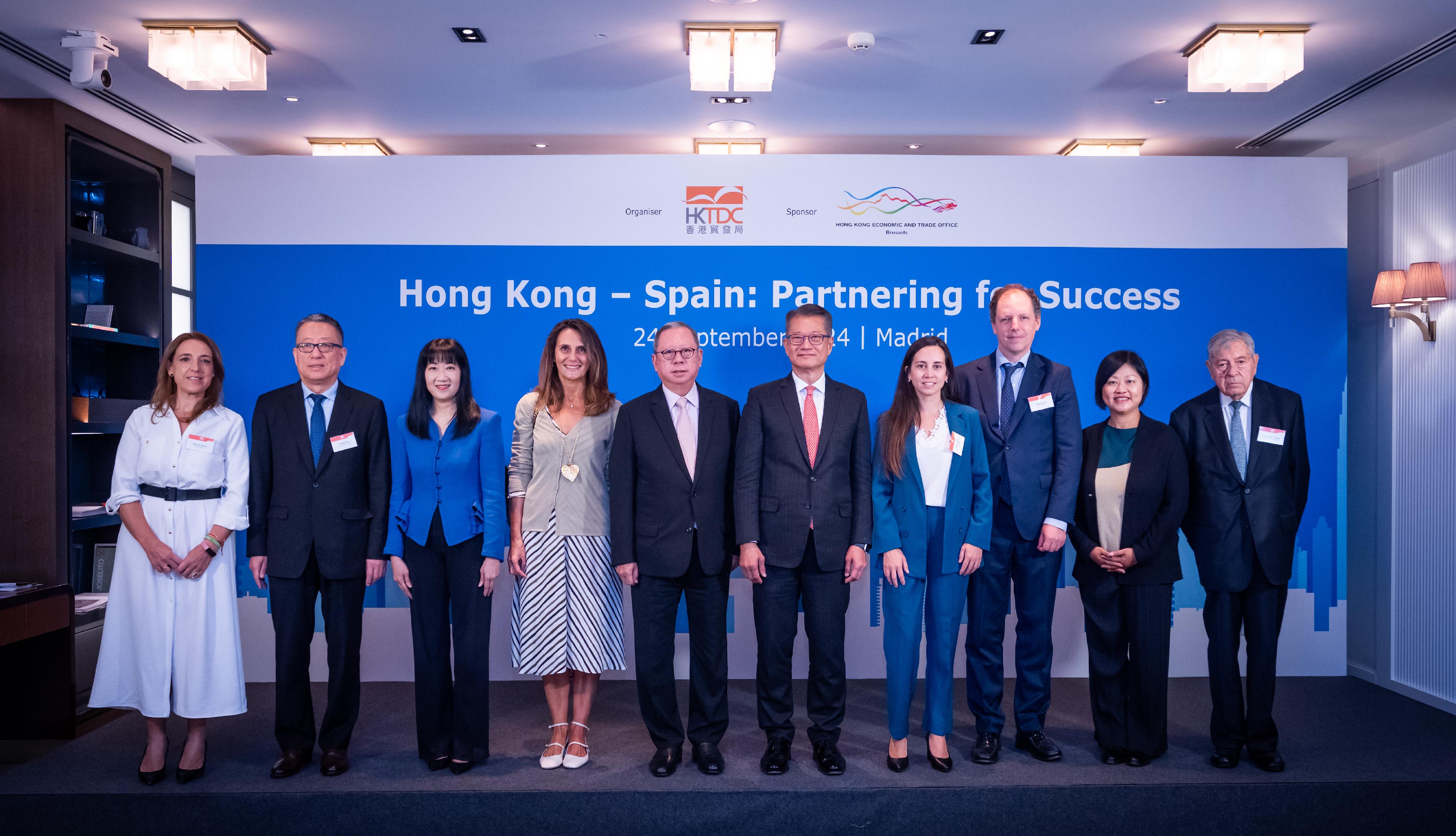
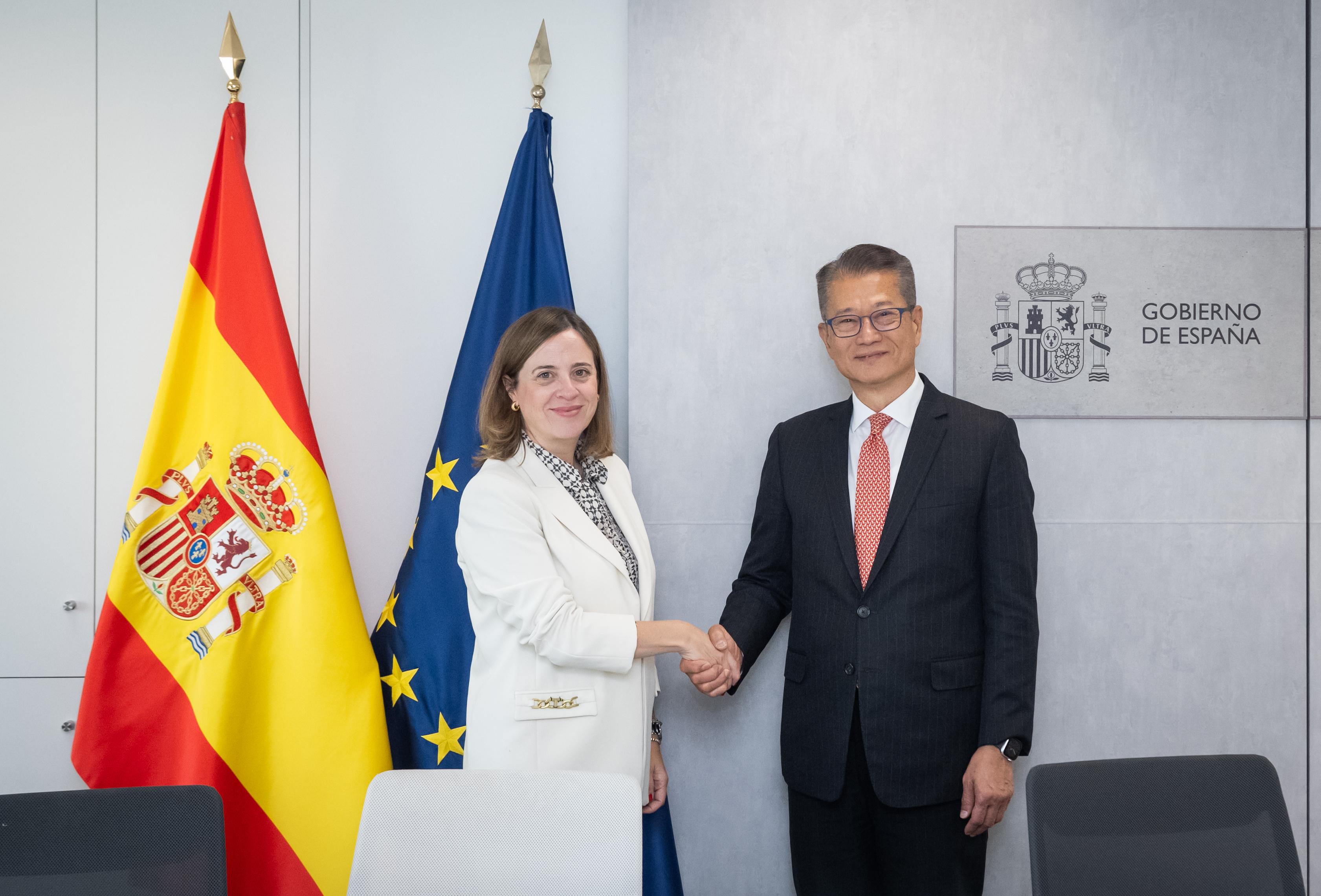
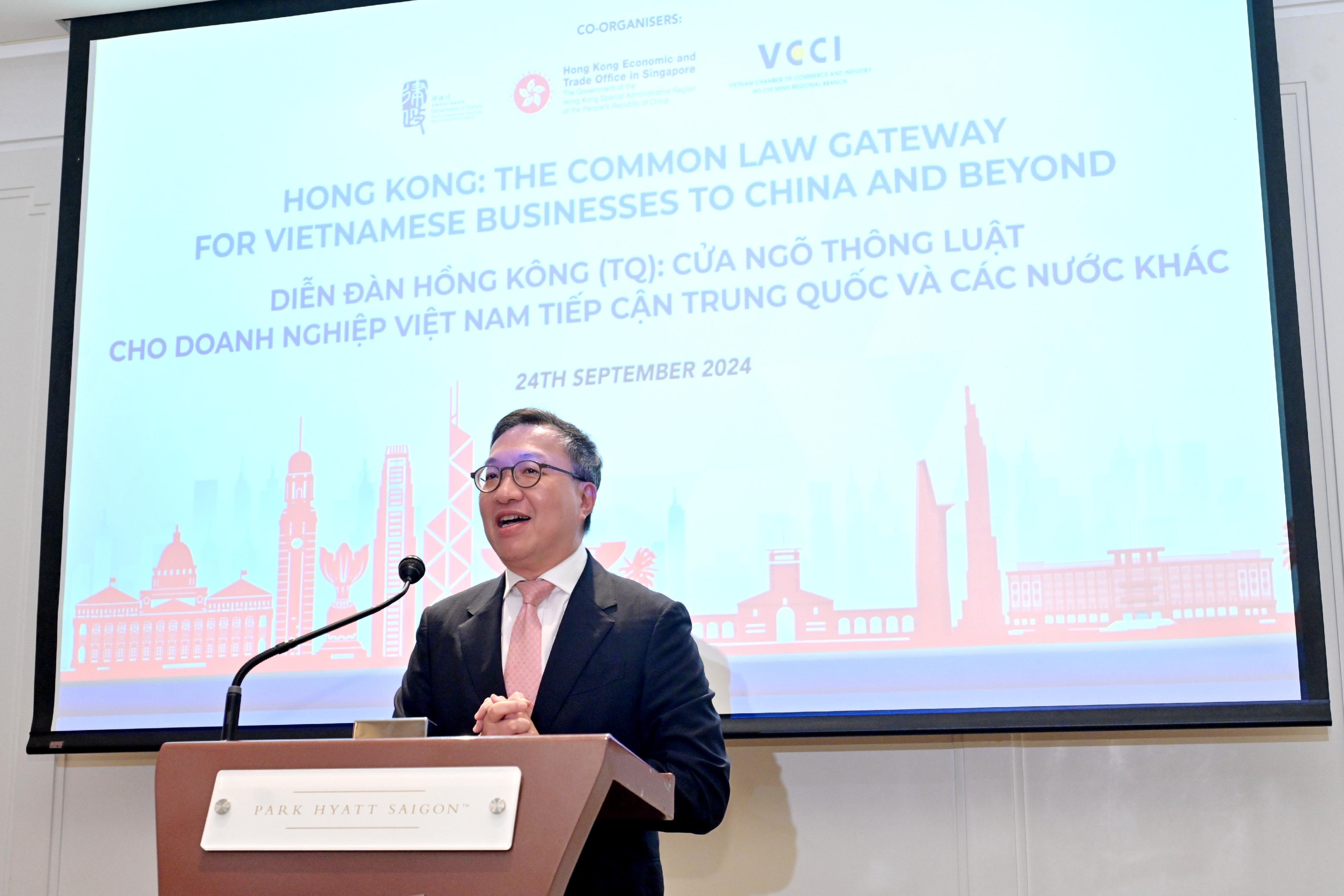
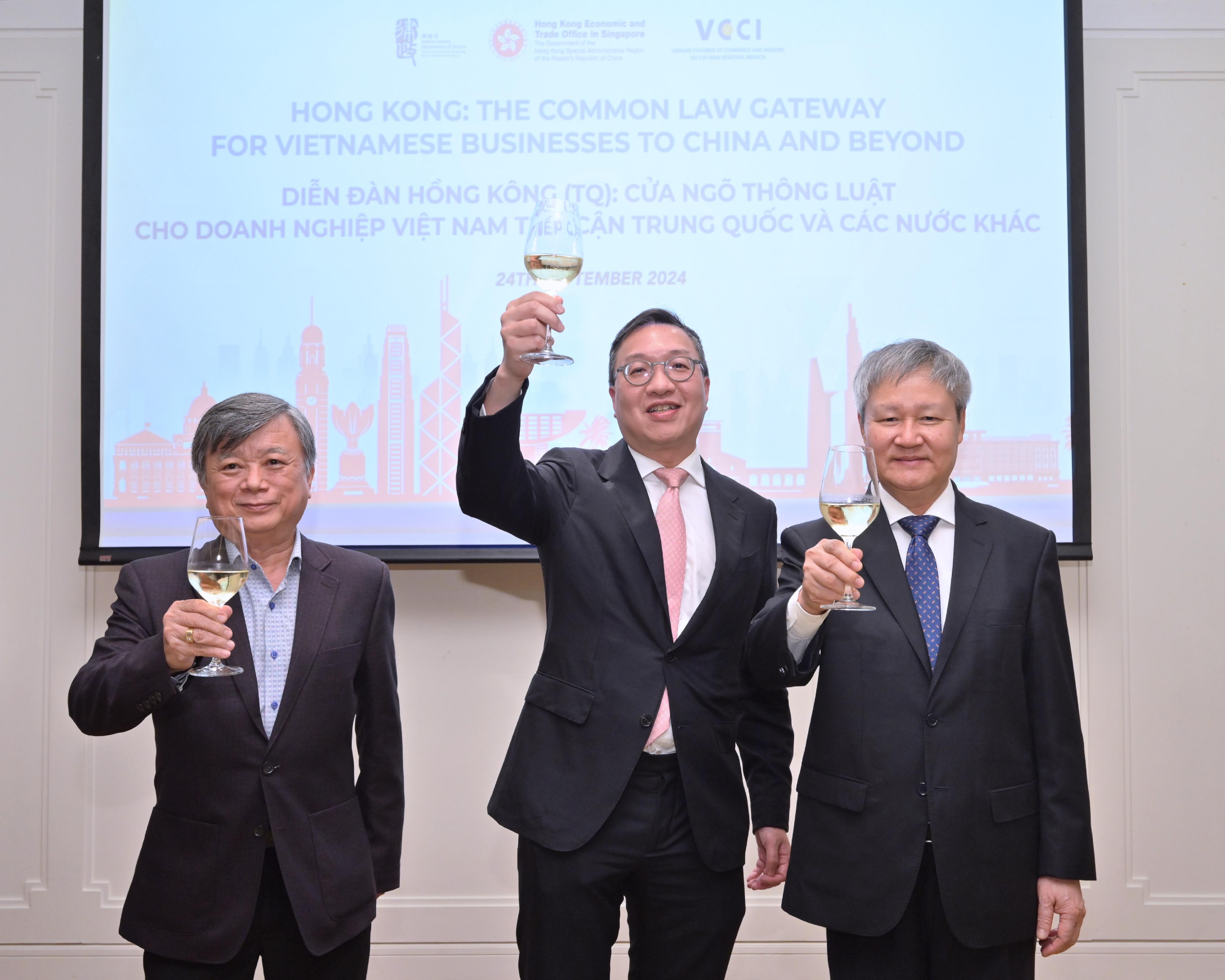
Following is the keynote speech by the Secretary for Justice, Mr Paul Lam, SC, at the networking dinner of the forum titled Hong Kong: The Common Law Gateway for Vietnamese Businesses to China and Beyond in Ho Chi Minh City, Vietnam, on September 24:
Ladies and gentlemen,
Good evening, xin chào buổi tối. Frankly speaking, I do not think I can do a better job than all the eminent speakers who have spoken before me. So I am not going to say something new. Instead, I wish to do a very quick recap to sum up the key and essential points made by various speakers so that you can have a few takeaways after today's event.
I prefer to do it by once again referring to the theme of our forum, "The Common Law Gateway for Vietnamese Businesses to China and Beyond", but I wish to focus on a few key phrases and do it in the reverse order. So I would like to focus on China and beyond first.
We are lawyers coming from Hong Kong. As I said in my opening remarks, obviously there have been very close relationships between Hong Kong and Vietnam. But the reason why we are here is not simply because of Hong Kong, it is about something much bigger than Hong Kong. That is our country, China, and beyond.
A number of speakers have referred to a very important concept known as the Guangdong-Hong Kong-Macao Greater Bay Area. And I wish to emphasise again the importance of the Greater Bay Area. You have been told that the Greater Bay Area consists of the Guangdong Province, in particular the nine cities in Guangdong Province, plus Hong Kong and Macao. To give you some ideas, the size of Greater Bay Area is almost like Croatia, a mid-size European country, with population around 86 million, similar to the population of Germany. If you look at what cities are situated within the Greater Bay Area, we have three very important cities: Guangzhou, of course, which is the capital of the province of Guangdong, a very important city in the southern part of China. And then you have Shenzhen, I think some of our speakers have mentioned Shenzhen, which is the innovation and high-tech hub, where you have the headquarters of Tencent, the factories of BYD and Huawei. All the advanced technology or high-tech innovative things are happening in Shenzhen, which is just across the border. And then of course you have Hong Kong, which is the international financial and trade centre.
Although there are different bay areas in the world, we have the Tokyo Bay area, the San Francisco Bay Area, but I venture to say that they cannot be compared to Hong Kong because in the Greater Bay Area, you have one country but three different jurisdictions, including Mainland China, Hong Kong, and also Macao which used to be ruled by the Portuguese. So it is a very special place with huge potential. Hong Kong may well be your final destination for your business and business venture. But it also may not be your final destination. Maybe you will find much more opportunities in the Greater Bay Area in China. And then in China, very often there would be investments and other business ventures with other countries. So it is really "China and beyond".
Now moving to "Gateway". I just mentioned that perhaps you will be more interested not just about opportunities for business investment in Hong Kong, but also those offered in Mainland China. And of course you would agree with me that legal service would be important. But you may wonder, if I wish to invest in Mainland China or co-operate with a Mainland partner, why shouldn't I simply instruct a Mainland lawyer? Why shouldn't I simply engage the legal service offered by Mainland China? And why should I do it via Hong Kong, which seems to be a little bit indirect or a bit convoluted. And of course, all the speakers who have spoken this afternoon have provided some very good answers. One of the key characteristics of this particular gateway, or using Hong Kong as a gateway, is our common law character, our common law tradition. But again, as pointed out by one of the participants who raised a question at the end of the first session, Hong Kong is definitely not the only common law jurisdiction in this world which can play the role as a gateway for the provision of legal service. I think my friend mentioned Singapore. Why not Singapore? Singapore is definitely a common law jurisdiction. Even in ASEAN, within the Southeast Asia, we have Malaysia which is also a common law jurisdiction. So it is our duty to explain to you a little further.
What is so special about Hong Kong? I hate to compare Hong Kong with Singapore, but because this question has been raised, I think I have to answer that question as if I were being asked to answer that question by a judge in the court. So I have to give a direct answer. But as a government official, I have to be as diplomatic as possible. The way I put it is that we can and we will offer something that only Hong Kong can offer. We can offer something that Singapore will not be able to do. It is because of six factors, as the sum total of these six factors that make Hong Kong truly unique and peculiar, unparalleled. So what are these six factors? Now, here comes my summary of what you have heard this afternoon.
First, Hong Kong provides a very stable legal environment. Stable in the sense that Hong Kong is the only common law jurisdiction within China. It is the only common law jurisdiction in China, and it will remain to be the only common law jurisdiction within China. The reason is that the common law system practiced in Hong Kong has been guaranteed by a constitutional document, which is our Basic Law. You can describe it as a mini-constitution. Now, there have been some queries in the past on certain wordings in our constitutional document. Some people questioned whether the principle of "one country, two systems" or the common law system practiced in Hong Kong will continue after 2047, which is the 50th anniversary of the resumption of sovereignty by China of Hong Kong. But that uncertainty has been removed very clearly by the leaders of China, in particular President Xi Jinping. Back in 2022, on July 1 when he came to Hong Kong, he made a very important speech, a very short speech. What is most telling is that in his very short speech, he mentioned the common law system in Hong Kong twice. He said that the common law system is a core element of the "one country, two systems" principle, which is a very good policy that is going to last basically forever. So there should be no doubt whatsoever that not only the principle of "one country, two systems", but also our common law system will continue. So the first point "stability" – it is very stable.
The second point is that our system is also very reliable. Now, that goes to the question of the existence of a very reputable and respected judiciary. When it comes to a judicial or legal system, two factors will be of crucial importance. First, quality, quality of justice, whether judges are smart enough to deliver true justice. Second, integrity, whether judges are seen to be able to discharge their duty fairly and impartially. Now, I think the Judiciary in Hong Kong fulfills these two very important essential criteria.
In terms of quality, as my friends said this afternoon, all the judges, they enjoy very high standing in the world. Our Court of Final Appeal, I should mention that the judgments delivered by the judges of the Court of Final Appeal, they were cited in other common jurisdictions from time to time. And we have foreign judges sitting as part-time judges in Hong Kong. I also remember that one of the speakers mentioned the World Justice Project Rule of Law Index, Hong Kong ranked the 23rd out of 142 jurisdictions in the world. And I think we ranked the sixth in East Asia and the Pacific region. Ahead of the United States, and if I recall correctly, Spain, another major economy in the world.
When it comes to integrity, once again my friends have informed you that how judges in Hong Kong are appointed. They are appointed completely independently by an independent statutory body. It is not possible for the executive to interfere with the performance of the judges. It is not possible for the executive to fire or sack any judges. And in fact, I have to tell you a very embarrassing piece of information which nobody dares mention, that is the Government lost cases before the court quite often. So I think that is a very good indication that judges in Hong Kong do exercise the judicial function very impartially.
But for your interest, I am sure you would be concerned whether Mainland parties, in particular state-owned enterprises, or very important, powerful business entities in Mainland China, would they enjoy any undue advantage when they engage in litigation against foreign parties in Hong Kong? Once again I am very sure that if you look at records, if you look at judgments, we have open judgments, you will see many cases which are decided entirely on merits. Sometimes state-owned enterprises or Mainland parties win, sometimes they lose. But there is not a single piece of evidence suggesting that in deciding these cases, the court in Hong Kong has taken into account any consideration other than the law and the evidence. And the best evidence is contained in our judgments, which you can inspect and you can read for yourself. So this is the second factor: very reliable.
Third factor: very business friendly. You have to remember that we have a bilingual legal system. So both English and Chinese are official languages. It is not just a working language, it is the official language by which we write our statute. We also use English in court proceedings, and very often in arbitration proceedings. This is an international language that is familiar to people outside Hong Kong, just like I am using English to communicate with you, hoping that you would be able to understand what I am trying to say.
The second point as to why business friendly is about the content of the law, the content of our substantive law, in particular when it comes to international commercial law, investment law. They are all very international in the sense that its content is substantially similar to the law that you find in other developed countries, for example, the United Kingdom, Australia, and New Zealand. So the principles of substantive law would be very familiar to the international business community, so it is business friendly.
The third point is that the Hong Kong Government has been very proactive to make Hong Kong a more attractive place for investment and doing business. I can give you some examples. For example, we are very active in promoting the establishment of family office in Hong Kong to encourage people to invest money to set up family office, in particular, for very resourceful families. In order to make this initiative attractive, we have amended our revenue law, our tax law, to lower our tax rate if you wish to set up family offices in Hong Kong. Another example is that our listing rules, IPO initial public offerings, if you wish to raise finance by getting your company publicly listed, the Hong Kong Stock Exchange has introduced a new scheme, it's called SPAC (Special Purpose Acquisition Companies). The idea is very simple. It enables a company without any track record but so long as it fulfills some sorts of requirement to ensure that the investors' interest will be protected, it will get the chance to be listed in Hong Kong. So I mean we are very proactive in making it more convenient. One of the speakers have mentioned about the difficulty of entering into Hong Kong because of the visa requirement. But as I said in my welcoming remarks, we are relaxing the restrictions or the requirement gradually. So starting from October last year, for the talents, they will be able to come to Hong Kong very easily. And for business travellers and for tourists, you will be able to obtain multiple visas very conveniently. And lastly, when it comes to arbitration, we have actually introduced a pilot scheme. At the moment, the arrangement is that if you are engaged and involved in the arbitration, no matter in what capacity, say, as arbitrator, as counsel, appearing for either party as a witness or even a party, you will be exempted from the need to obtain any visa if you come to Hong Kong for such purposes. So I would say that the difficulty is more apparent than real. So that is the third factor, business friendly.
The fourth factor: it is very safe and secure to use Hong Kong as a platform for doing business and investment. You must be concerned whether your money, your property can go into Hong Kong and leave Hong Kong easily and freely, and what happens when your property and money is in Hong Kong. Under our constitutional document Basic Law, we guarantee freedom of movement of funds, money and goods. So you can come anytime and your money can leave anytime. There is no exchange control, there is no improper expropriation, and when your money and your property is in Hong Kong, it is completely safeguarded by a stringent set of regulations, not just by statutes, but by other important statutory bodies like the Hong Kong Monetary Authority, the Securities and Futures Commission. There are very strict regulations to ensure that your investment and your property will be protected. And of course, the quality and integrity of the law enforcement agencies will be important. One strength of Hong Kong is that there is no question, no issue or any concern about corruption at all. Hong Kong is the cleanest place, one of the cleanest places in the world that you can find. If you look at the figures, I think Hong Kong ranks among the top five when it comes to the absence of corruption.
I wish to share a piece of information just to substantiate my confidence in the integrity of the financial market. A piece of latest news is that a British think tank just announced the Global Financial Centres Index. And Hong Kong had climbed back to the third place after New York and London. And this time we are ahead of Singapore. In 2022 up to last year, Hong Kong ranked the fourth for different reasons, but this year we managed to overtake Singapore to reclaim the third place, which I think is a very pertinent place. It served as a very good evidence of the competence of the people in Hong Kong's financial market. So this is the fourth factor.
The fifth factor is that Hong Kong provides dual connectivity. It allows you to connect to the world on the one hand, and also connect to the Mainland at the same time. My friend already said that Hong Kong has important legal connections with the rest of the world, for example, arbitral awards can be enforced and recognised because of the New York Convention. We have entered into a lot of arrangements with other international organisations. Important legal bodies would have their headquarters and offices in Hong Kong. Now this is where Singapore cannot be compared to Hong Kong – we have very special mutual legal assistance arrangements with Mainland China, which is made possible purely because Hong Kong is a part of China, though we practice different legal systems.
I simply wish to refresh your memory by highlighting one example, which is the arrangement concerning the possibility of granting interim injunction in arbitral proceedings. As business people, it is no use at all to you to spend a lot of money on arbitration if at the end of the day, what you get is a piece of paper. What is the most important is that you will be able to enjoy the fruit in case you succeed in arbitration. That means pending the conclusion of the arbitration proceedings, you need to have sufficient safeguard to ensure that the asset at stake will be protected. In addition, sometimes it would require the preservation of evidence to ensure that the merit of case can be fully reflected in the course of the proceedings. The special arrangement is that if you start arbitral proceedings in Hong Kong by using one of the designated arbitration institutions, then the Mainland court will be very willing to provide you with the assistance by giving you the interim injunction, which is very useful. I don't remember the figure, but the success rate is over 90 per cent. So this is the connectivity factor.
The last factor which is most important, and is evident by the quality of the speakers who have spoken before me, that is Hong Kong has an abundant supply of truly international legal talent. If you are using our legal service, if you instruct a Hong Kong lawyer, you are not simply enjoying Hong Kong legal service. You are engaging a global counsel. You are engaging and instructing a truly international lawyer. And again, I wish to repeat or perhaps add some figures to substantiate my point. You were told that we have a divided legal profession consisting of barristers and solicitors. I give you the numbers again. I would stand to be corrected. At the moment, I think there are around 1 600 barristers in Hong Kong, and among them 108 are Senior Counsel. We have three Senior Counsel here with us today. So in a small group of 15 persons, we already have three Senior Counsel – Queenie Lau, SC, Derek Chan, SC, and myself. And when it comes to solicitors, the figures are even more impressive. I think we have more than 13 000 solicitors in Hong Kong. And the important thing is that, look at the number of law firms, we have more than 920 law firms. Among these 900 law firms, around 351 have foreign offices. So they are not local law firms, they have presence in other jurisdictions. And I think 80 something have offices in Mainland China. And when we come to registered foreign law firms, there are 77. As for registered foreign lawyers who specialised or qualified in different jurisdictions, I think the number exceeds 1 400. You can tell from the composition, not just the quantity or the number, but the composition, a lot of them are associated one way or the other with law firms in other jurisdictions. Either they have their own presence in other jurisdictions, or they are closely related with some other very close law firms in other jurisdictions. So my point is, when you get the service of a Hong Kong lawyer, you are getting world service. You don't need to go anywhere. So this is the last factor, which I believe is the most important factor.
And the other thing is that, as mentioned by some of our friends, when it comes to legal service, it is not just the legal knowledge that matters. At the end of the day, legal service is about resolving people's problem. You have to understand culture. You have to understand the people. When you are doing business involving a Mainland element, because one of the speakers asked what the criteria of picking arbitrator or mediator are if Mainland element is involved, I think the answer should go beyond the choice of arbitrator and mediator. It goes to the choice of lawyer in general. I think you need to find someone who is not simply good at law but understands human nature and business culture. A good lawyer is somebody who is able to communicate with you, who can explain very technical matters in a way that you can understand, who can understand the whole business environment, who can understand why in a different jurisdiction, why in a different culture, things are done in a certain way, documents are drafted in a particular manner, why certain words are used, what's the magic, what's the hidden message. It is important for lawyers to be able to decipher all these subtle points. In Hong Kong, most of us are not just bilingual because we are Chinese, we understand the Chinese culture, we understand how things are done and said, but at the same time, we are trained by the common law tradition. So we are going to be a perfect interpreter, helping you to understand each other, to ensure that nothing will be lost in translation. I think that is a very important point when it comes to the choice of legal service.
So to sum up, six factors: it's stable, it's reliable, it's business friendly, it's secure, it provides dual connectivity, it provides abundant supply of truly international legal talent.
Maybe Singapore enjoys one or two or even five of the factors before, but I'm quite sure that if you do a checklist, Singapore will not be able to have all the ticks in all the six boxes. So it is really the sum total of these six factors which makes Hong Kong so unique.
The last thing that I would like to say is that I would like you to visualise, to have a sort of mental picture as to what I am saying. I would like to draw an analogy. The legal service of Hong Kong provides is just like a multi-storey building. In one single building, you have a food hall consisting different types of restaurants. We have Michelin three star restaurants, we have restaurants serving Vietnamese food, and we have restaurants serving Chinese food. The point is whatever you need, they will be available, in terms of price or whatever. And the food will be extremely hygienic and the quality will be very high. I think that's the concept, that's the main picture that I would like you to have after today's event. Thank you.