Xi honors military officers, unit ahead of Army Day

Chinese President Xi Jinping, also chairman of the Central Military Commission (CMC), on Friday awarded the Order of Bayi to 10 military officers and conferred a flag to a military company ahead of the Army Day, which falls on Aug. 1.

Approved by the CMC, the Order of Bayi is awarded to those who have made outstanding contributions to safeguarding national sovereignty, security and development interests, and advancing the modernization of national defense and the armed forces.

The officers receiving the honor included Chinese astronaut Jing Haipeng, commander of the Shenzhou-11 spacecraft. Jing was praised as a heroic astronaut dedicated to serving the country while taking to space to pursue his dreams.

Wang Gang, head of a detachment of the armed police in Xinjiang Uygur Autonomous Region, was also awarded the Order of Bayi. He was honored as a hero in anti-terrorist work, willing to endure “fire and water” and charge forward with great courage.

Xi, also general secretary of the Communist Party of China Central Committee, helped the 10 military officers wear their medals, and presented them with certificates of honor.

The president decorated an armored infantry company of the People’s Liberation Army (PLA), conferring a flag which reads: “Model company in learning and practicing the Party’s innovation theory.”

In another statement released Friday, Xi signed an order to give the company an honorary title.

It was the first time for the CMC to grant the Order of Bayi, the country’s highest military award, several days before the 90th founding anniversary of the Chinese armed forces.

It fully embodied the CMC’s respect and praise for the decorated officers, and will boost the morale of the military, and motivate soldiers to contribute to realizing the dreams of stronger country and stronger army, said a military statement released after the honoring ceremony.

Fan Changlong, CMC vice chairman, read an order signed by Xi to honor the officers and the unit. The awarding ceremony was presided over by Xu Qiliang, also vice chairman of the CMC.

In a separate statement, Xi signed orders to award merit citations to two military units and ten individuals for outstanding services.


Chinese woman has plastic surgery to avoid debts

A Chinese woman had plastic surgery in an attempt to disguise herself to avoid paying massive debts.

Zhu Najuan, 59, underwent plastic surgery and disappeared after a court in Wuhan, capital of central China’s Hubei Province, asked her to pay off huge debts of over 25 million yuan (3.71 million U.S. dollar) earlier this year.

In July, Zhu was reported to be in the southern Chinese city of Shenzhen, where police officers from the Intermediate People’s Court of Wuhan detained her and were astonished by her brand new face.

“We were very surprised at the scene,” a policeman said. “She looked in her thirties and was different from the photos we had.”

Zhu was detained and confessed that she had used people’s ID cards to buy high-speed train tickets and borrowed bank cards to support her face-changing “career.”

Recently, Wuhan judicial authorities launched a series of crackdowns on debt avoidance. The city’s courts detained 186 people for debt avoidance in the first half of the year.

China is building a “credit society.” On July 16, more than 300 Chinese cities jointly released a declaration about enhancing the credit system to improve people’s credit rating.


Beijing drafts fireworks ban

Chinese Lunar New Year is likely to be less noisy in Beijing in the future, as local authorities are considering a ban on fireworks, a traditional part of the celebrations.

The city’s legislative affairs office published a draft amendment Friday that prohibits fireworks within the fifth ring road. The draft will be open for public comment from Friday until Aug. 26.

Setting off firecrackers is a long-standing custom to celebrate the lunar new year, as Chinese believe the noise will drive away bad spirits and bring good luck. However, the tradition has caused fiery arguments in recent years, amid mounting air pollution complaints and safety concerns.

Although fireworks are allowed within the city during the lunar new year, or Spring Festival, the number of fireworks sold has declined year by year since the current regulations took effect in 2005, according to Zhang Changyu with the legislative affairs office.

In Beijing, the sales of fireworks and firecrackers during this year’s Spring Festival dropped by around 30 percent year-on-year, and by nearly 74 percent compared with that 12 years ago, Zhang said.

Nevertheless, they have continued to take their toll on air quality. During the past five years in Beijing, from the lunar new year’s eve to the fifth day of the holiday period, two to four days saw heavy air pollution, according to Sun Feng with the Beijing Municipal Environmental Monitoring Center.

From January to June, days with good air quality accounted for 55.3 percent, down 5.8 percentage points year-on-year, and the average density of hazardous fine particle matter PM2.5 was up 3.1 percent from the level in the first half of 2016.

In addition, fireworks and firecrackers caused more than 2,100 fires, killing five people and injuring eight others during the Spring Festival holiday periods from 2005 to 2017, inflicting direct losses worth 150 million yuan (US$22 million), Zhang said.

“In recent years, we’ve heard a stronger voice demanding stricter control of fireworks, and found that people care more about the environment and urban development,” Zhang said, adding that the amendment aims to better “adapt to the capital’s development” and “safeguard citizens’ lives and property.”

The proposed fireworks ban has split online opinion. Many support the idea, with some even suggesting a national ban, while opponents criticized it for killing off cultural traditions and questioned its effect on addressing the obstinate winter haze in Beijing.

Nationwide, 444 cities, including 10 provincial capitals, have banned fireworks.


China issues orange alert for ocean waves

China’s State Oceanic Administration (SOA) Friday issued this year’s first orange alert for ocean waves as Typhoon Nesat approaches.

The typhoon is expected to near coastal southern Taiwan Saturday and move to the central and southern parts of Fujian Province Sunday afternoon, according to the SOA.

Waves of four to 10 meters are expected in the southern East China Sea, northeast South China Sea, Taiwan Strait and Bashi Channel.

A blue alert, the lowest level in a four-tier warning system, was also issued by the SOA, for storm in waters off the coasts of Zhejiang and Fujian provinces.

The SOA warned vessels in affected waters to return to port, personnel to evacuate the site and related departments to close entertainment facilities on beaches.

China has a four-tier color-coded system for severe weather, with red being the most serious, followed by orange, yellow and blue.


Action plan for 2017 BRICS Youth Forum announced

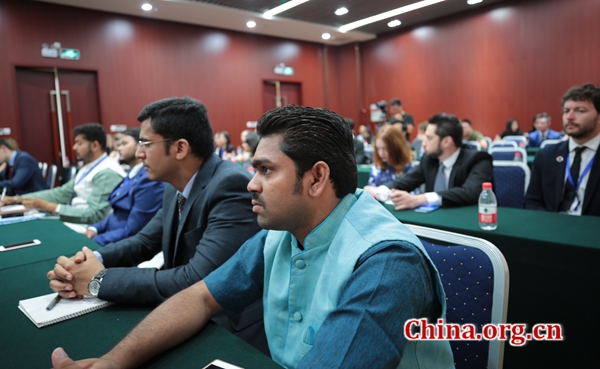
Young delegates from BRICS countries attend the concluding meeting of the 2017 BRICS Youth Forum to witness the announcement of The Action Plan for 2017 BRICS Youth Forum. [Photo by Li Huiru/China.org.cn]

The 2017 BRICS Youth Forum concluded in Beijing on July 27.

After three days of in-depth discussion and deliberation, young delegates from the BRICS countries (Brazil, Russia, India, China and South Africa) reached a consensus and The Action Plan for the 2017 BRICS Youth Forum (The Action Plan) was announced at the last plenary session before the closing ceremony.

The Action Plan, which takes aspects such as youth policy, youth innovation and entrepreneurship, and youth participation in global governance as the main fields for BRICS youth cooperation, has proposed concrete measures to establish a center for BRICS youth research, a platform for information exchanges, a network dedicated to boost BRICS youth innovation and entrepreneurship, and a BRICS volunteer database for international communication.

“The forum strengthened the bond of youth in BRICS,” said Chinese representative Kong Dewei, adding that, “much useful and practical advice has been proposed for youth policy, entrepreneurship and innovation, as well as global management. Delegates from different countries have also formed solid friendships during the forum.” Kong is a student from Nankai University.

Aleksandr Bolotnov, vice chairperson of National Youth Council of Russia emphasized the importance of such communication mechanisms among BRICS youth. In an interview with China.org.cn, he said, “The BRICS youth forum is a big contribution for the BRICS cooperation.” He added that the forum will help consolidate the relationships of BRICS countries.

“We have learnt a lot together during these three days,” Thamsanqa Zulu, manager of Mothosi Holdings in Brazil said. “I hope the vigor from the youth forum will be extended to other fields. Our South African delegation will bring back the documented agreements and make sure it will be carried out in a due manner.”

The Action Plan, as an achievement of BRICS youth cooperation, will be submitted to the preparatory committee of the Ninth BRICS Summit to be held in China’s Xiamen this September.

The 2017 BRICS Youth Forum hosted by the All-China Youth Federation was attended by a total of 50 young delegates from the BRICS countries.