China on its way to promote ecological civilization

“Clean water and lush mountains are priceless assets.” This philosophy for green development proposed by Chinese President Xi Jinping is changing the country.

A growing number of migrating birds stop over on the Chaobai River in spring in recent years in the eastern city of Rizhao in Shandong province. [Photo:dzwww.com]

 A growing number of migrating birds stop over on the Chaobai River in spring in recent years in the eastern city of Rizhao in Shandong province. [Photo:dzwww.com]

For the past 5 years, the world’s second largest economy has been trying to repair its environment, once contaminated due to unsustainable development.

The Chaobai River is one of the drinkable water sources of the eastern city of Rizhao in Shandong province. With its fresh air and forests nearby, a wetland park has been built alongside the river.

But several years ago it was a very different scene, with the river filled with rubbish and weeds.

The change came about, thanks to a river cleaning program conducted within the city last year, part of a government plan to carry out systematic ecological control of 61 major rivers over a period of 5 years.

One important step has been the establishment of a system of “river chiefs,” which requires officials at every level of government to take full responsibility for the protection of water resources in regions under their jurisdiction.

Wu Defeng is an official of Rizhao municipal government.

“The river system has been introduced since last year. Officials at the town level were appointed as river chiefs and those at the lower level take responsibility for the protection of different parts of the river. A concerted effort has been made in this way. The system is a good way to get all villagers involved in river protection.”

In December 2016, the central government released a document ordering the system to be established nationwide by the end of 2018.

The river chief system is just one of several major innovations in promoting green development proposed by the government since the 18th CPC National Congress in 2012.

During his visit to the city of Nanning in Guangxi province in April, President Xi Jinping reiterated the importance of developing ecological civilization for the country’s overall development.

“Promoting eco-civilization is an important part of China’s overall plan to develop its economy, politics, culture, social progress and ecology. It is also the internal need of China’s modernization construction. The people’s well-being also relies on a beautiful environment. The concept of green development should be embedded in every step of social construction.”

After decades of rapid expansion that has brought smog and contaminated soil, China is swiftly and steadily shifting from GDP obsession to a philosophy of balanced growth.

Environment Minister, Li Ganjie, has vowed to spare no effort in tackling pollution.

“The battle can be divided into three aspects: the fight against air pollution, water pollution and soil pollution. We should strictly prevent and control pollution as well as punish those accountable for it. A strong effort should be made to improve the quality of air, water and soil.”

Last year, over 6,000 officials were held accountable for negligence or malpractice in promoting ecological progress.

China’s efforts to promote green development have earned global recognition. The United Nations Environment Programme (UNEP) decided to promote China’s philosophy of ecological progress in February 2013 and released a report on China’s strategies and practices two years later.

From new energy vehicles to bike-sharing, low-carbon lifestyles have also become popular among Chinese people.

China seems well on its way to achieving a balance between man and nature.


For a fee, students can fake their internships

As junior students in Chinese colleges take on summer internships, some unscrupulous businesses can’t wait to make deals – like selling them fake internship certificates online.

For many students, internships are part of their course work and are directly connected with school credits. In 2015, the Ministry of Education issued a notice requiring that internships should account for at least 30 percent of all credit hours. Schools typically ask students to take up internships for a few months to prepare for future careers.

But if the students don’t go along, there is an easy way out. For just 200 yuan ($30) or less, you can get whatever internship certificate you like online. The business is obviously illegal, but it exists nevertheless.

On e-commerce website Taobao, one can find many items by searching “internship certificate”. Most are labeled “internship reports” and “designing internship certificates for college students”. Some even tout “tailor-made” internship certificates “providing all necessary stamps of any company of your choice”.

Xinhua reporters spoke to “Yibaifen”, an agent whose details were on Taobao, and tried to buy an internship certificate. The agent later said via WeChat that a certificate would cost about 50 yuan.

“You can choose any type of company in any city,” the agent said. The agent then sent the stamp of a well-known Beijing-based IT company and claimed it was real because he “has connections”.

“I can give you a discount if you buy two,” the agent said.

On Taobao, one agent has sold more than 100 fake certificates in the past month, according to a Tianjin newspaper.

To make the fake certificates appear authentic, some agents even promise to take follow-up calls from schools.

On Tencent’s instant messaging service QQ, an agent said that he is “on call 24/7”.

“I put my own phone number on the certificates, so if your teachers call about your internship, I can handle them,” the agent said.

Another agent claimed to have an authentic stamp of a Beijing advertising company. He declined to say whether or not he is an employee of the company, but he did say he “cooperates” with the company, and pays some “commission” to it for each stamp he puts on certificates.

But the general manager of the company denied any knowledge of the scam, saying the company has strict procedures about using its stamp, and that the agent’s stamp must be fake.

Under China’s Criminal Law, fabricating the stamps of government organs and companies could be a crime. Despite potential punishment, however, the business thrives, partly because of demand from college students.

Xiao Mo, an undergraduate at a college in Xuzhou, Jiangsu province, bought a fake internship certificate online. She said her college has “strict demands” with respect to its internship requirement, but she does not have time because she needs to prepare for graduate school.

“I really don’t have time for an internship,” she said. “Besides, my teachers probably won’t check the authenticity of the certificate, so it should be no problem.”

But a student surnamed Zhang from a Beijing college disagrees. Zhang, who has been working as an intern at a company the entire summer, said buying fake certificates is unacceptable.

“Internships are more about strengthening your ability than obtaining a piece of paper,” he said. “Buying fake certificates is unfair to the students who work hard.”

The phenomenon has fired up an angry discussion online.

“Internships are meant to prepare students for their future jobs, but buying fake certificates only damages their credibility,” read one comment.

“It is necessary to get tougher on the businesses, and colleges need to reevaluate their assessment methods for students,” said another.

Li Jiaxing, deputy head of the University of International Relations, said buying fake internship certificates is immoral.

“Colleges need to be credible,” Li said. “Anyone caught purchasing fake certificates should be regarded as cheating and be punished accordingly.”

Qu Wenyong of Heilongjiang University said providing fake internship certificates could be a violation of the law, and that the government should deal with the agents.

“E-commerce websites are also to blame for providing platforms for illegal businesses,” he said.


Lung cancer rising, but not from smoking

Chinese health authorities are trying to figure out the reason for the rapid rise in a form of lung cancer that develops deep in the lung and is not associated with smoking.

China has seen a sharp increase in the disease over the past 10 to 15 years, hitting groups traditionally not susceptible such as women and nonsmokers, said Xue Qi, deputy director of thoracic surgery at the Cancer Hospital Chinese Academy of Medical Sciences, also the country’s National Cancer Institute.

“It might be related to the long-term exposure to air pollution, particularly PM2.5,” he said, referring to particulate matter with a diameter of 2.5 microns or less.

China’s top health authority has been watching people’s health in relation to air pollution since 2013, said Mao Qun’an, spokesman for the National Health and Family Planning Commission.

“We need more research over a longer time to figure out the long-term health effects of air pollution,” he said. “Cancer is developed over a long period, not overnight.”

Latest cancer statistics from the government showed China recorded nearly 4.3 million new cancer patients in 2015, and more than 730,000 of them had lung cancer, accounting for nearly 36 percent of the world’s total.

There are two major types of lung cancer – lung adenocarcinoma and squamous cell carcinoma, experts said. The latter is closely associated with smoking.

Of newly detected lung cancer patients each year, the cases of adenocarcinoma – involving more females and nonsmokers have exceeded that of smoking-related carcinoma, even though the smoking rate in China has not declined, Xue said, citing figures from the nation’s cancer registry.

Ten to 15 years ago, squamous cell carcinoma took the lion’s share of all lung cancer cases, roughly 60 percent, he said. “At that time, most of the sufferers were smoking males, who are at high risk.”

The incidence of lung cancer has surged in recent decades.

For instance, in the 1960s the incidence of lung cancer in Guangzhou, Guangdong province, stood at 7 per 100,000 people. That surged to 70 per 100,000 in 2005, according to local health data.

Some lung disease experts suspect the rise might be related to PM2.5, but more research is needed to know for sure.

Xue said more government research funding and projects in the field are needed.

Internationally, small-scale studies have associated air pollution exposure with lung cancer, but a direct link has not yet been confirmed with large, long-term studies, he added.

Industrialized countries saw a rise in the proportion of adenocarcinoma before China, according to Xue, who said lung adenocarcinoma is now the most common type of lung cancer.

Squamous cell carcinoma has decreased over recent decades in Western countries due to an ever decreasing smoking population, he added.


China allocates 180 mln yuan for post-quake relief

The central government has allocated 180 million yuan (27.1 million U.S. dollars) for relief work after two major earthquakes hit northwest and southwest China.

Tourists gather their belongings at a hotel parking lot as they prepare to leave the mountainous earthquake zone on Wednesday, August 9, 2017. [File Photo: Xinhua]

Tourists gather their belongings at a hotel parking lot as they prepare to leave the mountainous earthquake zone on Wednesday, August 9, 2017. [File Photo: Xinhua]

A total of 80 million yuan has been given to Xinjiang Uygur Autonomous Region and Xinjiang Production and Construction Corps to support relocation of disaster-hit people and renovation of their houses, according to the Ministry of Finance.

Another 100 million yuan has been allocated to Sichuan Province for similar purposes.

A 7.0-magnitude earthquake struck Jiuzhaigou, a UNESCO nature reserve and popular tourist destination in Sichuan Province, at 9:19 p.m. Tuesday, leaving 20 people dead and over 400 injured so far.

Thirty-two people were injured and more than 1,000 houses damaged in a 6.6-magnitude earthquake that struck Jinghe County in Bortala Mongolian Autonomous Prefecture in Xinjiang on Wednesday morning.


36 dead, 13 injured in NW China road accident

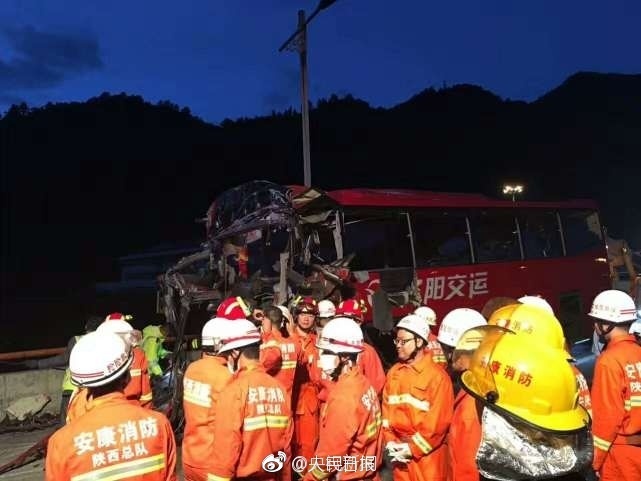
At least 36 people were killed and 13 others injured in an expressway accident in northwest China’s Shaanxi Province Thursday night, local authorities said Friday morning.

At least 36 people were killed and 13 others injured in an expressway accident in northwest China's Shaanxi Province Thursday night, local authorities said Friday morning.

At least 36 people were killed and 13 others injured in an expressway accident in northwest China’s Shaanxi Province Thursday night, local authorities said Friday morning.

The accident occurred at around 11:34 p.m. when a coach hit the wall of the Qinling tunnel of the Xi’an-Hanzhong Expressway, according to the public security department of Shaanxi.

The coach was en route to Luoyang City, central China’s Henan Province, from Chengdu City, capital of southwest China’s Sichuan Province.

The injured have been rushed to the hospital.

Rescue work is underway.