China launches first Internet court in e-commerce hub
|
|
|
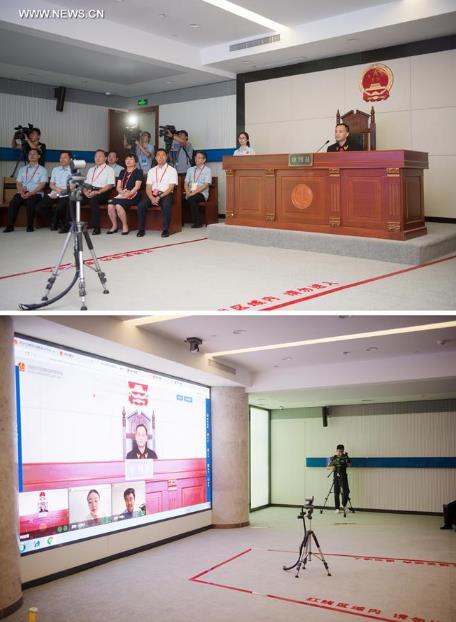
Combo photo shows the working process in a court room of the Internet court in Hangzhou, capital of east China’s Zhejiang Province, Aug. 18, 2017. The court, first of its kind in China, specializing in handling Internet-related cases, opened Friday to cater to the increasing number of online trade disputes and copyright lawsuits. The cases handled by the court will be tried online. [Photo/Xinhua] |
China’s first court specializing in handling Internet-related cases opened Friday in the e-commerce hub of Hangzhou, capital of Zhejiang Province, to cater to the increasing number of online disputes.
The Hangzhou Internet Court heard its first case regarding a copyright infringement between an online writer and internet giant Netease on its opening day.
Sitting in front of their computers in Hangzhou and Beijing, the agents representing the plaintiff and the defendant communicated with the judge online. The trial lasted about 20 minutes.
“The Internet court breaks geographic boundaries and greatly saves time in traditional hearings,” said Wang Jiangqiao, vice president of the court.
The court mainly handles civil cases such as contract disputes involving online shopping, service and small loans, copyright and infringement lawsuits, domain name dispute, Internet defaming and some administrative lawsuits.
It will also handle certain cases assigned by superior courts.
By registering on court’s website, plaintiffs can file lawsuits and pay legal costs. The cases handled by the court will be tried online. The process is quicker, and plaintiffs and defendants can have their disputes handled while at home and at much lower cost.
“The hearing of an Internet-related case often lasts at least two days and each side has to spend thousands of yuan to travel to the court,” said Zhang Sijia, a lawyer.
“We are involved in cases all over the country and the costs are too high to attend every lawsuit. Sometimes even if we win the case, we lose a huge amount of money in the process. It will significantly lower our costs if we can have them done online,” said Yang Wei, vice president of Netease.
The opening of the court is along with the fast growing internet users and the consequent online disputes in China.
According to the latest report from the China Internet Network Information Center, China had about 751 million Internet users and 724 million mobile Internet users as of the end of June.
As China pushes its Internet Plus and innovation strategies, the Internet is playing an increasingly important role in the country’s economic transformation. China is home to a number of Internet giants such as Alibaba, Baidu and Tencent.
The income of China’s top 100 Internet companies rose 46.8 percent year-on-year to 1.1 trillion yuan (about 164 billion U.S. dollars) in 2016, latest official data showed.
It was the first time the total has surpassed one trillion yuan, according to calculations by Ministry of Industry and Information Technology and the Internet Society of China.
But the country is also seeing a surge in cyber disputes as more people go online to shop, publish their works and manage finance.
In 2015, the Zhejiang provincial higher people’s court initiated a pilot online court program at three district courts in Hangzhou to handle online trade, copyright and financial services disputes.
So far, a total of 15 courts in Zhejiang have joined the program and dealt with nearly 23,000 cases.
“With more cases accepted, we found it hard to judge a case according to traditional lawsuit regulations,” said Li Shaoping, deputy head of Supreme People’s Court.
The Internet court was therefore outlined at the 36th meeting of the Central Leading Group for Deepening Overall Reform in June as the latest effort to deepen judical reform through lifting the efficiency of justice, improving the hearing procedures of Internet-related cases and promoting the sound development of the Internet industry.
The new court allows both sides to submit evidence in real time and is connected with big data to help judges make decisions.
“For example, the system can present the judge with similar cases as references in the course of the proceeding,” said Wang. “The judge can also check the transaction history at any time when dealing with cases involving online transaction disputes.”
“By setting up the Internet court, we hope to establish a professional platform to deal with Internet-related cases with new concepts and specially-designed regulations,” Li said.
Zhou Hanhua, law researcher with the Chinese Academy of Social Sciences, said the Internet court involved the use of information technology in judicial procedures and process transformation.
The reform should try to let everyone feel justice in each case, he added.