Smuggling suspect returned to China

One of China’s most-wanted fugitives, suspected of smuggling ordinary goods valued at 438 million yuan ($65.7 million), was captured and returned from Indonesia to face trial, according to the General Administration of Customs on Sunday.

Ji Wenhong is detained on suspicion of smuggling luxuries at Xiamen Gaoqi International Airport in Fujian province on Wednesday. Ji was returned to China after Interpol captured him in Indonesia. [Photo/Xinhua]

Ji Wenhong is detained on suspicion of smuggling luxuries at Xiamen Gaoqi International Airport in Fujian province on Wednesday. Ji was returned to China after Interpol captured him in Indonesia. [Photo/Xinhua]

Ji Wenhong, founder and former chief executive officer of online luxury retailer Shenzhen Zouxiu Network and Technology – branded as Xiu.com was arrested in the island province of Bali in early August and returned to China on Thursday after spending 15 months on the run in Indonesia.

An online statement on Sunday by Xiu confirmed that the third-party cross-border operation platform had been involved in smuggling, and that some individuals in the company were under investigation.

“We believe the judicial departments will make a fair judgment,” the statement said; meanwhile, “all the company’s business is normal”.

“We have always had legal operations. We feel that giving back to society is our responsibility, and we will adhere to that purpose in the future,” the statement said.

According to Gongbei customs in Guangdong, under Ji’s leadership Xiu transported luxury clothing purchased in Europe and the United States to Hong Kong.

The goods were then sent to an employee of a logistics company, identified only as Wu, who hired travelers to carry the merchandise through customs inspections. The smuggled goods were then transported to a Xiu company warehouse.

Xiu also offered false price information to an online retailer in Shenzhen and a logistics company in Guangdong, then smuggled the goods into China via express by declaring a low price and fabricating other information, customs officials said.

According to the authorities, imported goods were made to look like ordinary personal belongings, lowering the declared price below China’s 800 yuan threshold, to reduce fees.

The administration said goods worth as much as 321 million yuan were handled by Xiu.com. Ji was also involved in other smuggling, it said.

When the operation was exposed, Ji fled the country on May 17 last year, a few days after being charged with smuggling ordinary goods.

In October, Interpol issued a red notice for Ji, and Indonesian police captured him on Bali island on Aug 4. Chinese anti-smuggling police escorted him to Xiamen airport on Aug 16.

Interpol issued red notices for the 100 most-wanted Chinese officials in April 2015. So far, more than 40 have returned from more than 16 countries and regions – including the US, Canada, Australia and New Zealand – to stand trial.


Book highlights Xi’s seven years in Shaanxi village

A newly published book of the seven years that President Xi Jinping spent at a poor village four decades ago has gained popularity soon after its debut, with many analysts saying the book is encouraging and enlightening.

A customer reads Xi Jinping's Seven Years as an Educated Youth in Wangfujing Bookstore in Beijing on Sunday. [Photo by Zhu Xingxin/China Daily]

A customer reads Xi Jinping’s Seven Years as an Educated Youth in Wangfujing Bookstore in Beijing on Sunday. [Photo by Zhu Xingxin/China Daily]

The book, Xi Jinping’s Seven Years as an Educated Youth, was a collection of interviews with people who used to live and work with Xi when he was a zhiqing, or educated youth, in Liangjiahe village, Yanchuan county, Shaanxi province, from 1969 to 1975.

Zhiqing refers to urban youths sent to the countryside for “re-education” amid late chairman Mao Zedong’s campaign for urban youth to experience rural labor during the “cultural revolution” (1966-76). Xi was only 15 when he was sent to Liangjiahe in early 1969.

The book was brought out by the Publishing House of the Party School of the CPC Central Committee.

He Yiting, executive vice-president of the Party School of the CPC Central Committee, said Liangjiahe was Xi’s first stop to get into society, and his life in the village had a great influence on him.

After its debut last week, the book became so popular that the publishing house staff has been working around the clock to meet demand, he said at a seminar on Sunday to discuss the book.

The book is a vivid text for young people to set up a positive outlook on their lives, and it also tells Party officials of all levels about how to act in accordance with the Party’s discipline, he added.

In the book, 29 people were interviewed, including some other “educated youths” who worked with Xi in the village and Liangjiahe villagers who worked with Xi for years. They recalled how Xi strove to help farmers and remain optimistic about life in the difficult period.

For example, Zhang Weipang, a Liangjiahe farmer, said in the book that “no matter how bad the food was, Jinping would have a good appetite, and no matter how poor a person was, Jinping would never despise him”. In another story, a villager recalled how Xi helped him find a lost pig-the most valuable asset of the poor family.

During his time in the poverty-stricken village, Xi led villagers to accomplish various things, such as building the first methane-generating pit in north Shaanxi to improve the peoples’ livelihood. His down to earth spirit won the recognition of and compliments from the villagers.

“I found myself easily traveling several kilometers of mountain road while carrying a shoulder pole weighing more than 50 kilograms,” Xi said in a previous interview with China Central Television.

Tao Haisu, who used to work with Xi as a zhiqing at Liangjiahe, said at the seminar that “the sweat that Xi shed with the people” has deep and great influence on the president’s thoughts.

“If you understand Xi’s experience at Liangjiahe, you will understand the measures he had taken after the 18th National Congress of the Party, and you will know why he deeply hates the corrupt officials who bully the people,” he said.

Xuan Yong, Party secretary of Zhejiang International Studies University, said at the seminar that the book is enlightening for young people, and the university will arrange for students to read the book.

The university also will dispatch volunteers to Liangjiahe during next year’s summer holiday to elaborate on the stories of Xi for those who visit the village, he said, adding that the president’s spirit of keeping firm belief at difficult times should be learned by the nation’s youth.

Liu Dawei, assistant minister of education, said that by looking back at the history in the book, readers will be much more confident about the future of the country.


New Kuomintang chairman reaffirms 1992 Consensus

The new chairman of Taiwan-based Kuomintang acknowledged the one-China policy and firmly opposed “Taiwan independence” on his inauguration ceremony and the party’s 20th plenary congress on Sunday in Taichung.

“Upholding the foundation of the 1992 Consensus, we will firmly oppose ‘Taiwan independence’ and carry forward Chinese culture, promote mutual respect and tolerance and maintain dialogue through economy, culture and the peace forum,” Chairman Wu Den-yih said in his inauguration speech.

The Kuomintang will also work to improve understanding between the two sides, explore peaceful cross-Straits prospects, ensure peace and stability in the region and safeguard the well-being of the people of Taiwan, he said.

Wu was elected KMT chairman on May 20 with 52 percent of the vote.

The meeting on Sunday also approved a new party platform that pledged to oppose “Taiwan independence”.

The KMT will follow the “common aspirations and prospects of cross-Straits peace and development” issued in 2005 by leaders of the Communist Party of China and the KMT as well as the basic principles practiced during the administration of Taiwan’s former leader Ma Ying-jeou.

The party will also push forward all activities conducive to peaceful and stable development of cross-Straits ties, it said.

“Cross-Straits relations are challenging and complicated. Under the common political foundation of upholding the 1992 Consensus, which refers to the one-China policy and opposes ‘Taiwan independence’, we are willing to stay in communication and enhance dialogue with the KMT to maintain peaceful development of cross-Straits relations,” said An Fengshan, spokesman for the Taiwan Affairs Office of the State Council, China’s Cabinet.

“It is time to have confidence in cross-Straits relations,” said Liu Guoshen, a professor of Taiwan studies at Xiamen University.

He praised the Kuomintang’s acknowledgment of the 1992 Consensus, the one-China principle.

However, he said that the Kuomintang, as a non-ruling party, does not have much say in cross-Straits economic and commercial exchanges.

“Communication between the mainland and the island is insufficient. More communication channels are welcomed,” he said.

Since the Democratic Progressive Party took office in May 2016, it has refused to acknowledge the 1992 Consensus, and official channels of cross-Straits communication have been suspended.

Taiwan leader Tsai Ing-wen’s reluctance to acknowledge the 1992 Consensus “has damaged all the hard work toward peaceful relations across the Taiwan Straits”, Ma Xiaoguang, another spokesman for the Taiwan Affairs Office of the State Council, has previously said.

Over the past year, the number of mainland tourists visiting Taiwan has sharply declined.


Heavy rain to hit central China

Heavy rain will fall in parts of central China in the next 24 hours, the country’s meteorological agency said Sunday.

Southern parts of Anhui and Jiangsu, the eastern part of Hubei, and western part of the Sichuan Basin will have thunderstorms and gales, the National Meteorological Center said.

From Aug. 21-23, parts of the northwest and north China will see torrential rain, including northern Shaanxi, central and northern parts of Shanxi and central Hebei.

The meteorological agency warned the public to take appropriate precautions.


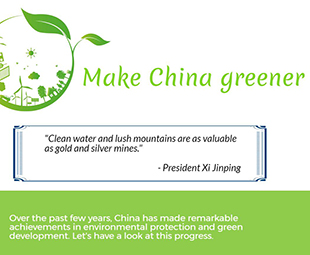
Make China greener

0 Comment(s)PrintE-mail China Daily, August 20, 2017
 
1   2   3   Next  

No comments.

  • User Name Required
  • Your Comment
  • Enter the words you see:   
    Racist, abusive and off-topic comments may be removed by the moderator.
Send your storiesGet more from China.org.cnMobileRSSNewsletter