People calls for harsher sexual harassment penalties

The Chinese public has called for harsher punishment for those found guilty of sexual harassment, according to a recent survey.

The China Youth Daily research showed that of 2,023 people surveyed, 71.5 percent wanted harsher punishment for people committing sexual harassment.

Over 53 percent of women said that they or someone they knew had been sexually harassed on the subway.

Beijing police launched recently a crackdown on sexual harassment on the subway and arrested more than 20 suspects over two weeks.

“Despite the current achievement, a single crackdown far from tackles the root cause of the problem. More laws and regulations are needed and law enforcement should be intensified,” said Zhang Lingxiao, a lawyer with Jingsh Law Firm.

Under Article 44 of the law on public security administration, a person who molests another person or intentionally exposes their body in public shall be detained for at least five but no more than ten days.

Article 237 of the criminal law states that those who act indecently or threaten woman with violence or coercion shall be sentenced to fixed-term imprisonment of up to five years.

Zhang said the current laws dealing with sexual harassment were not specific enough in terms of definition or punishment.

Interviewees were also concerned about the difficulty of judging if sexual harassment had actually been committed, with 68.7 percent worried that the common physical contact on the subway during peak hours could be used an excuse for sexual harassment.

A total of 63.2 percent of those surveyed pointed out that it was difficult for subway cameras to record harassment; 41.1 percent said the reluctance of victims to call the police or provide evidence posed difficulties in fighting sexual harassment; 29.6 percent said victims might be unsafe if they overreacted.

Zhang called for more subway supervision, quicker police response and punishment, as well as better education on sexual harassment.
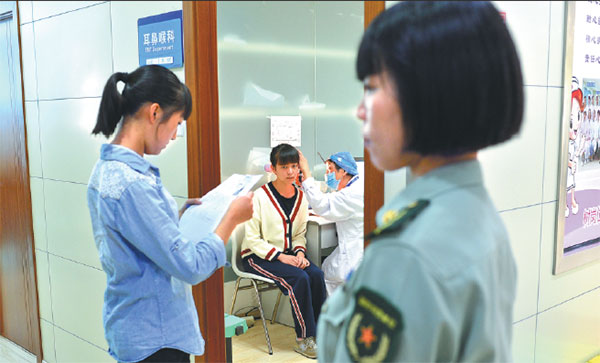


Military says quality of recruits is ‘guaranteed’

The Chinese military has dismissed speculation that unhealthy applicants are entering the armed forces, and has reassured the public about the quality of new recruits.

Teenagers have their ears checked during the extensive physical examination process for military recruits in Kunming, Yunnan province, on Monday. Candidates must pass every item on the checklist to be accepted. Gao Wei / For China Daily

Teenagers have their ears checked during the extensive physical examination process for military recruits in Kunming, Yunnan province, on Monday. Candidates must pass every item on the checklist to be accepted. Gao Wei / For China Daily

“Recruitment is the foundation of national defense, and high-quality recruits are crucial to the military’s combat capability,” the Defense Ministry’s recruitment office said in an online statement on Tuesday.

The military eliminates unfit applicants who fail rigorous physical examinations, it said, adding that recent public worries about the quality of recruits were the result of people mistakenly assuming that an increase in the number of rejected applicants meant there were more subpar recruits.

In 2014, the United States military turned down 80 percent of all applicants, but that led to the highest quality of military recruits in 40 years, as the Obama administration moved to downsize the US Army, according to the Pentagon.

“China’s recruitment process has strict rules and procedures,” the Defense Ministry office said. “The quality of our recruits is guaranteed, and the headwaters of our military will flow long and strong.”

On Saturday, the People’s Liberation Army Daily said on its WeChat account that around 56 percent of those who applied to join the army in an unnamed city this year failed to meet physical standards.

The post spurred heated online discussion about the quality of young recruits, as well as how unhealthy diets and the overuse of smartphones may have undermined their health and eyesight.

“A war zone does not need weak ‘pretty boys’. Only strong young men can shoulder the responsibility of protecting the nation,” said netizen Xu Xuewei in an online comment.

The PLA is undergoing a series of reforms to become a world-class fighting force. However, it is having a hard time finding recruits, as couples are having fewer children.

As a result, in 2014, the Chinese military relaxed its physical standards so that recruiters could attract more young people with higher education backgrounds.

The height requirement for males was lowered from 162 centimeters to 160 cm, and for female candidates from 160 cm to 158 cm.

It also reduced eyesight requirements. Nearly 70 percent of high school and university students in China are nearsighted, according to Peking University.

“While the physical criteria may have been lowered slightly, the educational requirement has been increased significantly,” said Major General Zhu Chenghu, a professor at PLA National Defense University.

“The general quality of young recruits has actually improved over the years, with many college students holding degrees in engineering and international relations,” he said. “A strong body is still very important for a soldier, but education is now more valuable than ever in building a strong, modern military.”


New steps to tackle air pollution set for Beijing region

China will launch a regional campaign to help the Beijing-Tianjin-Hebei region and neighboring provinces control air pollution this autumn and winter, with more effort placed on regulating government officials and companies that pollute.

The Ministry of Environmental Protection has drawn up a series of plans for the regional campaign, which will start soon, Liu Youbin, a senior official from the ministry’s publicity department, said on Tuesday.

In addition to the general action plan for the campaign, officials will keep track of every issue reported and how it was resolved, Liu said.

Another six supportive documents were prepared with detailed stipulations on the key regions and industries, as well as to ensure the timely disclosure of problems to the public.

Those documents also list punishments that irresponsible government officials can expect during the campaign, he said, responding to reports that some disclosed pollution issues were not resolved.

“In the coming campaign, the ministry and involved governments will take efforts to keep the polluting companies from resuming production or will relocate them to other areas-and then fully implement the control measures,” he said.

The Beijing-Tianjin-Hebei region, prone to suffer through severe smog in the autumn and winter months, faces a large risk of air pollution returning in the coming months, the ministry said on Sunday.

This past January and February, the concentration of PM2.5-hazardous fine particulate matter with diameter less than 2.5 microns-soared due to the severe air pollution in the region. This was caused by a confluence of several factors, including windless weather, active production, coal consumption for heating and vehicle exhaust, Liu said.

The ministry’s data showed that in the first seven months, the region’s PM2.5 average concentration increased by 11.3 percent year-on-year.

The average PM2.5 concentration in the region should by the end of this year be cut by 25 percent from the 2012 level.

Beijing needs to lower its PM2.5 level to 60 micrograms per cubic meter, as the central government required in 2013. The capital saw the average PM2.5 level fall to 52 in July, but in January it was as high as 116, a year-on-year increase of 70.6 percent.

To tackle the air pollution, the ministry has conducted a yearlong inspection of 28 major cities in the Beijing-Tianjin-Hebei region and the neighboring provinces of Shandong, Shanxi and Henan, which began in April.

The latest data from the ministry showed that through Aug 20, inspectors have checked 40,925 companies, of which 55 percent, or 22,620, were found with various pollution problems, such as discharging pollutants excessively or not installing emission-reduction equipment.

“Besides, these cities have found over 170,000 small and polluting companies, which should be shut down or improve their pollution reduction facilities,” said Bie Tao, head of the policy and laws department of the ministry, on Tuesday.


China implements coordinated control of PM2.5 and O3

China will implement a plan to control the country’s major air pollutants, PM2.5 and ozone (O3), the Ministry of Environmental Protection (MEP) said Tuesday.

While reducing the level of hazardous fine particle matter PM2.5 is still the top priority, the country will take measures to simultaneously curb O3 pollution, Liu Youbin, a MEP official, said at a press conference.

In order to contain O3, the country will reduce the emissions of nitrogen oxides (NOx) and volatile organic compounds (VOC), which are considered O3 precursors.

China’s environmental authorities have been undertaking inspections to discover the sources of air pollution, especially in the smog-plagued Beijing-Tianjin-Hebei area.

The MEP reiterated Tuesday that it will have “zero tolerance” for companies that have violated environmental laws, and encouraged local authorities to protect the legal rights of enterprises that abide by the law.

Latest data showed that the density of PM2.5 nationwide dropped 6.9 percent year on year in July, while Beijing reported PM2.5 density of 64 micrograms per cubic meter in the first seven months of 2017, down 34.7 percent from the same period in 2013.


China implements coordinated control of PM2.5 and O3

China will implement a plan to control the country’s major air pollutants, PM2.5 and ozone (O3), the Ministry of Environmental Protection (MEP) said Tuesday.

While reducing the level of hazardous fine particle matter PM2.5 is still the top priority, the country will take measures to simultaneously curb O3 pollution, Liu Youbin, a MEP official, said at a press conference.

In order to contain O3, the country will reduce the emissions of nitrogen oxides (NOx) and volatile organic compounds (VOC), which are considered O3 precursors.

China’s environmental authorities have been undertaking inspections to discover the sources of air pollution, especially in the smog-plagued Beijing-Tianjin-Hebei area.

The MEP reiterated Tuesday that it will have “zero tolerance” for companies that have violated environmental laws, and encouraged local authorities to protect the legal rights of enterprises that abide by the law.

Latest data showed that the density of PM2.5 nationwide dropped 6.9 percent year on year in July, while Beijing reported PM2.5 density of 64 micrograms per cubic meter in the first seven months of 2017, down 34.7 percent from the same period in 2013.