9 killed as China hit by strongest typhoon of year

At least nine people have been killed and one remains missing as the strongest typhoon of the year hit south China Wednesday.

A broken tree is seen in Zhuhai, south China’s Guangdong Province, Aug. 23, 2017. [Photo/Xinhua]

Typhoon Hato made landfall in the city of Zhuhai in Guangdong Province at noon Wednesday, bringing winds of up to 160 kph to the mouth of the Pearl River and heavy rain to nearby regions, the local meteorological bureau said.

When the typhoon swept past Macao, a wall brought down by strong winds killed a man. Another person died after falling from the 11th floor of a building, and a third after being hit by a truck, according to Macao health authorities, which confirmed two more deaths and 153 injuries late Wednesday night.

There was a brief blackout in Macao but power resumed at 2 p.m.

In Guangdong, four people have died and one remains unaccounted for. The government has evacuated 26,817 people to temporary shelters. About 664 hectares of farmland has been damaged.

Power transmission facilities suffered heavy loss, disrupting electricity supply to 1.91 million households.

About half of the households had power back by late Wednesday.

In Zhuhai, a ship which lost control amid gales and high tides hit a pier of a major bridge, causing the bridge surface to tilt. The bridge, part of a coastal highway, remains cordoned off.

Alerts for landslides, flooding, and other geological disasters have been issued.

“Compared to other typhoons, Hato moved fast, quickly grew more powerful and caused massive amounts of rainfall,” said Wu Zhifang, chief weather forecaster at Guangdong meteorological bureau.

Meteorologists had earlier warned of unusually high flooding as the typhoon came during high tides.

Hundreds of thousands of residents in low-lying areas, workers on coastal fish farms, and tourists have been transferred to safer places.

In one of the hardest-hit areas, 19 villages near the town of Guanghai, Taishan city, were flooded, according to local resident Xie Yongbin. Power was cut off. However, no casualties have been reported as the evacuation started early.

In Zhuhai, trees and billboards have been blown down. At a wharf, boats were pushed onto shore while vehicles on the roads were floated.

But floodwater has begun to recede.

Huang Xin, an employee of a fishing gear shop at the wharf, said the shop’s gate and windows were broken by huge tides. Boats, though being moored, were damaged.

Across the province, classes and work were suspended in many cities on Wednesday. Several expressways were closed and train services halted.

At least six ships on the mouth of the Pearl River have reported emergencies. Maritime rescue workers saved 118 crew members, according to the Ministry of Transportation.

Hato is forecast to move northwest and enter Guangxi Zhuang Autonomous Region by dawn Thursday. As the typhoon moves further inland its strength is expected to drop.

In Guangxi, more than 15,000 workers at the local power grid were put on standby while precautions have been taken to minimize the damage caused by potential flooding and landslides.

More than 11,860 fishing boats have been moored.


US-born panda Bao Bao celebrates 4th birthday in China

U.S.-born panda Bao Bao celebrated her fourth birthday in southwest China’s Sichuan Province Wednesday.

Staff with the Dujiangyan base of the China Conservation and Research Center for Giant Panda prepared a 50-kilogram birthday cake made from bamboo, carrots, steamed buns and apples.

Bao Bao (Treasure) was born on Aug. 23, 2013 at the Smithsonian’s National Zoo in Washington D.C., the second panda born there.

Her parents Mei Xiang and Tian Tian moved to the American zoo in 2000 under a cooperation agreement between China and the United States. According to the agreement, panda cubs born in the United States to parents on loan from China must be returned to China so that they can enter breeding programs.

Bao Bao arrived in Chengdu on Feb. 22 this year before being quarantined for a month.

More than 100 tourists and staff gathered for Bao Bao’s birthday party. American tourist Charlin, who watched the live transmission of Bao Bao’s birth four years ago, traveled to Sichuan from Virginia to attend the party.

“I hope she is healthy and happy here,” she said.

Bao Bao’s carer Zou Wenyong said that when Bao Bao first returned to China, she was still living on American time and was excited late at night and early morning.

“She liked biscuits from the United States and was insensitive to my instructions when she returned. After six months of training, she is accustomed to life here,” Zou said.

“At the beginning, Bao Bao wouldn’t eat steamed buns, so I had to cut the buns into thin slices and dip them into honey, a lot of honey. I had to get her used to the Chinese diet,” he said. “Then I started to cut the buns into bigger chunks and reduce the amount of honey. Now she can eat 1,200 grams a day.”

The panda has put on eight kilograms since her return.

The panda breeding center has similar collaborations with 12 zoos in 10 countries.


China launches first round of marine inspections

China has begun a first round of marine inspections to deal with land reclamation problems.

According to the State Council, China’s cabinet, inspections will focus on reclamation processes as well as marine resource exploitation and utilization.

China’s State Oceanic Administration sent two inspection teams Tuesday to Liaoning and Hainan provinces, and another four will start on-site investigations into Guangxi Zhuang Autonomous Region and the provinces of Hebei, Jiangsu and Fujian.

Inspections will last about a month, and public feedback is welcomed via telephone hotlines and PO boxes.


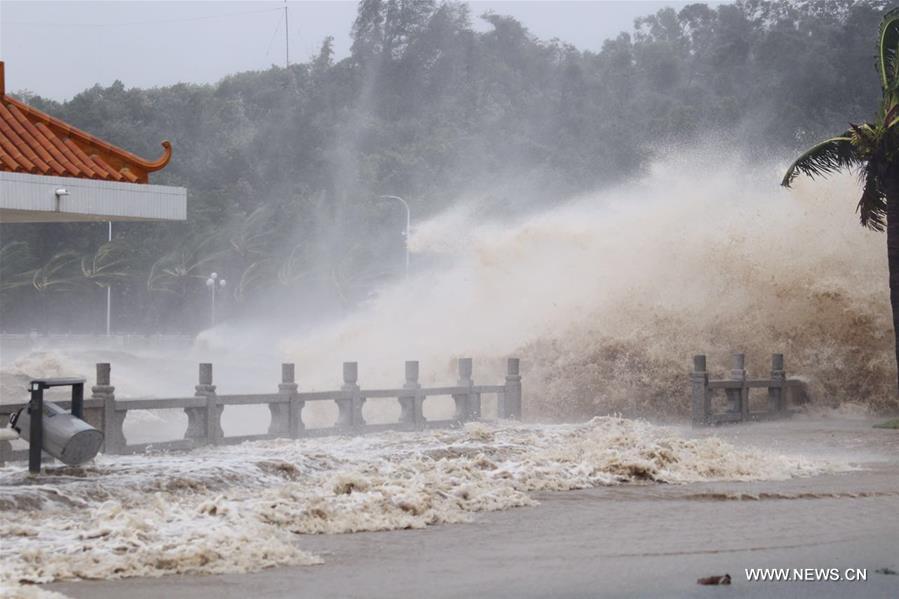
Typhoon Hato lands in south China

Photo taken on Aug. 23, 2017 shows billows in Zhuhai, south China’s Guangdong Province. (Xinhua)

Hato, the 13th typhoon to hit China this year, made landfall in the city of Zhuhai in southern China’s Guangdong Province at noon Wednesday, bringing gales of up to 45 meters per second.

Hato will move west and scale down to a tropical storm passing Guangxi Zhuang Autonomous Region on Wednesday night, the National Meteorological Center said.

As of 5 p.m., no casualties were reported in Guangdong Province.

So far, 13 cities and counties in Guangdong have issued red alerts for the typhoon.

Gales and downpours have suspended work, classes, and production in the cities of Zhuhai, Jiangmen and Zhongshan. Several expressways have also been closed.

Initial investigation showed the typhoon blew down over 2,000 trees, damaged signs, railings and fences on roads in the province.

Power supplies were disrupted in some areas but had been partially restored as of 3 p.m..

As the typhoon moves westward, neighboring provinces have also been affected. Flights were disrupted in Guangxi and rail services delayed or canceled in Yunnan Province.

The typhoon will also bring heavy rain to central China’s Hunan Province, the provincial flood control headquarters warned on Wednesday.

On Tuesday, thousands of people were evacuated in parts of south China in preparation for the arrival of Hato.

China has a four-tier color-coded weather warning system, with red the most severe, followed by orange, yellow and blue.


Ex-lawyer admits subversion in trial

A former Beijing lawyer pleaded guilty to subversion in court on Tuesday and confessed to receiving Western training that sparked ideas of “overthrowing China’s current political system”.

Jiang Tianyong, 46, stood trial at the Changsha Intermediate People’s Court, in Hunan province, for inciting the subversion of State power. He expressed remorse and asked for leniency.

Jiang denied rumors that he was tortured in detention, and he admitted to fabricating such rumors about former lawyer Xie Yang in an effort to smear the image of the Chinese government and judiciary.

Jiang said he realized “that my behavior to subvert State power and overthrow the socialist system was counter to Criminal Law and constituted a crime. I deeply regret what I’ve done and plead guilty”.

A verdict will be handed down at a later date, according to the court.

During the trial, prosecutors presented evidence that Jiang repeatedly attacked the Chinese government, judicial organs and political system on the internet and in overseas media.

Since 2009, he wrote more than 33,000 social media posts, 214 of which incited subversion, prosecutors said.

He intentionally exaggerated “sensitive cases”, unscrupulously distorted facts and incited others to gather and cause trouble in public areas, according to the indictment.

In July of 2016, Jiang used Telegram, an overseas instant messaging application, to organize and incite others to gather at the gate of a local court in Tianjin on Aug 1, where a subversion lawsuit would be held several days later, prosecutors said.

He colluded with anti-China forces overseas and incited hostility against the government, according to the indictment.

Jiang confessed in court that he went abroad five times to receive Western constitutional system training and that this prompted him to try to overthrow China’s political system.

The training “had an impact on me, helping develop ideas of overthrowing China’s system and implementing the Western system in China”, he said.

Jiang confessed to being behind multiple rumors of the torture of another former lawyer, Xie Yang.

“I deliberately fabricated torture details of Xie while he was in police detention and played to Western media’s taste, aiming to tarnish the image of the government and judicial organs,” he said.

Jiang became a lawyer in Beijing in 2004 but was barred from practicing law by the Beijing Justice Bureau in 2009.

He was placed under surveillance on Dec 1, 2016, and formally arrested on May 31, according to prosecutors.

Jiang said his legal rights had been fully protected. “Judicial authorities have handled the case in strict accordance with the law,” he said, adding that the rumors he was tortured are untrue.

About 40 people attended his trial, including his relatives and attorneys, as well as legislators, political advisers and journalists.

Jiang’s father attended the trial, though his wife, Jin Bianling, who is now overseas, did not, despite being informed of the hearing, according to the court.

Video footage of the trial was broadcast on the Changsha Intermediate People’s Court’s Sina Weibo micro blog.