China issues emergency response to Guizhou landslide

China issued a grade-IV emergency response on Monday following a landslide in the city of Bijie, southwest China’s Guizhou Province.

The China National Commission for Disaster Reduction and the Ministry of Civil Affairs have sent officials to the area to assist disaster relief work.

The landslide occurred at about 10:40 a.m. in Zhangjiawan township, affecting 34 households. Two people have died and a further 25 are missing.

Local civil affairs authorities sent tents, quilts and camp beds to the site after the disaster.

A grade-IV response, the lowest in China’s emergency response system, means a 24-hour alert, daily damage reports, and the allocation of money and relief materials within 48 hours.


China reviews draft amendment on unfair online competition

China’s latest draft amendment to the Unfair Competition Law made changes on regulating unfair online competition.

The draft revision was given a second reading at a five-day bimonthly session of the National People’s Congress (NPC) Standing Committee, which opened Monday.

Compared with the previous draft reviewed in February, the new draft stipulates that online business operators must also follow the rules that are already in the law.

“Some unfair online competition is just the same as traditional competition, while some is unique to the Internet for technical reasons,” said Zhang Mingqi, vice chairman of the Law Committee of the 12th NPC.

Operators cannot use technical means to influence Internet users’ decisions or to disturb or sabotage products and services legally provided by other operators, said the draft.

The banned online activity includes misleading, cheating or forcing users to “modify, close or uninstall” competitors’ products or services, the draft said.

It also includes products or services that are maliciously designed to be incompatible with other products or services, the draft noted.

The Unfair Competition Law took effect in 1993.


Openness and cooperation vital for solution of IP issues: WIPO official

History tells us that maintaining an open and cooperative attitude toward difficulties in the China-US relationship regarding intellectual property rights plays a crucial role in achieving win-win results, according to a senior official at World Intellectual Property Organization (WIPO) in Beijing on Saturday.

Speaking at a session about people-to-people exchanges and U.S.-China relations during the Taihe Civilizations Forum, Chen Hongbing, director of the WIPO China Office, underlined openness and cooperation in solving the simmering Sino-American friction following a U.S. decision to launch a Section 301 investigation into China’s intellectual property (IP) practices.

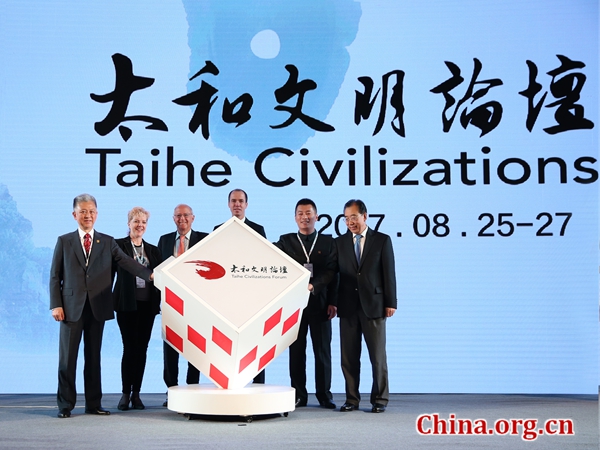
Taihe Civilizations Forum is held in Beijing from Aug. 25 to 27. [Photo/China.org.cn]

Over the past 38 years since China was first introduced to the idea of intellectual property and joined the WIPO, it has established its own IP system fully integrated into the global IP framework, and more importantly, had included IP protection in national strategy, Chen said.

According to the latest release from WIPO, Chinese patent filings, accounted for over 38.1 percent of the world’s total applications in 2015, followed by the U.S. and Japan with 20.4 percent and 11 percent.

Moreover, China accounted for a third of the entire world’s trademark filing activity and around 49.7 percent of industrial design filings.

China has gradually become the world’s largest IP creator and owner, Chen stressed.

Earlier this year, attorney and consultant Wayne P. Sobon, former president of the American Intellectual Property Law Association, wrote an opinion article entitled “The surprising rise of China as IP powerhouse,” declaring that “China is quickly becoming a, if not the, global leader of intellectual property protection and enforcement.”

“Just as Western democracies (especially the United States) have grown increasingly skeptical of the value of intellectual property and weakened protection and enforcement, China has been steadily advancing its own intellectual property system and the protected assets of its companies and citizens,” Sobon wrote.

China’s courts accepted an astounding 109,386 civil intellectual property cases in 2015 (6 percent up year-on-year), including more than 11,000 patent cases. By comparison, the number of patent litigations filed in the United States in 2015 was 5,830 (down from the high-water mark of 6,114 in 2013). IP-related litigations totaled around 14,500 cases (including about 5,000 copyright and about 3,500 trademark actions).

In response to the latest U.S. investigation, the Ministry of Commence of China said that Beijing considered it symbolic of unilateralism and protectionism, and the Chinese government would take all necessary measures to protect the legitimate rights of China and Chinese enterprises.

As an U.N. agency, WIPO believes members could maintain and enhance mutually-beneficial, transparent and rule-based collaboration in the IP field as long as they retained an open and cooperative attitude to each other, Chen said.


Macao residents praise PLA soldiers’ typhoon relief efforts

The people of Macao have been showing their gratitude to People’s Liberation Army (PLA) soldiers who have been operating in the Special Administrative Region to help with disaster relief.

Around 1,000 Chinese People's Liberation Army soldiers join the relief efforts after Macao was hit by Typhoon Hato. [Photo: js7tv.cn]

Around 1,000 Chinese People’s Liberation Army soldiers join the relief efforts after Macao was hit by Typhoon Hato. [Photo: js7tv.cn]

One online post shows the Chinese mainland soldiers rescuing four people trapped in a car by rising floodwaters received hundreds of likes on social media shortly after it was uploaded, reports the South China Morning Post.

A photo of the dramatic rescue was posted by a coach driver called Ieong Fong-tang, who wrote that the PLA soldiers arrived 25 minutes ahead of the Macao police, and helped the trapped people get out of the car, adding that he couldn’t imagine what would have happened without their help.

About 1,000 members from the PLA Garrison in Macao were mobilized on Friday at the request of the Macao Special Administrative Region government, after the city was ravaged by Typhoon Hato, which left ten people dead and over 200 others injured.

They’ve been helping principally with recovery efforts, clearing debris and spraying disinfectant. It’s the first time since the handover in 1999 that PLA soldiers from Macao operated on the streets of the city.

Local residents have welcomed their presence, and praised them for their help. Many applauded and cheered when PLA trucks were spotted in the city. Some said the appearance of the PLA troops made them feel safe.

Meanwhile, Pakhar, the 14th typhoon this year, hit Macao during Sunday.

The Macao Meteorological and Geophysical Bureau issued a Signal No. 8 warning, one of the highest levels, at 6:00 local time.

The typhoon brought rain and gales to Macao, along with Guangdong, Fujian, Hainan provinces.


Full speed ahead for Tibet on prosperity highway

“A region has to build roads if it wants to build wealth” the saying goes, and they are certainly sticking to it in the Tibet Autonomous Region, an area of more than 1.2 million square kilometers.

“It was a headache to travel to the Ali district in the past as there were only cobblestone and mud roads. It might take one week from Lhasa to Ali by truck, and you had to take water and food with you as there were no restaurants along the way,” said Tsering, a driver in Lhasa.

Today, it takes him under four days as there are several blacktop highways between both places.

Tibet has seen its economy invigorated by improved transport conditions.

The total length of highways in Tibet grew from 65,198 kilometers in 2012 to over 82,000 kilometers today, extending by over 4,200 kilometers a year. High-grade highways, similar to expressways, saw their length increase six-fold from 2012 to 2016, said Chen Chao, deputy head of the region’s transport bureau.

In 2013, the Motuo Highway opened to traffic, linking the outside world with the remote region of Motuo in southeastern Tibet. It was the last Chinese county without access to highways.

The rapid development of highways is the result of investment which grew from 10.101 billion yuan (US$1.52 billion) in 2012 to over 40 billion yuan in 2016, increasing by 41.3 percent a year.

Thanks to investment in infrastructure and the effects of improved transport, Tibet posted impressive economic growth in the past five years, recording an annual average GDP growth of 11 percent. The region’s economy grew 10.8 percent year on year in the first half of 2017, outperforming every other provincial region.

“Once transport barriers are removed, there will be more commercial activities like logistics and tourism, thus improving local people’s livelihoods,” Chen said.

And building highways can help protect the environment, Chen said. When there were no highways, drivers would cross a region randomly, destroying the vegetation. Grass and plants are now spared as drivers run on a fixed route.

By 2020, Tibet will have 110,000 kilometers of highways, with all counties having access to blacktop highways and all towns connected by cement roads.