No environmental impact detected in China after DPRK nuclear test

The nuclear test conducted by the Democratic People’s Republic of Korea (DPRK) on Sunday had not impacted China’s environment as of 4 a.m. Monday, according to radiation monitoring data.

All monitoring stations in China’s northeastern border areas in the provinces of Heilongjiang, Jilin, Liaoning and Shandong recorded radiation at normal levels, the Ministry of Environmental Protection (MEP) said in an online statement.

The MEP on Sunday started monitoring the radiation levels in the border areas in an emergency response to the nuclear test. The monitoring data will be made public, it said.

The China Earthquake Administration reported that a magnitude 6.3 earthquake struck the DPRK at 11:30 a.m. Sunday with an epicenter depth of zero km, saying that it might have been caused by explosion.

The DPRK’s Korea Central Television announced Sunday that the country had successfully detonated an H-bomb, a hydrogen bomb that can be carried by an intercontinental ballistic missile.

China’s Foreign Ministry has issued a statement expressing firm opposition to and strong condemnation of the test.


ICCIE to open with more international participation

A total of 69 delegations from 59 countries and regions as well as international organizations have confirmed their participation in the 12th International Cultural and Creative Industry Expo (ICCIE), organizers said on Aug. 30.

The annual expo, taking place in Beijing from Sept. 11 to 13, will focus on innovative development of culture, science and technology through over a hundred events including exhibitions, promos, forums and parallel sessions.

The exhibitions will showcase the integrated development in the Beijing-Tianjin-Hebei region, the international language service industry, creative crafts and artwork in famed museums, Taiwan’s cultural and creative industry as well as traditional ethnic culture, said Lin Bin, a senior official from the ICCIE’s organizing committee.

To facilitate cultural exchange among the Belt and Road countries, the ICCIE organizers also invited representatives from 45 embassies in China as well as international organizations to promote their countries’ culture, education and tourism in face-to-face interactions with visitors at the expo.

This year’s expo will also highlight innovation and entrepreneurship from the younger generation as business-minded college students in Beijing will showcase their work and promote their creativity at the innovation fair.

The ICCIE in the previous 11 years had attracted 17,413 companies and organizations, bringing over 786 billion yuan in the forms of trade and cooperative agreements.


New species discovered along China-Myanmar border

Chinese scientists have discovered a new endangered species of flowering plant from the Annonaceae family, and the finding has been published in an international botanical journal.

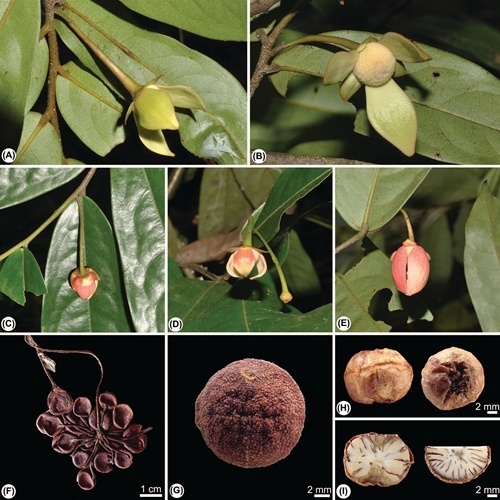
Polyalthia yingjiangensis flower and its fruits. 

Polyalthia yingjiangensis, known in Chinese as Yingjiang An Luo, was named after Yingjiang County in southwest China’s Yunnan Province where it was discovered. It belongs to the same botanical family as the custard apple and ylang-ylang, a tree whose fragrant greenish-yellow flowers are used to distill perfume.

“The discovery enriches the diversity of the area,” said Tan Yunhong, a botanist from Xishuangbanna Tropical Botanical Garden, Chinese Academy of Sciences (CAS).

Tan and other scientists from Southeast Asian Biodiversity Research Center and South China Botanical Garden discovered the plant during a field survey in Hongbenghe close to the China-Myanmar border. They believe the new species could also be found in Myanmar.

The Chinese scientists only found 10 plants during the survey conducted in April, 2016. A paper on the finding co-authored by Tan was published in the latest issue of Nordic Journal of Botany.

The plant was originally seen in 1980, but not confirmed as a new species at that time and this was the first time it has been seen again in 36 years, according to Tan.

Polyalthia yingjiangensis has been designated an endangered species, according to classification by the World Conservation Union. Currently there are only four samples available and the trees are known to grow in three localities, all in Yunnan.

Knowledge about the species is limited, however, scientists hope more field surveys can be done in areas that have not been studied, to help better understand the newly discovered plant.

Tan suggested conservation areas be set up to help preserve the rare species and public awareness be raised to save the plant from extinction.

Yingjiang, located in the transitional zone between India-Myanmar and East Himalayan flora, is rich in biodiversity. A large number of new species have been discovered in the region in recent years.


Typhoon Mawar lands in south China

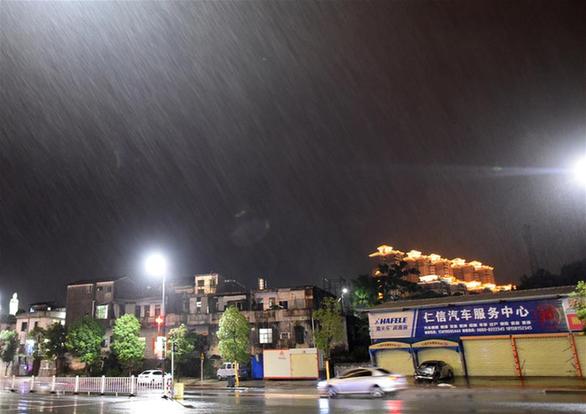
Mawar, the 16th typhoon this year, landed around 9:30 p.m. Sunday in Lufeng under Shanwei city in south China’s Guangdong Province, bringing gales of 20 meters per second at its eye, according to local meteorological authorities.

Torrential rain hits Lufeng City after the 16th typhoon Mawar lands in south China’s Guangdong Province, Sept. 3, 2017. Mawar, the 16th typhoon this year, landed around 9:30 p.m. Sunday in Lufeng, south China’s Guangdong Province, bringing gales of 20 meters per second at its eye. Mawar is the third typhoon that landed in Guangdong in the recent half month after Hato and Pakhar. [Photo/Xinhua]

Heavy rain battered the landing areas. Local government said about 2,200 fishing boats had returned to the harbor while more than 15,000 people were relocated to safe places.

The provincial meteorological bureau forecast that the typhoon would weaken rapidly after the landing and move towards northwest at a speed of about 10 km per hour, bringing downpours and gales to other cities in the province from Sunday night to Monday.

Flights and trains were suspended. Authorities have been on alert for secondary disasters.

Mawar is the third typhoon that landed in Guangdong in the recent half month after Hato and Pakhar.


China starts radiation monitoring after DPRK nuclear test

China starts radiation monitoring after DPRK nuclear test on September 3, 2017. [File Photo: zhb.gov.cn]

China has started monitoring the radiation levels in its northeastern border areas in an emergency response to a nuclear test conducted by the Democratic People’s Republic of Korea (DPRK).

The Ministry of Environmental Protection (MEP) initiated the emergency response at 11:46 a.m. Sunday, MEP said in a statement.

“At present, the automatic radiation monitoring stations in the provinces of Heilongjiang, Jilin, Liaoning and Shandong are functioning properly,” the statement said.

By 4 p.m., monitoring data from the four provinces showed that China’s environment had not been affected by the nuclear test, the ministry said in a separate statement.

All monitoring spots saw radiation at their normal levels, the ministry added.

The China Earthquake Administration reported that a magnitude 6.3 earthquake struck the DPRK at 11:30 a.m. with an epicenter depth of zero km, saying that it might have been caused by explosion.

The DPRK’s central television announced Sunday that the country had successfully detonated an H-bomb, a hydrogen bomb that can be carried by an intercontinental ballistic missile.

China’s Foreign Ministry has issued a statement expressing firm opposition to and strong condemnation of the test.