College dorms launch facial recognition technology

All the dormitories have installed facial recognition system in Beijing Normal University, reported the Beijing News on Sept 4.

A student at Beijing Normal University has her facial information input into a new facial recognition security system. [Photo/bjnews.com] 

The Beijing Normal University greeted 2,626 freshmen on Sunday, aged 14 to 28, who need to register with the facial recognition system to enter the dormitories.

The system requires the facial information from all the new comers–they need to stand in front of the machine for two seconds to register.

The campus first tried facial recognition system in May and later installed it in every dorm.

It is said there’re three ways to launch the system. Students can swipe their campus card, shout out their name, or put in last four digits of campus card passwords to enable the system to proceed with facial recognition.

The system can identify 26 kinds of dialect when students use voice to launch the system.

It is reported 62 percent of the new comers were born in 1999, with the youngest born in 2003 and the oldest in 1989.

It is the first time that those born in 2000s are entering college.


Typhoon Mawar rains more misery on Guangdong

Guangdong province was battered by its third typhoon in 12 days on Monday, with torrential rains again flooding urban areas in several cities.

People walk across a flooded street in Guangzhou, Guangdong province, on Monday. Kindergartens and primary and middle schools were closed after Typhoon Mawar battered the city.[Photo/Chinanews.com] 

Typhoon Mawar, the 16th typhoon formed in the northwest Pacific this year, made landfall in Lufeng at 9:30 pm on Sunday, packing winds of up to 72 kilometers per hour.

Although weaker than the previous two typhoons in recent weeks, Hato and Pakhar, authorities issued red alerts for rainstorms, while kindergartens and primary and middle schools were closed in Shenzhen, Zhuhai, Zhongshan, Shanwei, Shantou, Chaozhou and Guangzhou.

Many roads in Zhuhai and Shenzhen were flooded, cutting off traffic. More than 20 bus lines were suspended in Zhuhai, a city that felt the full force of Typhoon Hato on Aug 23.

The wind caused by Mawar was not very strong but rain was heavy, said Zhou Shuying, a resident in the city.

Roads were seriously waterlogged and many cars were submerged by water. Traffic was brought to a standstill on some roads.

Water and power supplies remained normal in Zhou’s neighborhood and the floodwater began to retreat gradually after 3 pm on Monday, she said.

Police officer Tan Jiaguang waded in water up to his waist in Zhuhai’s Nanyangpu village to reach a gong, which he rang to warn residents to relocate to emergency shelters. His station helped transport about 600 people, including in speed boats, Zhuhai Daily reported.

A minor landslide occurred in Jigongsan Street in Zhuhai on Monday morning and people living in adjacent areas were evacuated. No casualties were reported.

Several students were rescued and taken to safety in a dinghy by firefighters after their school bus stalled in a flooded street in Huangjiang town, Dongguan.

Mawar, which forced the evacuation of 57,120 people in Guangdong before it made landfall, affected power supplies to 115,000 homes and businesses. Services were fully restored by 10:30 am, according to China Southern Power Grid.

The arrival of Mawar marks the fifth time Guangdong has witnessed three typhoons in half a month since meteorological records began, with the previous case in 1993, Wu Zhifang, chief forecaster for the Guangdong Meteorological Observatory, told Xinhua News Agency.

In the past two weeks, subtropical high pressure and southwestern monsoons have remained stable, which has seen tropical depressions formed near the Philippines mostly move northwestward onto the Guangdong coastline, said Zhang Ling, chief forecaster for the National Meteorological Center.


Beijing’s winter smog to arrive earlier this year

Beijing’s smog is expected to arrive earlier this year, said China’s Ministry of Environmental Protection (MEP).

The smog, which often occurs in late autumn and winter, has already returned to the capital city in early September. Air quality started to worsen Saturday morning, with PM 2.5 density reaching 176 micrograms per cubic meter of air, indicating heavy air pollution, according to data from the Beijing Municipal Environmental Protection Monitoring Center.

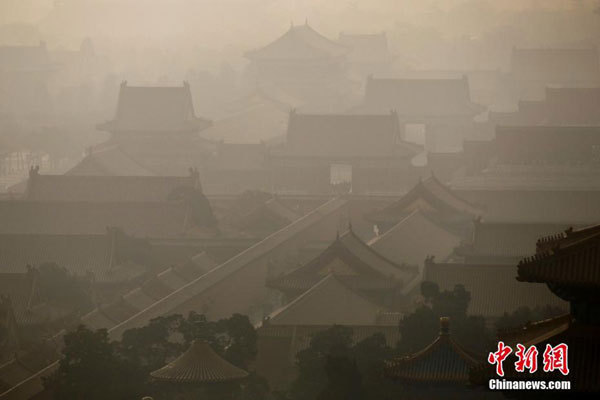
The Forbidden City in Beijing, is shrouded in smog in early April, 2017. [File photo/Chinanews.com] 

The smog will persist until Tuesday, when rain and a northerly wind are forecast to hit the city.

The new round of air pollution is a result of unfavorable air conditions and high local vehicle emissions, the Beijing Municipal Environmental Protection Bureau explained.

Nitrate has been confirmed as a main pollutant, accounting for 30percent of PM 2.5 as of Monday noon.

“Our monitor shows the concentration of nitrogen oxide, which can turn into nitrate, at night is two to four times that of the day, indicating diesel trucks only allowed to enter Beijing at night are the main culprits,” said Liu Baoxian, senior engineer at the monitoring center.

Beijing’s 5.8 million vehicles produce more than 10 tonnes of nitrogen oxide and hydrocarbon compounds annually. Heavy-duty diesel vehicles only account for 4 percent of the total vehicles in the capital, but discharge half of the nitrogen oxide, and 90 percent of particulate matter of car exhaust.

The case is even worse if non-local heavy-polluting diesel trucks are counted.

The Beijing Municipal Environmental Protection Bureau has therefore partnered with 13 departments to improve supervision of heavy-duty vehicles. As of August, more than 12,000 vehicles had been fined for excessive discharge on the road.

“Beijing is introducing a smart monitoring system that can capture high-emission vehicles in real time,” said Su Xuetian, from the city’s environmental protection bureau.

According to the MEP statement Sunday night, the possible earlier smog is forecast based on the melting of Arctic sea ice and the temperature variation of the Pacific Ocean.

It also said a weaker Siberian High was expected to bring fewer cold fronts in the following months, resulting in a more humid, warmer winter, which also means earlier heavy air pollution.

The MEP said that it would launch a campaign against heavy air pollution in autumn and winter.

In the plan, the country should improve its forecast calculation capacity to extend the forecast period from seven to 10 days, and emergency response plans should be improved in 28 cities in northern and central China to ensure the effectiveness of measures to cut emissions.

MEP will also set up a Beijing-Tianjin-Hebei air environment management agency to help deal with heavy pollution in autumn and winter.

Density of PM2.5 nationwide dropped 6.9 percent year on year in July, while Beijing reported an average PM2.5 density of 64 micrograms per cubic meter in the first seven months of 2017, down 34.7 percent from the same period in 2013.




Conversations with chief correspondents in Beijing (I): Levent Uluçer

Radio Beijing International launched an interview series in Beijing on Sept. 2, in which Beijing-based foreign chief correspondents and heads of foreign media who have been working and living in Beijing for years are invited to share their views on the changes taking place in the Chinese capital over the past five years.

Levent Uluçer, the chief correspondent and head of China Offices of Aydınlık Turkish daily newspaper and Ulusal TV Channel Turkish TV. [Photo provided to China.org.cn] 

The first guest invited to the interview “Beijing in My Eyes — Conversations with Chief Correspondents” is Levent Uluçer, the chief correspondent and head of China Offices of Aydınlık Turkish daily newspaper and Ulusal TV Channel Turkish TV.

Uluçer said he was enchanted by the breathtaking beauty of China and made a quick decision to come in 2003 when he had already established a successful career as a TV host in Turkey.

Since then, he has been working and living in Beijing for nearly 15 years, first serving as a Turkish expert of China Radio International and then working for several influential Turkish media, producing thousands of reports to familiarize his audience with the oriental civilization.

Besides his numerous reports on China, Uluçer also shot the “Silk Road” documentary as the line-producer and cameraman along the ancient Silk Road from Xi’an to Xinjiang for 3 weeks, which was later aired on TRT Avaz (Turkish National TV) in 2014.

Uluçer calls himself a “Lao Beijing Ren” (native Beijinger), taking Beijing as his hometown. “When I go to Turkey, there’s actually no home for me,” he said, “When I come back here, I come to my home.”

When asked about the changes and development of Beijing and China in the past five years, he shared his perspectives regarding the Belt and Road Initiative, technology innovation, the sharing economy as well as sports and culture.

Over the coming weeks, six more heads of foreign media and chief correspondents will take part in the interviews. The seven-episode series will be aired on Radio Beijing International through 92.3FM and 774AM in late September.


Thousands evacuated after typhoon hits south China

Nearly 70,000 people have been evacuated after Mawar, the 16th typhoon this year, made landfall in Guangdong Province on Sunday night.

At least four cities, Zhuhai, Zhongshan, Dongguan and Shenzhen, activated red alerts for heavy rainfall, the highest warning level, on Monday.

Zhuhai flood control headquarters ordered all schools to be closed as heavy rain continues to batter the city.

Typhoon Mawar made landfall in the city of Lufeng in Guangdong on Sunday night, bringing heavy downpours to the area.

Some 10,000 fishermen returned to shore ahead of the typhoon’s arrival. Another 57,120 people were evacuated from low-lying areas.

The Guangdong provincial flood control headquarters warned of possible flooding and landslides.

Provincial maritime authorities have ordered rescue vessels to be on standby for emergency response.

China’s National Meteorological Center (NMC) issued a yellow alert for rainstorms on Monday. Some regions will receive up to 200 millimeters of precipitation, the NMC said.

Mawar is the third typhoon to make landfall in Guangdong in the last two weeks following typhoons Hato and Pakhar.

China has a four-tier color-coded weather warning system, with red the most severe, followed by orange, yellow and blue.