China to push through domestic law on Antarctic activities

The South Pole has become a popular destination for Chinese tourists in recent years. During the 2016-2017 travel season, China exceeded Australia to become the second largest origin of tourists in Antarctic, following the United States. [Photo/Shanghai Daily] 

With increasing numbers of Chinese tourists heading for the South Pole, China is pushing through domestic legislation on Antarctic activities to regulate related human activities and better protect the environment there, officials said on Thursday.

The domestic legislation is in urgent need and needs to be speed up, said Qin Weijia, director of the Chinese Arctic and Antarctic Administration, during the 2017 annual meeting of the Asian Forum for Polar Sciences, which was held in Shanghai.

During the 2016-2017 travel season, China exceeded Australia to become the second largest origin of tourists to Antarctica, following the United States. The travel season is usually between November and March.

A total of 5,286 Chinese tourists traveled to the South Pole during that period, accounting for 12 percent of the total number of tourists, according to the International Association of Antarctic Tour Operators.

Qin added that the total number of expedition members from China’s state-organized Antarctic expedition was only around 5,000 during the past 30 years.

He said only four of the Antarctic Treaty’s 29 consultative members do not have domestic laws regarding Antarctic regulations, and that includes China. The other three are India, Poland and Ecuador.

“With international regulations on the protection of the Antarctic getting increasingly detailed, China’s domestic legislation is in urgent need,” Qin said.

He added that the international rescue operation for trapped Russian vessel Akademik Shokalskiy in the Antarctic in 2013 triggered discussion on how to share rescue bills in such Antarctic rescues.

Qin said that domestic regulations would contribute to regulating coordination on related rescues if tourists encountered accidents on the South Pole.

“The legislation aims to both regulate activities among ordinary residents like tourists, as well as state-organized activities on the Antarctic,” Qin said.

In April, Lin Shanqing, deputy director of the State Oceanic Administration of China, also said that the national legislative body has started to pay attention to the promotion of legislation on domestic Antarctic law, Xinhua News Agency reported.

Extremely popular

Eying the booming business, travel agencies in China started offering charter cruise tours to the pole.

In November and during the Spring Festival holiday, Tongcheng, an online travel operator, organized two charter cruise trips with more than 800 tourists in total to visit the South Pole.

Taking MS Midnatsol of Hurtigruten Cruises, they visited the China Antarctic Great Wall Station, watched penguins, whales and seals, crossed Drake Passage, appreciated magnificent glaciers, and tried ice-swimming in the South Pole.

Middle-aged people and seniors were the major participants, with more than 50 percent of South Pole cruise passengers aged above 50 years of age, the travel agency said.

“Celebrating the Spring Festival in the South Pole is becoming a fresh and exciting way for Chinese to experience travel overseas, and seniors are more interested than youngsters,” said Wang Kai, vice president of Tongcheng. “Visiting the South Pole and stepping onto the pure holy land is the dream of many people.”

On the website, a 23-day tour including the South Pole, Falkland Islands, Chilean Fjords and Chile, setting off on December 15, is priced at 87,999 yuan per person for the cheapest suite. The cheapest 35-day itinerary is 132,999 yuan per person.

Some travel agencies offer high-end itineraries with experts specializing in ocean, wildlife and history hosting guides and in-depth exploration experiences on the pole.

They are priced from 189,000 yuan to 665,000 yuan per person minimum on HHtravel, a luxury travel operator affiliated with Ctrip.

The majority of luxury tourists are senior managers at companies and private entrepreneurs aged between 35 and 50 years old, HHtravel said.

Deng Shen, a 28-year-old professional traveler who has been to about 100 countries, was at the South Pole in January and February this year.

She did not rely on travel agencies and booked a cruise ticket to the South Pole online herself.

“A ticket can only be secured if you book it at least six months or one year in advance of your departure because of the South Pole trip boom among Chinese,” she said.

Deng said tourists are required not to bring any food or beverages onto the pole, and they are also told to keep a distance from wildlife.

She said she did not see uncivilized behavior on the pole, but she heard it was chaotic when charter cruise ships arrived as many people jostled to the front. She said she heard that there were also some Chinese tourists chasing penguins.

“But the South Pole is the most beautiful among all these places I have ever visited. It is heaven.”



‘Mars Village’ for tourists, not astronauts

The site where China’s first Mars simulation base will be built in Qinghai province mirrors similar features of the red planet. [Photo/Xinhua] 

China will finish building its first Mars simulation base in Northwest China for ecotourism and outdoor scientific experiments by 2020, but it won’t be a scientific simulation base for future astronauts, a senior scientist said.

The base will boost the local tourism economy, educate the public about space exploration and provide a multifunction, outdoor experiment field for scientists around the world, Liu Xiaoqun, director of the General Office of Lunar and Deep Space Exploration of the Chinese Academy of Sciences, told China Daily in an exclusive interview.

Some other notable planet simulation bases include NASA’s Hawaii Space Exploration Analog and Simulation, the Mars Desert Research Station in Utah in the United States, Russia’s Mars500 project and the most recent one-the Poland Mars Analogue Simulation 2017.

However, unlike those bases, Liu said China’s “Mars Village” is not a serious simulation colony or a training ground for future Mars astronauts. “It is first and foremost a Mars exploration-themed tourist site,” he said.

Liu said the base is expected to consist of a “Mars community” and a “Mars campsite”. The campsite will have a number of experimental, modulelike accommodations and recreation spots. The base might also include sets for shooting films and TV shows.

“It will be built as a one-stop base for experiential learning in aerospace, astronomy, geography and new energy,” he said. “But it is too early to claim the base as a place for scientific research, because its surroundings have not been thoroughly analyzed for scientific purposes.”

On Sept 5, planners set out a 400 million yuan ($62 million) development plan to build the base in the red rock area in the Qaidam Basin in western Qinghai province.

The base will be more than 2,000 meters above sea level. Its surrounding area is barren, dry, cold and has intense solar radiation as well as sharp ridges and mounds of dunes that were formed over centuries by wind erosion-thus mirroring similar features and climate found on the arid surface of Mars.

“The base’s environment will be suitable to test space exploration equipment, like the moon and Mars rovers, as well as solar panels and other tools,” he said, adding that scientists often do these outdoor experiments in desolate areas while living in tents.

“The base, with its recreational facilities, will provide better living quarters and infrastructure for scientists,” he added. “It is also an ideal camp base for foreign scientists to study western China’s unique and mysterious geography.”


Chairman Mao Memorial Hall reopens to public

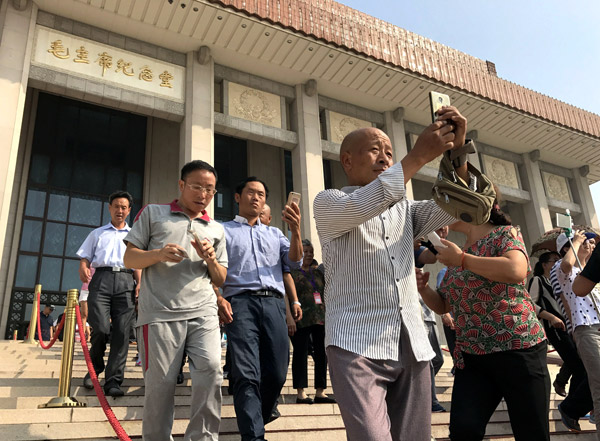
Visitors take photos after leaving the Chairman Mao Memorial Hall in Tian’anmen Square in Beijing on Sep7 8, 2017. [Photo/China Daily] 

A long line of people visited the memorial hall of Chairman Mao Zedong to commemorate the late Chinese leader on Friday, one day ahead of the 41st anniversary of his death.

At 8:30 am, about 300 people were waiting in the queue to enter the hall, which was reopened on Sept 1 following six months of renovation. The hall, located at Tian’anmen Square in Beijing, is open from 8 am to noon every day but Monday.

Because visitors are required to keep walking in a line and cannot stop in the hall, the line moved relatively quickly and visitors had a wait of only about 10 minutes before entering the hall.

Chen Hao, a student at Beijing Forestry University, came to visit the hall in April but found it closed for renovation.

The 23-year-old, who is pursuing a master’s degree, returned on Friday after hearing the hall had reopened. “Chairman Mao has been an icon for me,” he said.

Chen said he felt lucky to visit the chairman in person ahead of the 19th National Congress of the Communist Party of China, which is scheduled to begin on Oct 18. He also brought his girlfriend with him this time.

Tenzin Gyalpo visited the hall for the first time with his mother. The 23-year-old from Qamdo prefecture in the Tibet autonomous region, said the hall is a sacred and spectacular place for him.

People laid so many flowers on a 2-meter-long table set in front of a sculpture of Mao near the hall entrance that workers had to place them on the floor every 30 minutes to make way for more.

The renovation of the 40,744-square-meter hall took 184 days and was finished on Aug 31, according to China Xinxing Construction & Development General Co, which won the bid for the project.

The work included electromechanical devices, some of the guards’ rooms and the reception hall in the five-story building, according to company officials.

It was the third large-scale renovation of the hall in the past two decades, but the shortest one. The work in 1997 took nine months while the renovation in 2007 took seven.

The hall, which opened to the public on Sept 9, 1977, has received more than 200 million visitors from home and abroad, according to Chinese media reports.


China spends big to ensure clean winter heating

Chinese central and local governments are committed to huge spending in the coming three years to ensure clean winter heating in 12 cities in northern China.

Those cities, including Shijiazhuang, Taiyuan and Tianjin, are in a pilot program for winter heating with clean energy sources, as they have been frequented by smog in winter partly due to over-reliance on coal.

Local finances will contribute about 69.7 billion yuan (11 billion U.S. dollars) to complete clean heating renovation in the next three years, Liu Wei, deputy minister of finance, said at a Friday meeting on the issue.

Financial institutions, companies and other non-government sources will spend more than 200 billion yuan, Liu said.

The pilot program was unveiled in May, with central finance to provide between 500 million yuan to 1 billion yuan to each city.

The program came after this year’s government work report said that China will address pollution caused by coal, with measures including clean winter heating in the north and replacing coal with electricity and natural gas in more than 3 million households.

At the meeting, pilot cities were asked to seek new ways of capital input, encourage more private funds into the pilots, and coordinate the prices for electricity, natural gas and heating.


Top graft-buster appeals for calm among supervisory officials

Wang Qishan, head of the Communist Party of China (CPC) disciplinary body, has asked supervisory officials to remain calm and clear-headed.

Wang, head of the CPC Central Commission for Discipline Inspection (CCDI), made the remarks at a commendation conference on Friday.

He spoke highly of accomplishments at all levels since the 18th CPC National Congress in 2012, and said that a number of outstanding individuals had emerged in the anti-graft battle and that those recognized by the conference were only the tip of the iceberg.

Officials should review their work during the past five years to discover problems and deficiencies, he said.

“We should continue to improve our political standpoint and consciousness, be modest and prudent, and continue to make great achievements for the Party and the people,” Wang said.

“Discipline inspection and supervisory bodies at all levels should adhere to the highest standards,” he said.