Li stresses vocational education to boost ‘Made in China’ brand

Chinese Premier Li Keqiang has stressed the importance of vocational education in boosting products made in China.


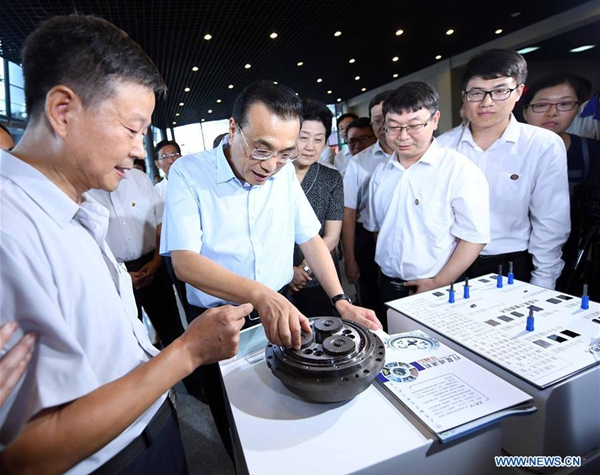
Chinese Premier Li Keqiang (2nd L, front) views technological achievements during an inspection to Tianjin University of Technology and Education in Tianjin, north China, Sept. 8, 2017. Li made an inspection here on Friday and stressed the importance of vocational education in boosting products made in China. During his inspection, the premier extended festive greetings to the teachers ahead of National Teachers’ Day, which falls on Sept. 10. (Xinhua/Zhang Duo)

Li made the remarks while inspecting Tianjin University of Technology and Education on Friday.

“While implementing the strategy of innovation-driven development, we need to encourage innovation on the one hand and translate good ideas into high-quality products on the other hand,” he said during the inspection ahead of Teachers’ Day, which falls on Sept. 10.

China needs to cultivate more professionals with higher quality, promote the spirit of the craftsman and encourage enterprises of various sizes to provide fine products amid efforts to boost the “Made in China” brand, Li said.

During his inspection, the premier extended festive greetings to the teachers.

He called for more efforts to foster a good environment of respecting teachers and valuing education and improve the quality of education to serve the country’s economic and social development.


Nanjing becomes China’s first International City of Peace

Nanjing has become China’s first International City of Peace.

In the notorious Nanjing Massacre during World War II, about 300,000 Chinese people lost their lives and 20,000 women were raped, said J. Fred Arment, executive director of International Cities of Peace in a video speech.

This history makes people remember the war and makes them more aware of the significance of peace, he said.

Nanjing in east China’s Jiangsu Province was an ancient capital for six of China’s dynasties. The freezing winter of 1937 saw brutal killing by invading Japanese troops. One person was killed every 12 seconds.

A total of 172 cities in about 50 countries and regions are now on the International Cities of Peace list, according to its website, including Coventry in England, Bern in Switzerland, Amsterdam in the Netherlands and Berlin, Germany.

Liu Cheng, UNESCO Chair on Peace Studies and a professor at Nanjing University, said that there were certain requirements for becoming an International City of Peace.

“For instance, the city might be traumatized by war or have witnessed big peace-related events,” he said. “It should also be advanced in peace studies and activities.”

More than two years ago, Liu’s Institute for Peace Studies, together with the Institute of Nanjing Massacre History and International Peace, submitted an application to the International Cities of Peace.

“What was left by history was not hatred, but our awareness of peace,” he said.

“Nanjing is among the cities that felt the greatest pain in World War II, and the Nanjing Massacre left us indelible memories,” said Zhang Jianjun, executive chairman of the Institute of Nanjing Massacre History and International Peace. “So we understand better how valuable peace is.”

Peace education has always been emphasized in Nanjing. Nanjing University is the first university to conduct research on peace studies in China.

Kawasaki Akira, a representative with the Japanese NGO Peace Boat, said that the designation of Nanjing as an International City of Peace could help China cherish peace and Japan reflect on itself.

“Peace does not only mean ‘no war,'” said Lee Ji Won, a professor at Daelim University of Republic of Korea. “Peace also means reducing violence, improving justice and safeguarding human rights.”

“Peace is the only way out for human beings,” said Cao Lubao, a publicity official with Nanjing City. “People from all countries should take lessons from history and enhance communication.”


Chinese police warn of food delivery-related road accidents

The Ministry of Public Security has issued warnings about road accidents related to the fast-growing food delivery business in cities.

In east China’s Nanjing City alone, three people died and 2,473 were injured in 3,242 road accidents related to such services in the first half of this year, according to figures released by the ministry’s traffic management bureau.

Seventy-six such cases occurred in Shanghai Municipality in the same period, according to the bureau.

Delivery workers riding electric bikes are frequently seen racing through streets as a growing number of people, especially the young, order food online.

Some delivery staff use mobile phones while driving, and some have been found to violate regulations, including speeding or running red lights, according to the bureau.

The bureau stressed abiding by laws and regulations and urged online catering companies to raise the safety awareness of delivery workers.


Xiongan New Area grants first land compensation to local farmer

The first land compensation funds were granted Saturday to a farmer who gave up his land for the Xiongan New Area.

The New Area, which covers Xiongxian, Rongcheng and Anxin counties in Hebei Province, is about 100 kilometers south of Beijing. It will facilitate the coordinated development of Beijing and the surrounding region.

A temporary administrative center will be built in Rongcheng. For the construction, about 1,000 mu (about 66.7 hectares) of land was taken from 240 farmer households.

The affected farmers can receive 1,500 yuan (about 231.6 U.S. dollars) per mu annually as land compensation, and another 1,500 yuan in compensation for agricultural losses.

Jiang Junming from Mazhuang Village was the first to sign a land contract with the local government. He received 4,147.5 yuan as compensation on Saturday.

“The amount is greater than what I can earn from crops on the land,” he said. “I am proud as a native of Xiongan. Our lives will surely be better in the future.”

The temporary administrative center will include the Party working committee of Xiongan, its management committee, offices of some enterprises in the new area, and serve other functions such as hosting receptions, conferences, and exhibitions.


Xinjiang to send 5,000 bilingual teachers to kindergartens each year

Starting this fall, Xinjiang will send 5,000 people each year to the south of the region to work as bilingual teachers for local preschoolers, said local authorities on Saturday.

According to the education department of northwest China’s Xinjiang Uygur Autonomous Region, the 5,000 people include 3,000 civil servants and 2,000 teachers, who will work for a year in Kashgar, Hotan, Aksu or the Kirgiz Autonomous Prefecture of Kizilsu.

Kashgar, Hotan, Aksu and Kizilsu have had a shortage of bilingual teachers in kindergartens, and many teachers cannot teach Mandarin Chinese.

Xinjiang plans to open or expand 4,387 kindergartens to serve as bilingual kindergartens in rural areas, including 3,223 in southern areas, in order to extend free three-year bilingual preschool education to the entire region.