112 countries united to save productive land

With President Xi Jinping stressing international cooperation on Monday to combat desertification, more countries have agreed to act in an unprecedented global campaign to conserve productive land.

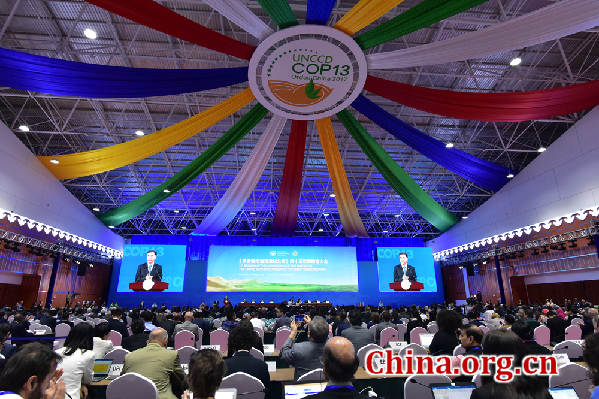
A high-level meeting of the 13th Session of the Conference of the Parties (COP13) to the United Nations Convention to Combat Desertification (UNCCD) opens in Ordos, Inner Mongolia Autonomous Region, Sept. 11, 2017. [Photo by Han Lin/China.org.cn] 

During a high-level meeting of the 13th Session of the Conference of the Parties (COP13) to the United Nations Convention to Combat Desertification (UNCCD) in Ordos, Inner Mongolia, Vice Premier Wang Yang read a letter by Xi to the conference, with the theme of “Combating Desertification for Human Well-being,” which intends to develop a new strategic framework for the UNCCD and will be significant for guaranteeing global ecological security.

António Guterres, secretary-general of the United Nations, also sent a video message to the meeting. “Healthy and productive land is a foundation for dignity and prosperity. The planet’s limited land resources are under growing pressure. Climate change, land degradation and drought threaten food security and stability and the well-being of societies,” he said.

“The solution is to assess resilience and promote inclusive and sustainable development,” he pointed out, “That means better managing land, rehabilitating what has been lost, and being better prepared for droughts and the challenges of a warming planet. I encourage you to be bold. And the world looks to the UNCCD parties to deliver an ambitious and practical strategy for alleviating land degradation and desertification.”

Wang said over the coming decades that China will place an emphasis on combating desertification as an important part of the development of the ecological civilization, work and communicate comprehensively with the international community, and strive to explore a path of desertification control with Chinese characteristics.

Liu Dongsheng, vice minister of the State Forestry Administration said in a press conference held later that China has done a remarkable job in combating desertification and over the past few years has restored more land than has degraded. Deserts have gone from expanding annually by 10,400 square kilometers at the end of the last century in China to reducing by 2,424 square kilometers. This year, the country has restored over 1,000 square kilometers above the net balance. Liu added that China will handle 50 percent of manageable desert by 2020 and restore all of the manageable desertified land by 2050.

But as Xi noted in the letter, land desertification is a major ecological issue affecting the existence and development of mankind, and the situation for controlling desertification remains grave despite the progress the world has achieved since the UNCCD came into effect 21 years ago.

According to the UNCCD, up to 2 billion hectares of land are degraded. On average, 12 million hectares are lost every year and 169 countries are affected by land degradation, desertification and drought. China, Brazil, Russia, India, Nigeria and South Africa have committed to the national targets in a move that could see over 1.3 billion of the mostly poor people regaining food, water, energy and job security. Conservative estimates put the cost of land degradation globally at US$297 billion per year.

Under the Land Degradation Neutrality: The Target Setting Program spearheaded by the UNCCD and supported by 17 international partners, 112 countries have agreed to make the United Nations Sustainable Development Goals target of achieving land degradation neutrality by 2030 a national target for action to conserve productive land. More than 60 of these countries have already established national land degradation baselines and set neutrality targets.

Desertification, land degradation and drought are now recognized as threats to global security due to their impacts on livelihoods tied to the productivity of land. This year, drought led to the worst humanitarian crises since World War II. Migration driven by desertification is expected to reach 60 million by 2045, it was revealed at a ministerial meeting held later on Monday, where more than 80 ministers from all over the world discussed pursuing land degradation neutrality.

“The population is growing at an extra 200,000 people every day, while 20 countries have declared drought emergencies in the last 18 months alone. We are clearly not sufficiently prepared for these challenges. Hundreds of millions of people go to bed desperate, hungry and thirsty as a result. Under business as usual scenarios, there is no future relief,” said Monique Barbut, executive secretary of UNCCD.

She said the Convention, at its current Conference, “can offer the poor a new deal. By using our land resources rationally and acting before it is too late, there is enough for everyone to live well…We can be better prepared for drought and offer stable, green and land-based employment and development for millions of rural people. We can promote harmony between city and country and offer opportunity for all.”

About 1,400 delegates from 196 parties and more than 20 international organizations attended the 13th Session of the Conference of the Parties to the UNCCD from Sept. 6 -16.



CSCLF, Honda launch program to help distressed youth

Honda, the Japan-based multinational automaker, has partnered with the China Soong Ching Ling Foundation (CSCLF) on Monday to support distressed and poor youth in China.

The CSCLF & Honda Dream Fund is launched in Beijing on Sept. 11, 2017. [Photo/China.org.cn] 

Called the CSCLF & Honda Dream Fund, the program was launched in Beijing to help youngsters nationwide pursue their dreams.

“China is an enormous country with a large population, and many of the youth have lost their dreams due to economic constraints,” said Mizuno Yasuhide, president of Guangqi Honda Automobile Co., Ltd.

He hoped that the fund can encourage young people to dream boldly and embrace more hope and opportunities in life.

Unlike traditional charity programs, the fund provides a package of measures to the qualified students including long-term financial support, mentorship and continued tracking system to monitor and evaluate their performance.

The program will not only target talented students in prestigious universities but also those in remote areas and vocational schools, according to Honda’s briefing.

As of the end of 2016, there were over 40 million people in China living below the country’s poverty line, accounting for about 3 percent of the country’s population.

Jing Dunquan, vice chairman of CSCLF, said the fund will help establish a platform for poor young Chinese to pursue and achieve their dreams and motivate them to embrace a better future.

He hoped the initiative will also bring vitality to China-Japan relations.


Chinese scientists reveal evidence of dynamical dark energy

An international research team led by Chinese astronomers revealed an evidence of dynamical dark energy.

The discovery, recently published on Nature Astronomy, with a News & Views article written by a world expert on cosmology, found that the nature of dark energy may not be the cosmological constant introduced by Albert Einstein 100 years ago, which is crucial for the study of dark energy.

The new study was supported by the National Natural Science Foundation of China (NSFC), Chinese Academy of Sciences, and a Royal Society Newton Advanced Fellowship.

Revealing the nature of dark energy is one of key goals of modern sciences. The physical property of dark energy is represented by its Equation of State (EoS), which is the ratio of pressure and energy density of dark energy.

In the traditional Lambda-Cold Dark Matter (LCDM) model, dark energy is essentially the cosmological constant, i.e., the vacuum energy, with a constant EoS of -1. In this model, dark energy has no dynamical features.

In 2016, a team within the SDSS-III (BOSS) collaboration led by Prof. Gong-Bo Zhao of National Astronomical Observatories of China (NAOC) performed a successful measurement of the Baryonic Acoustic Oscillations (BAO) at multiple cosmic epochs with a high precision.

Based on this measurement and a method developed by Zhao for dark energy studies, the Zhao team found an evidence of dynamical dark energy at a significance level of 3.5 sigma. This suggests that the nature of dark energy may not be the vacuum energy, but some kind of dynamical field, especially for the quintom model whose EoS varies with time and crosses the -1 boundary during evolution, according to NAOC.

“As the Zhao team reported in this work, a dynamical dark energy model is able to naturally reconcile tensions between local and primordial measurements of cosmological parameters in the LCDM model,” Prof. Xinmin Zhang at the Institute of High Energy Physics (IHEP) of the Chinese Academy of Sciences (CAS) told Xinhua.

“Which makes a crucial step towards understanding the nature of dark energy,” he added.

The dynamics of dark energy needs to be confirmed by next-generation astronomical surveys. The team points to the upcoming Dark Energy Spectroscopic Instrument (DESI) survey, which aims to begin creating a 3D cosmic map in 2018.

In the next five to ten years, the world largest galaxy surveys will provide observables which may be key to unveil the mystery of dark energy, according to a news release of NAOC.


One of the most wanted fugitives comes home

A former banker, who is one of Shanghai’s most-wanted fugitives, has turned himself in.

Chen Fujin, 72, former director of the Minhang branch of the Bank of Communications, used a fake passport to fly to the United States on March 13, 1996.

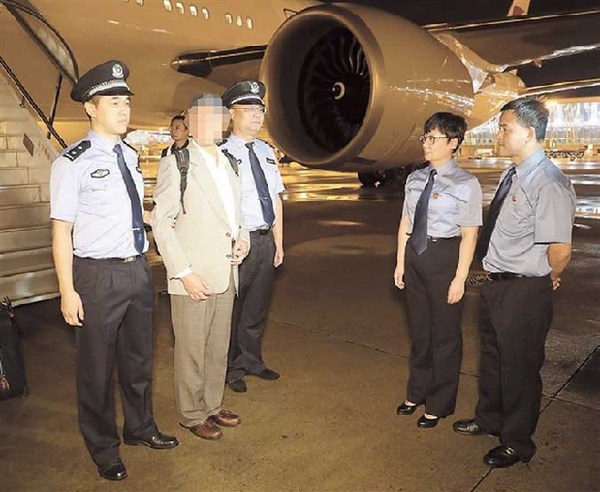
Chen Fujin is met at Pudong airport on his return to Shanghai. [Photo/Shanghai Daily]

His wife escaped with him, according to prosecutors of Minhang District.

On October 18, 1997, he was put on Interpol’s “red notice” wanted list of Chinese economic fugitives who had fled overseas. He was also wanted as part of China’s “Sky Net” anti-graft campaign, started in April 2015, to repatriate fugitive officials.

Details about what Chen’s corruption involved were not disclosed.

Sun Jing, director of the Minhang District People’s Procuratorate, said officials approached Chen and his relatives via WeChat and persuaded him to return to Shanghai, which he did last Thursday.

“I am willing to receive any punishment,” Chen said on a local TV broadcast.

He was arrested on his arrival, prosecutors said.

Shanghai prosecutors said that they have now detained nearly 20 suspects, or about half of those who are being sought in the Sky Net campaign.


Nanjing plays a ‘key role’ in peace

More than 100 scholars and history researchers from China, Japan and South Korea called for peace and mutual understanding in Nanjing, which became China’s first International City of Peace on Saturday.

Ye Nanke, head of the Nanjing Academy of Social Sciences, said Nanjing has set up international peace schools, peace communities and peace research institutes to educate the next generation and bring peace to the public.

“Nanjing plays a key role in peace education and international communications because of its history,” he said. “In the future, the city will establish more peace museums, squares, hospitals and schools.”

Ye made the comments at China’s Concept and Practice of the Right to Peace Seminar, which was held in Nanjing on Monday.

Starting on Dec 13, 1937, some 300,000 Chinese people were killed by Japanese troops in a six-week rampage-one of the most brutal massacres in modern history.

International Cities of Peace, a global nonprofit association dedicated to connecting, promoting and encouraging peace worldwide, approved the city’s application on Aug 31.

Cui Yuying, vice-minister of the State Council Information Office and deputy head of the Publicity Department of the Communist Party of China Central Committee, said at the seminar that China adheres to peaceful development as it tries to promote common development globally.

“China has always been peace-loving, and peace is one of the core values of Chinese civilization,” she said. “Over the years, China has made a significant contribution to the maintenance of peace, both for the Chinese people and the peoples of the world.”

Chang Jian, deputy director of the Human Rights Research Center at Nankai University in Tianjin, said the right to peace means the right to enjoy a peaceful life.

“To enjoy peaceful lives, people should not be threatened by organized violence. Many methods should be adopted to eliminate violence and its causes,” he said.

“Researchers should look at how violent methods used to eliminate violence can be controlled and what alternatives can be used instead,” he said.

Chen Xiaolyu, director of the European Union Research Center at Nanjing University, said that long-term peace can only be acquired when the interests of all parties are respected without the influence of military forces.

“China doesn’t want to realize its goals by forcing other countries,” he said. “We say that China is a peace-loving country, and that is not empty flattery. Plenty of evidence can be provided to prove that.

“China will be an important force in safeguarding world peace. Its development will benefit not only the Chinese but also the peoples of the world.”