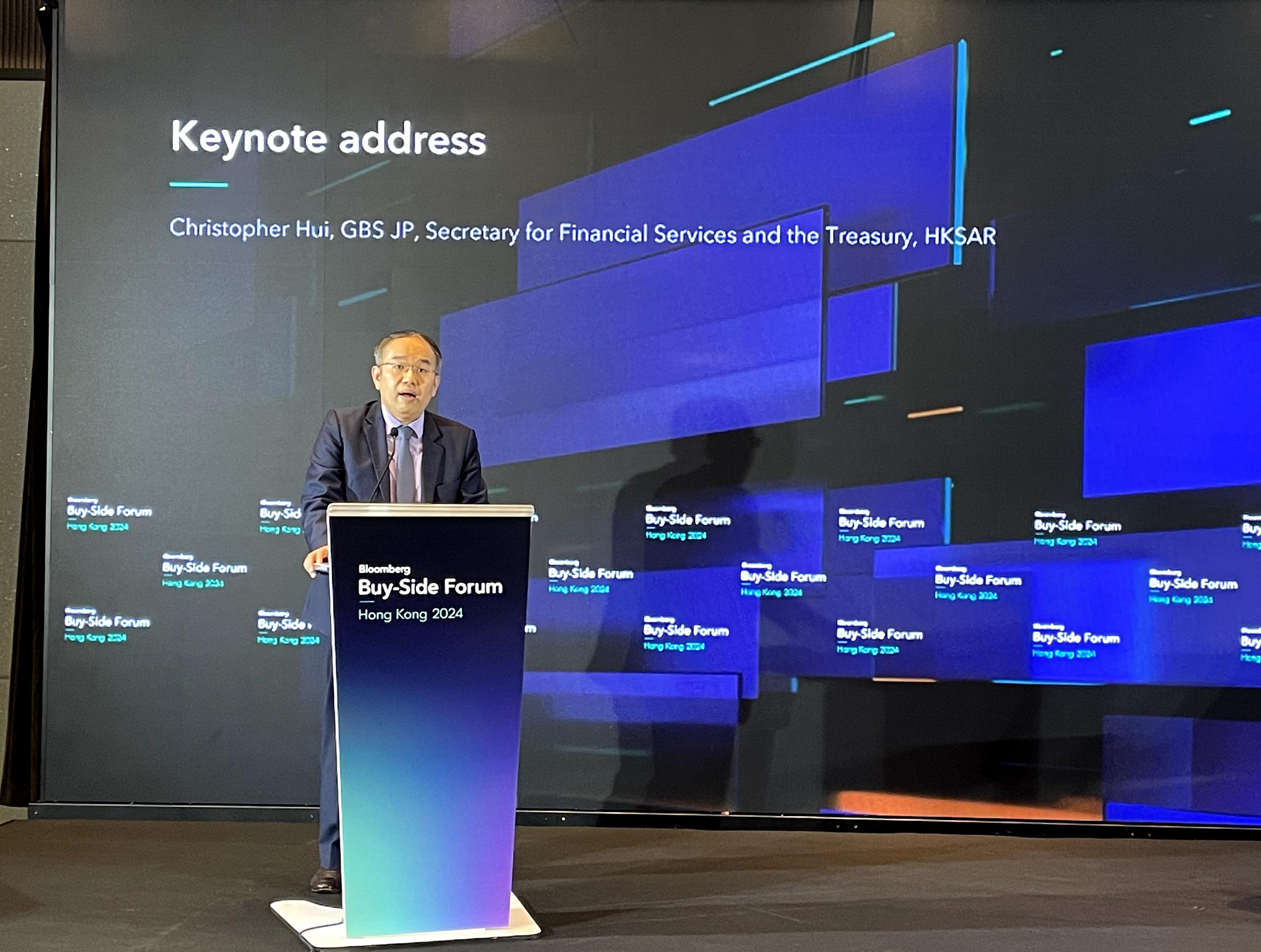
Following is the speech by the Secretary for Financial Services and the Treasury, Mr Christopher Hui, at the Bloomberg Buy-Side Forum Hong Kong today (September 26):
Jeffrey (Global Head of Buy-Side Enterprise Sales of Bloomberg, Mr Jeffrey Leckstein), Manju (APAC Head of Buy-Side Product Sales of Bloomberg, Ms Manju Sakhrani), Irene (Head of Sales, Greater China Buy-Side of Bloomberg, Ms Irene Lam), distinguished guests, ladies and gentlemen,
Good morning. I am very delighted to join you all at the Bloomberg Buy-Side Forum Hong Kong. This flagship event brings together influential business leaders and decision makers to explore timely and transformative topics that are reshaping the asset and wealth management industry. And this is very timely. Just last week the Federal Reserve cut interest rates by 0.5 percentage points. Hong Kong quickly followed suit and the news was cheered by investors and financial markets. Also, Hong Kong ranked third globally in the Global Financial Centres Index 36 Report published two days ago, up by one place from the previous issue. Back in April this year, I had the pleasure of meeting Mr Michael Bloomberg in New York to discuss global financial trends. During my visit to the Big Apple, I also spoke about the "ABCs" of Hong Kong's role as a global financial centre: an "anchor" for financial stability, a "buffer" against risk and a "capstan" with a strategic location in Asia. Today I would like to focus on the "D" word – "dividends"
Overview
Today's agenda explores new prospects for growth and innovation in the Asia Pacific markets, covering key topics including risk management, automation, data and technology, and more. A common factor is that all of these topics are conducive to long-term, sustainable growth and dividends for investors and the industry.
As with our ongoing efforts to boost Hong Kong's position as the region's premier international financial centre, Hong Kong offers three distinct types of dividends, namely "diversification", "succession" and "silver" dividends. These will surely help investors and the industry embrace new opportunities and unleash their potential. Let me tell you how.
Diversification dividend
First, Hong Kong is well poised to provide a diversification dividend with our unique geographical, functional, product and service offerings. All this ensures an excellent platform for diversification, supported by our "one country, two systems" advantages and our role as a financial "super connector" linking Mainland China and global markets. We offer abundant investment opportunities, a full suite of professional services and a top-notch regulatory framework.
In terms of investment opportunities, last year the AUM (assets under management) of Hong Kong's asset and wealth management business reached about US$4 trillion (HK$31.193 trillion). What's more, over half of the funds were sourced from international investors outside Hong Kong and the Mainland. In fact, in 2023, Hong Kong was the world's second-largest cross-boundary wealth management centre, after Switzerland. Hong Kong is also Asia's largest hedge fund hub and our private equity capital under management ranks second in Asia after the Mainland.
As China's hub for offshore Renminbi (RMB) business, Hong Kong holds about one trillion in RMB deposits, and processes about 80 per cent of the global offshore RMB payments. We will continue to expand our RMB-denominated investment and risk-management products to suit users' needs. For the wider financial market, we will also continue to diversify and deepen the products and services we offer, ranging from new fund structures to listing platforms.
Mutual access
Mutual market access between the Mainland and Hong Kong continues to expand in scope and capacity. Up to August this year, the total turnover (including buy and sell trades) of northbound trading of Stock Connect reached about RMB20,000 billion, while that of southbound trading exceeded HK$5,600 billion. This demonstrates our pivotal role for international and Mainland enterprises as well as investors to raise funds and make investments.
The Hong Kong stock market has also seen many recent achievements. The average daily turnover of ETFs (exchange traded funds) listed in Hong Kong reached HK$11.8 billion in 2023, an increase of 20 per cent compared to 2022 (HK$9.8 billion). The derivatives market also saw the average daily trading volume of futures and options reaching 1.35 million contracts last year, further rising to over 1.5 million contracts in the first half of this year. This showcases Hong Kong's ongoing development as an international risk management centre.
In April, the China Securities Regulatory Commission announced five new measures to support the development of Hong Kong's financial sector. These include expanding the scope of ETFs under Stock Connect as implemented in July. The measures would also bring long-term structural enhancements to the Hong Kong market, such as including REITs (real estate investment trusts) under Stock Connect, further enriching the choice of products available.
Green and sustainable finance
Meanwhile, sustainable development and technology are the emerging major forces shaping the financial industry. Demand for green finance is growing worldwide, as part of the global green transformation. Statistics show that the Asian region will require some US$66 trillion in climate investment over the next 30 years.
Zooming into Hong Kong's green and sustainable finance market, the total green and sustainable debt (including both bonds and loans) issued in Hong Kong amounted to US$50 billion. Among which, the volume of green and sustainable bonds arranged in Hong Kong topped the Asian market, accounting for 37 per cent of the total share.
We will continue to develop Hong Kong into an international green technology and green finance centre through five key directions, namely building a green technology ecosystem; green finance application and innovation; green certification and alignment with international standards; training talents; and enhancing exchanges and co-operation with the Greater Bay Area and international markets.
Virtual assets and fintech
Hong Kong is a prime destination for the development of digital finance and for fintech companies to establish or expand their business locally, regionally and globally. We are home to eight virtual banks, four virtual insurers and two licensed virtual assets trading platforms. There are also around 1 000 fintech companies operating in Hong Kong. They cover a variety of businesses including mobile payment, cross-border wealth management, AI (artificial intelligence) financial consultancy, wealth and investment management, regulatory technology and many more.
With the rapid development of the virtual asset market, Hong Kong issued the Policy Statement on Development of Virtual Assets in October 2022. We are also among the first jurisdictions to adopt a comprehensive framework to regulate virtual asset activities with robust investor protection.
Premising on a balance between appropriate regulation and market development, we will continue to provide an enabling environment and support measures. This will help to sustain the development of digital and decentralised finance, and facilitate responsible and healthy industry development. For example, we are actively establishing regulatory regimes for both stablecoin issuers and over-the-counter (OTC) trading of virtual assets. We will introduce the bill for regulating stablecoin issuers into the Legislative Council within this year. We are also reviewing the consultation feedback for virtual asset OTC trading to examine ways to improve the proposed regulatory framework.
Succession dividend
Moving on to succession dividend, which is growing in prominence here. That's because Hong Kong is home to over 2 700 single-family offices and 12 500 ultra-high-net-worth individuals. These figures speak of the city's appeal for family offices and asset owners looking to diversify their asset portfolios and sustain family wealth for future generations.
Last year, we published the Policy Statement on Developing Family Office Businesses in Hong Kong. Since then, a series of measures have been implemented to create a favourable environment for wealth management and succession planning, adding to the already diverse investment opportunities available in the city.
To name a few, the profits tax exemption regime for single family offices' eligible investments was introduced last year, to provide tax certainty and attract family offices to set up in Hong Kong. We also launched the New Capital Investment Entrant Scheme (CIES) in March this year, offering a clear pathway for asset owners to reside and pursue development in Hong Kong. The new scheme has been well-received by asset owners and talents outside Hong Kong. So far, we have received over 550 applications, potentially bringing HK$16.5 billion of capital to the city.
Besides attracting professionals, we are also committed to nurturing talents for the family office sector. Last year, we established the Hong Kong Academy for Wealth Legacy. The Academy not only provides training but also fosters collaboration, networking and knowledge-sharing between the industry and next-generation asset owners.
This brings me to a fast-emerging category of impact investing. We are working to foster charitable endeavours that would make a positive impact on society. The Academy will launch the "Impact Link" later this year. It will provide a repository platform to connect family offices and asset owners with high-potential and high-social impact charitable programmes. This will further enhance family offices' engagement in charitable projects to create positive change and realise the full potential of philanthropy.
Art collections and investments are also gaining popularity among family offices, and Hong Kong is an ideal hub for this with our simple tax system and zero tariff on art trading. We are the second-biggest city for contemporary art sales after New York, recording US$414 million in the year 2022-23. By leveraging Hong Kong's rich art and culture scene, we will continue to consolidate our position as a leading art exhibition and trading centre to create a dynamic ecosystem for art collection and investments for family offices and other investors.
Beyond creating a thriving family office ecosystem, we recognise that each family office has its unique needs and preferences. The dedicated family office team of Invest Hong Kong is here to offer one-stop support services specifically catered to the needs of each family office. Through key events such as the annual Wealth for Good in Hong Kong Summit, we will continue to deepen our connections with global family offices, supporting their evolving needs and garnering dividends from succession and legacy planning.
Silver dividend
My third topic today is the silver dividend. Similar to many developed economies, Hong Kong faces the challenge of a rapidly ageing population. By 2046, over one-third of our population will be aged 65 or above. While this trend poses significant challenges, it also creates opportunities.
Among other things, an ageing population underscores the importance of accumulating sufficient savings to support post-retirement life. With this in mind, the Government launched the Mandatory Provident Fund (MPF) system back in 2000, to help our workforce save up for their retirement. As of June this year, our MPF system was managing a total of HK$1,230 billion of assets, representing an increase of about 126 per cent over the past 10 years.
MPF investment with stable returns
Enabling the general public to feel and share the benefits brought about by the development of financial services has always been our goal. In recent years, our society, particularly among those who will soon retire, has clear aspirations for financial products that offer stable returns amid a changing economic environment. This is evident in the overwhelming response to the Silver Bond issuance last year – where the total application amount (around HK$71.7 billion) and the number of applications (323 789 valid applications) were at record highs.
Likewise, our MPF scheme members have similar aspirations. The Government and the Mandatory Provident Fund Schemes Authority (MPFA) persistently strive to widen the scope of permissible investments to improve risk-adjusted returns. For instance, in June 2022, the Central People's Government, the People's Bank of China, and the three Mainland policy banks were added to the list of "exempt authority" to facilitate MPF investment in sovereign bonds. It provides scheme members with greater access to one of the world's largest bond markets. In June last year, we also put in place a mechanism to earmark a certain proportion of Government green bonds for priority investment by MPF funds.
These measures allow MPF fund managers to consider more investment instruments with stable returns in their portfolio management for the benefit of scheme members. As of June this year, MPF funds invested HK$8.3 billion and HK$600 million in sovereign bonds and government green bonds respectively, representing an increase of 159 per cent and 50 per cent respectively before the facilitative measures were put in place.
Diversification and optimisation of MPF investment
We believe that our robust asset and wealth management industry is serving the MPF system well. It offers world-class investment management services along with a diverse range of financial products and innovative market arrangements.
In view of the growing internationalisation of the Mainland's equity market, back in 2020, we included the Shanghai and Shenzhen stock exchanges in the list of "approved stock exchanges", facilitating MPF investments into Mainland A-shares. Since the inclusion of the two stock exchanges, the exposure of MPF funds to Mainland A-shares has soared by 111 per cent to HK$24 billion as of June this year. Not only has this been welcomed by the market, it also provides more diversified investment opportunities for MPF assets.
Fee reduction and eMPF Platform
Apart from offering a more diversified range of investment products for MPF scheme members, the Government and the MPFA are determined to explore and take forward more cost saving initiatives by leveraging innovation and technology. Launched in June this year, the eMPF Platform is a good example of how innovation and technology could resolve long-standing pain points in MPF scheme administration. They also create room for fee reductions for the ultimate benefit of scheme members.
We expect that the eMPF Platform will be fully implemented by end-2025. Through standardising, streamlining and automating different MPF administration processes, this first-of-its-kind centralised platform will significantly reduce the average MPF administration fee. This publicly funded digital infrastructure will also lower the entry barrier for newcomers to the MPF industry.
Closing
Ladies and gentlemen, I know you have a busy day ahead. So let me conclude by stressing the importance of joining hands in building, investing and enjoying the diversification dividend, succession dividend and silver dividend in Hong Kong. This forum is the perfect opportunity to share ideas and strengthen collaboration to achieve a more stable, sustainable and prosperous financial future in Hong Kong and far beyond.
I wish you all a rewarding forum today and the best of health and business. Thank you.