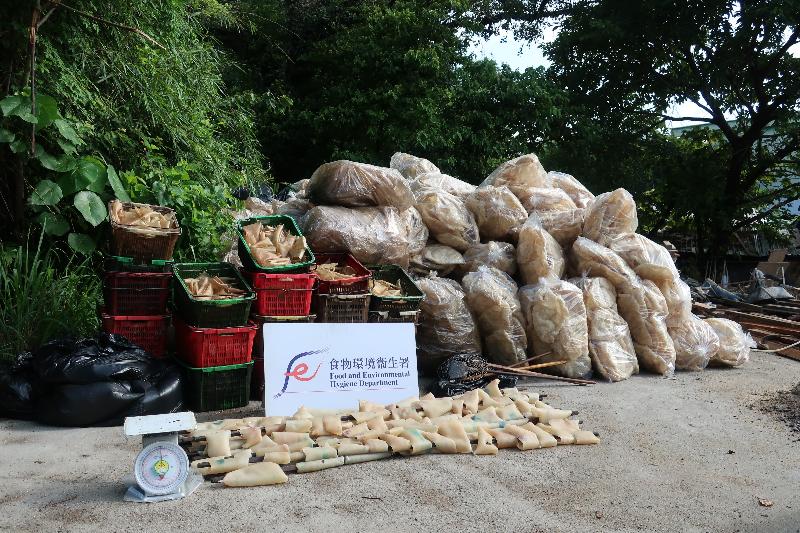
Unlicensed food factory in Yuen Long raided (with photo)

     The Food and Environmental Hygiene Department (FEHD) raided an unlicensed food factory at Shek Wu Wai, Yuen Long, early this morning (June 26).
      
     During the operation, FEHD officers seized about 2 300 kilograms of pig skin intended for human consumption and some tools. A 26-year-old man was arrested and charged with operating an unlicensed food factory and failing to maintain cleanliness of food premises.
      
     "The FEHD will continue to take stringent enforcement action against unlicensed food factory activities. Under the Food Business Regulation (Cap 132X), anyone operating an unlicensed food factory commits an offence and is liable to a maximum fine of $50,000 and imprisonment for six months upon conviction," a spokesman for the FEHD said.
      
     "Members of the public can report suspected unlicensed food factories by calling the FEHD hotline on 2868 0000."

Photo  


CHP investigates case of Legionnaires’ disease in elderly home

     The Centre for Health Protection (CHP) of the Department of Health is today (June 26) investigating a case of Legionnaires' disease (LD), and stressed the importance of using and maintaining properly designed man-made water systems and that susceptible groups should strictly observe relevant precautions.

     The male patient, aged 81 with underlying illness, who lives in a residential care home for the elderly (RCHE) in Kowloon City District, has developed fever, cough with sputum, runny nose and shortness of breath since June 21 and was admitted to Kwong Wah Hospital for treatment the next day. The clinical diagnosis was pneumonia and he is in a stable condition.
 
     The patient's urine sample tested positive for Legionella pneumophila serogroup 1 antigen upon laboratory testing.
 
     Initial enquiries revealed that the patient had no travel history in the incubation period.

     "Epidemiological investigations with the RCHE are ongoing to identify potential sources of infection, high-risk exposure and clusters, if any. Relevant water samples and environmental swabs have been collected from potential sources for testing," a spokesman for the CHP said.
 
     Tracing of contacts including staff and residents in the RCHE where the patient stayed is ongoing and those identified will be put under medical surveillance. The CHP has provided health advice against LD to staff and residents, including those with weakened immunity who should use sterile or boiled water for drinking, tooth brushing and mouth rinsing.

     Legionellae are found in various environmental settings and grow well in warm water (20 to 45 degrees Celsius). They can be found in aqueous environments such as water tanks, hot and cold water systems, cooling towers, whirlpools and spas, water fountains and home apparatus that support breathing. People may get infected when they breathe in contaminated droplets (aerosols) and mist generated by artificial water systems. They may also get the infection when handling garden soil, compost and potting mixes.

     Persons with weakened immunity should strictly observe the health advice below:
 

  • Use sterile or boiled water for drinking, tooth brushing and mouth rinsing;
  • Avoid using humidifiers, or other mist- or aerosol-generating devices. A shower may also generate small aerosols; and
  • If using humidifiers, or other mist- or aerosol-generating devices, fill the water tank with only sterile or cooled freshly boiled water, and not water directly from the tap. In addition, clean and maintain humidifiers/devices regularly according to manufacturers' instructions. Never leave stagnant water in a humidifier/device. Empty the water tank, wipe all surfaces dry, and change the water daily.

     The public, including susceptible groups, should take heed of the general precautions against LD below:
 

  • Observe personal hygiene;
  • Do not smoke and avoid alcohol;
  • Strainers in water taps and shower heads should be inspected, cleaned, descaled and disinfected regularly or at a frequency recommended by the manufacturer;
  • If a fresh water plumbing system is properly maintained, it is not necessary to install domestic water filters. Use of water filters is not encouraged as clogging occurs easily, which can promote growth of micro-organisms. In case water filters are used, the pore size should be 0.2 micrometres (µm) and the filter needs to be changed periodically according to the manufacturer's recommendations;
  • Drain and clean water tanks of buildings at least quarterly;
  • Drain or purge for at least one minute the infrequently used water outlets (e.g. water taps, shower heads and hot water outlets) and stagnant points of the pipework weekly or before use;
  • Seek and follow medical advice regarding the use and maintenance of home respiratory devices and use only sterile (not distilled or tap) water to clean and fill the reservoir. Clean and maintain the device regularly according to manufacturer's instructions. After cleaning/disinfection, rinse the device with sterile water, cooled freshly boiled water or water filtered with 0.2-micrometre filters. Never leave stagnant water in the device. Empty the water tank, keep all surfaces dry, and change the water daily; and
  • When handling garden soil, compost and potting mixes:
  1. Water gardens and compost gently using low pressure;
  2. Open composted potting mixes slowly and make sure the opening is directed away from the face;
  3. Wet the soil to reduce dust when potting plants; and
  4. Avoid working in poorly ventilated places such as enclosed greenhouses.

     More information is available in the CHP's LD page, the Code of Practice for Prevention of LD and the Housekeeping Guidelines for Cold and Hot Water Systems for Building Management of the Prevention of LD Committee, and the CHP's risk-based strategy for prevention and control of LD.


Mobile Library 7 resumes service

     The services provided by Mobile Library 7 have resumed after completion of urgent repairs to the mobile library van, a Leisure and Cultural Services Department spokesman announced today (June 26).
 
     The service points of Mobile Library 7 are Fung Tak Estate and Chuk Yuen (South) Estate in Wong Tai Sin, Hoi Fu Court in Mong Kok West, Sceneway Garden in Lam Tin and Kai Yip Estate in Kowloon Bay.
 
     For enquiries about Mobile Library 7 services, please call 2926 3056.


HAD to open temporary night heat shelters

     The Home Affairs Department will open 18 temporary night heat shelters tonight (June 26) for people in need of the service.
      
     The shelters will be open from 10.30pm until 8am tomorrow.

     For further information, please call the department's enquiries hotline before midnight on 2835 1473.
      
     The 18 night heat shelters are located at:
 
Hong Kong Districts:
———————
 
Central and Western –
Sai Ying Pun Community Complex Community Hall
3/F, Sai Ying Pun Community Complex
2 High Street, Sai Ying Pun
 
Eastern/Wan Chai –
Causeway Bay Community Centre
Waiting Lobby, 3/F, 7 Fook Yum Road, Causeway Bay
 
Southern –
Lei Tung Community Hall
Lei Tung Estate, Ap Lei Chau
 
Kowloon Districts:
——————
 
Kowloon City –
Hung Hom Community Hall
Multi-purpose Room, 1/F, Kowloon City Government Offices
42 Bailey Street, Hung Hom
 
Kwun Tong –
Lam Tin (West) Estate Community Centre
71 Kai Tin Road, Lam Tin
 
Sham Shui Po –
Shek Kip Mei Community Hall
G/F, Block 42, Shek Kip Mei Estate
Nam Cheong Street, Sham Shui Po

Wong Tai Sin –
Tsz Wan Shan (South) Estate Community Centre
Hall, G/F, 45 Wan Wah Street, Tsz Wan Shan
 
Yau Tsim Mong –
Henry G Leong Yaumatei Community Centre
60 Public Square Street, Yau Ma Tei
 
New Territories Districts:
————————–
 
Islands –
Tung Chung Community Hall
G/F, Tung Chung Municipal Services Building,
39 Man Tung Road, Tung Chung
 
Kwai Tsing –
Kwai Shing Community Hall
Podium, Block 6, Kwai Shing West Estate, Kwai Chung
 
North –
Cheung Wah Community Hall
Cheung Wah Estate, Fanling
 
Sai Kung –
Hang Hau Community Hall
G/F, Sai Kung Tseung Kwan O Government Complex,
38 Pui Shing Road, Hang Hau, Tseung Kwan O
 
Sha Tin –
Lung Hang Estate Community Centre
Lung Hang Estate, Sha Tin
 
Tai Po –
Tai Po Community Centre
2 Heung Sze Wui Street, Tai Po
 
Tsuen Wan –
Lei Muk Shue Community Hall
G/F, Hong Shue House, Lei Muk Shue Estate, Tsuen Wan
 
Tuen Mun –
Butterfly Bay Community Centre
Butterfly Estate (near Tip Sum House), Tuen Mun
 
Yuen Long –
Long Ping Community Hall
Long Ping Estate, Yuen Long
 
Yuen Long –
Tin Yiu Community Centre
Tin Yiu Estate, Tin Shui Wai
      
     The temporary night heat shelters will resume their functions as either community centres or community halls in the daytime for hire by the local community and cannot continue to be open as heat shelters. People may choose to take refuge from the heat during the daytime in the common areas in any of the 21 designated community centres or community halls. Their opening hours are from 9am to 10pm. For addresses of the community centres or community halls, please browse the following webpage: https://www.had.gov.hk/file_manager/en/documents/public_services/emergency_services/List_CH_CC_Day_E.pdf


Wage and payroll statistics for March 2018

Overall wage and payroll statistics

     According to the figures released today (June 26) by the Census and Statistics Department (C&SD), the average wage rate for all the selected industry sections surveyed, as measured by the wage index, increased by 4.0% in nominal terms in March 2018 over a year earlier.

     About 68% of the companies reported increase in average wage rates in March 2018 compared with a year ago. 27% of the companies recorded decrease in average wage rates over the same period. The remaining 5% reported virtually no change in average wage rates.

     After discounting the changes in consumer prices as measured by the Consumer Price Index (A), the overall average wage rate for all the selected industry sections surveyed increased by 1.2% in real terms in March 2018 over a year earlier.

     As for payroll, the index of payroll per person engaged for all the industry sections surveyed increased by 3.8% in nominal terms in the first quarter of 2018 over a year earlier.

     After discounting the changes in consumer prices as measured by the Composite Consumer Price Index, the average payroll per person engaged increased by 1.3% in real terms in the first quarter of 2018 compared with a year earlier.

     The wage rate includes basic wages and other regular and guaranteed allowances and bonuses. Payroll includes elements covered by wage rate as well as other irregular payments to workers such as discretionary bonuses and overtime allowances. The payroll statistics therefore tend to show relatively larger quarter-to-quarter changes, affected by the number of hours actually worked and the timing of payment of bonuses and back-pay.

Sectoral changes

     For the nominal wage indices, year-on-year increases ranging from 3.1% to 4.9% were recorded in all selected industry sections in March 2018.

     For the real wage indices, year-on-year increases ranging from 0.4% to 2.1% were recorded in all selected industry sections in March 2018.

     The year-on-year changes in the nominal and real wage indices for the selected industry sections from March 2017 to March 2018 are shown in Table 1.

     As for the nominal indices of payroll per person engaged, year-on-year increases ranging from 2.8% to 4.8% were recorded in all selected industry sections in the first quarter of 2018.

     For the real payroll indices, year-on-year increases ranging from 0.3% to 2.3% were recorded in all selected industry sections in the first quarter of 2018.

     The year-on-year changes in the nominal and real indices of payroll per person engaged for selected industry sections from the first quarter of 2017 to the first quarter of 2018 are shown in Table 2. The quarterly changes in the seasonally adjusted nominal and real indices of payroll per person engaged between the first quarter of 2017 and the first quarter of 2018 are shown in Table 3.

Commentary

     A Government spokesman noted that overall nominal wages registered a slightly faster year-on-year increase in March 2018, on the back of robust economic growth and the progressive tightening of the labour market over the past year. Wages of lower-paid workers continued to see more appreciable growth.

     Payroll per person engaged, which covers discretionary bonuses and other irregular payments, sustained solid and broad-based year-on-year increase in the first quarter of 2018. Among the major industries, more notable rises in payroll were seen in accommodation and food service activities, professional and business services, as well as real estate activities.

     The spokesman added that the generally sanguine economic situation and positive hiring sentiment should bode well for the overall earnings situation in the near term. The Government will nevertheless monitor various external uncertainties and their potential impact on the local labour market closely.

Other information

     Both wage indices and payroll indices are compiled quarterly based on the results of the Labour Earnings Survey conducted by the C&SD.

     Wage statistics are conceptually different from the payroll statistics. Firstly, wage rate for an employee refers to the sum earned for his normal hours of work. It covers basic wages and other regular and guaranteed allowances and bonuses, but excludes earnings from overtime work and discretionary bonuses, which are however included in payroll per person engaged. Secondly, the payroll index of an industry is an indicator of the simple average payroll received per person engaged in the industry. Its movement is therefore affected by changes in wage rates, number of hours of work and occupational composition in the industry. In contrast, the wage index of an industry is devised to reflect the pure changes in wage rate, with the occupational composition between two successive statistical periods being kept unchanged. In other words, the wage index reflects the change in the price of labour. Thirdly, wage index only covers employees up to the supervisory level (i.e. not including managerial and professional employees), whereas payroll index covers employees at all levels and proprietors actively engaged in the work of the establishment. Because of these conceptual and enumeration differences between payroll and wage statistics, the movements in payroll indices and in wage indices do not necessarily match closely with each other.

     It should also be noted that different consumer price indices are used for compiling the real indices of wage and payroll to take into account the differences in their respective occupation coverage. Specifically, the Composite Consumer Price Index, being an indicator of overall consumer prices, is taken as the price deflator for payroll of workers at all levels of the occupational hierarchy. The Consumer Price Index (A), being an indicator of consumer prices for the relatively low expenditure group, is taken as the price deflator for wages in respect of employees engaged in occupations up to the supervisory level.

     Detailed breakdowns of the payroll and wage statistics are published in the "Quarterly Report of Wage and Payroll Statistics, March 2018". Users can download this publication free of charge from the website of the C&SD (www.censtatd.gov.hk/hkstat/sub/sp210.jsp?productCode=B1050009).

     For enquiries on wage and payroll statistics, please contact the Wages and Labour Costs Statistics Section (1) of the C&SD (Tel: 2887 5550 or email: wage@censtatd.gov.hk).