Consumer Price Indices for July 2018

     The Census and Statistics Department (C&SD) released today (August 21) the Consumer Price Index (CPI) figures for July 2018. According to the Composite CPI, overall consumer prices rose by 2.4% in July 2018 over the same month a year earlier, remaining virtually unchanged as compared to June 2018. Netting out the effects of all Government's one-off relief measures, the year-on-year rate of increase in the Composite CPI (i.e. the underlying inflation rate) in July 2018 also remained virtually unchanged at 2.7% as compared to June 2018.
 
     On a seasonally adjusted basis, the average monthly rate of increase in the Composite CPI for the three-month period from May to July 2018 was 0.2%, and that for the three-month period from April to June 2018 was 0.1%. Netting out the effects of all Government's one-off relief measures, the average monthly rate of increase in the Composite CPI for the three-month period from May to July 2018 was 0.2%, the same as that for the three-month period from April to June 2018. 

     Analysed by sub-index, the year-on-year rates of increase in the CPI(A), CPI(B) and CPI(C) were 2.5%, 2.3% and 2.3% respectively in July 2018, as compared to 2.6%, 2.3% and 2.2% respectively in June 2018. Netting out the effects of all Government's one-off relief measures, the year-on-year rates of increase in the CPI(A), CPI(B) and CPI(C) were 2.8%, 2.7% and 2.6% respectively in July 2018, as compared to 2.9%, 2.7% and 2.5% respectively in June 2018. 

     On a seasonally adjusted basis, for the three-month period from May to July 2018, the average monthly rates of increase in the seasonally adjusted CPI(A), CPI(B) and CPI(C) were all 0.2%. The corresponding rates of increase for the three-month period from April to June 2018 were 0.2%, 0.1% and 0.1% respectively. Netting out the effects of all Government's one-off relief measures, the corresponding average monthly rates of increase in the seasonally adjusted CPI(A), CPI(B) and CPI(C) for the three-month period from May to July 2018 were all 0.2%, and the corresponding rates of increase for the three-month period from April to June 2018 were 0.3%, 0.2% and 0.2% respectively. 

     Amongst the various CPI components, year-on-year increases in prices were recorded in July 2018 for food (excluding meals bought away from home) (4.8% in the Composite CPI and 4.5% in the CPI(A)); electricity, gas and water (4.2% in the Composite CPI and 4.5% in the CPI(A)); meals bought away from home (2.9% in the Composite CPI and 3.0% in the CPI(A)); clothing and footwear (2.4% in the Composite CPI and 2.2% in the CPI(A)); housing (2.2% in the Composite CPI and 2.4% in the CPI(A)); transport (2.2% in the Composite CPI and 1.6% in the CPI(A)); miscellaneous services (1.8% in the Composite CPI and 1.0% in the CPI(A)); miscellaneous goods (1.4% in the Composite CPI and 1.9% in the CPI(A)) as well as alcoholic drinks and tobacco (0.6% in both the Composite CPI and CPI(A)). 

     On the other hand, year-on-year decrease in prices was recorded in July 2018 for durable goods (-2.1% in the Composite CPI and -2.0% in the CPI(A)). 

     Taking the first seven months of 2018 together, the Composite CPI rose by 2.3% over a year earlier. The corresponding increases in the CPI(A), CPI(B) and CPI(C) were 2.5%, 2.2% and 2.2% respectively. Netting out the effects of all Government's one-off relief measures, the Composite CPI, CPI(A), CPI(B) and CPI(C) rose by 2.5%, 2.7%, 2.4% and 2.4% respectively in the first seven months of 2018 over a year earlier. 

     For the three months ended July 2018, the Composite CPI rose by 2.3% over a year earlier, while the CPI(A), CPI(B) and CPI(C) rose by 2.5%, 2.2% and 2.1% respectively. The corresponding increases after netting out the effects of all Government's one-off relief measures were 2.6%, 2.8%, 2.6% and 2.4% respectively. 

     For the 12 months ended July 2018, the Composite CPI was on average 2.0% higher than that in the preceding 12-month period. The respective increases in the CPI(A), CPI(B) and CPI(C) were 2.2%, 1.9% and 2.0% respectively. The corresponding increases after netting out the effects of all Government's one-off relief measures were 2.1%, 2.3%, 2.0% and 2.1% respectively. 

Commentary

     A Government spokesman said that underlying inflation pressure held largely steady in July, with the year-on-year rate of change in the underlying Composite CPI staying unchanged at 2.7%. In view of the edging up of global inflation and continued feed-through of earlier rises in fresh-letting residential rentals, local underlying consumer price inflation in the months ahead may remain somewhat higher than in the first half of 2018, when it averaged 2.4%. Yet, inflation should stay within a moderate range for 2018 as a whole. The Government will continue to monitor the situation closely, particularly the impact on the lower-income people.

Further information

     The CPIs and year-on-year rates of change at section level for July 2018 are shown in Table 1. The time series on the year-on-year rates of change in the CPIs before and after removing the effects of all Government's one-off relief measures are shown in Table 2. For discerning the latest trend in consumer prices, it is also useful to look at the changes in the seasonally adjusted CPIs. The corresponding time series on the average monthly rates of change during the latest three months for the seasonally adjusted CPIs are shown in Table 3. The rates of change in the original and the seasonally adjusted Composite CPI and the underlying inflation rate are presented graphically in Chart 1.

     More detailed CPI data (including year-on-year comparison, month-to-month comparison, seasonally adjusted data series and the CPIs by the Classification of Individual Consumption According to Purpose (COICOP)) are available in the monthly reports.  Users can download the July 2018 issue of the "Monthly Report on the Consumer Price Index" (www.censtatd.gov.hk/hkstat/sub/sp270.jsp?productCode=B1060001), the time series of CPIs at detailed level (www.censtatd.gov.hk/hkstat/sub/sp270.jsp?productCode=D5600001), the time series of CPIs at COICOP division level (www.censtatd.gov.hk/hkstat/sub/sp270.jsp?productCode=D5600002) and the time series of CPIs after netting out the effects of all Government's one-off relief measures (www.censtatd.gov.hk/hkstat/sub/sp270.jsp?productCode=D5600003) free of charge at the website of the C&SD.

     For enquiries about the CPIs, please contact the Consumer Price Index Section of the C&SD (Tel: 3903 7374 or email: cpi@censtatd.gov.hk).



Senior appointment (with photos)

     The Government announced today (August 21) that Mr Lam Sai-hung, Director of Civil Engineering and Development, will assume the post of Permanent Secretary for Development (Works) on October 13, 2018, succeeding Mr Hon Chi-keung, who will proceed on pre-retirement leave.

     Commenting on the appointment of Mr Lam, the Secretary for the Civil Service, Mr Joshua Law, said, "Mr Lam is an experienced senior civil servant with profound knowledge and rich experience in the works field. He also possesses effective leadership and management skills. I have every confidence that he will continue to serve the community with professionalism in his new capacity."
  
     On the retirement of Mr Hon, Mr Law said, "Mr Hon has rendered 35 years of dedicated public service to the community and has made tremendous contributions in the many different professional areas of works and engineering. I wish him a fulfilling and happy retirement."

     Brief biographical notes of the two officers are set out below:

Mr Hon Chi-keung
——————–

     Mr Hon joined the Government as an Assistant Engineer in August 1983. He was promoted to Chief Engineer in May 1999, to Government Engineer in July 2005, and to Principal Government Engineer in November 2008. He was Project Manager of the Hong Kong Island and Islands Development Office in the Civil Engineering and Development Department from March 2008 to January 2011 and Director of Civil Engineering and Development from January 2011 to April 2015, and has been Permanent Secretary for Development (Works) since April 2015.

Mr Lam Sai-hung
——————-

     Mr Lam joined the Government as an Assistant Engineer in August 1986. He was promoted to Chief Engineer in August 2009, to Government Engineer in April 2012, and to Principal Government Engineer in May 2014. He was Project Manager of the Hong Kong Island and Islands Development Office in the Civil Engineering and Development Department from June 2015 to August 2016. He has been Director of Civil Engineering and Development since September 2016.

Photo  Photo  


Effective Exchange Rate Index

     The effective exchange rate index for the Hong Kong dollar on Tuesday, August 21, 2018 is 104.1 (down 0.3 against yesterday's index).


EPD successfully prosecutes importer for illegal import of hazardous electronic waste from United States (with photo)

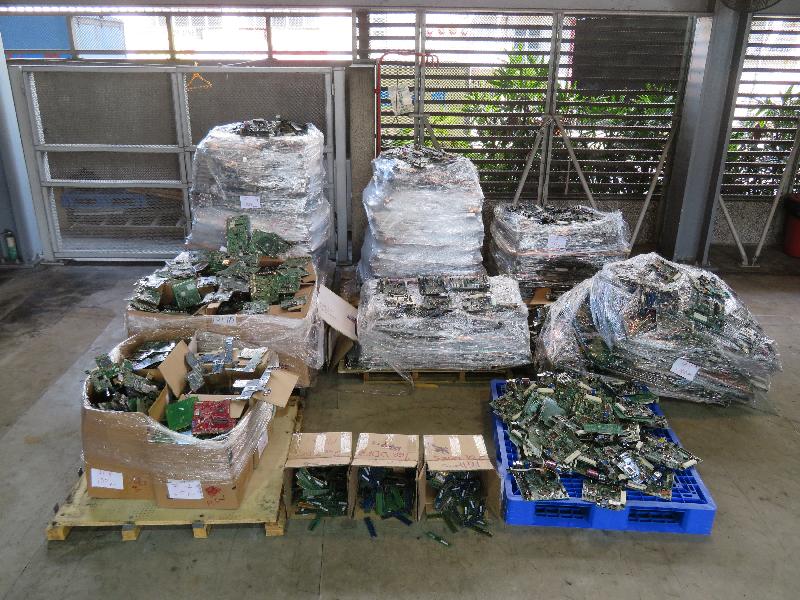
     â€‹The Environmental Protection Department (EPD) successfully intercepted a case of illegal import of hazardous electronic waste (e-waste) from the United States (US) at the Kwai Chung Container Terminals. The local importer concerned, Intech Environmental Recycling Limited, was fined $20,000 at Fanling Magistrates' Courts today (August 21) for contravening the Waste Disposal Ordinance (WDO).

     With the assistance of the Customs and Excise Department, EPD staff intercepted an imported container from the US at the Kwai Chung Container Terminals in April this year. The container was claimed to contain computer parts, but upon inspection it was found to be loaded with hazardous e-waste comprising waste printed circuit boards (PCBs), with a market value of about $360,000. The intercepted container was immediately returned to the place of origin. The EPD notified the foreign enforcement authorities concerned about the return shipment and instigated prosecution against the importer in accordance with the WDO.

     An EPD spokesman stressed that dismantled or destroyed PCBs are hazardous waste, containing various heavy metals and other toxic chemical substances. They are classified as chemical waste and are regulated under the existing laws on chemical waste disposal. To protect the environment, the EPD rigorously combats the illegal import and export activities of hazardous waste.

     The spokesman reminded importers of the waste recycling trade not to import (including import into or transshipment through Hong Kong) or export hazardous waste. According to the WDO, it is an offence for anyone to import or export hazardous waste unless obtaining a valid permit beforehand. First-time offenders are liable to a maximum fine of $200,000 and six months' imprisonment. For subsequent offences, offenders are liable to a maximum fine of $500,000 and two years' imprisonment.

     Members of the public may visit the EPD's website for more information about the control of chemical waste: www.epd.gov.hk/epd/english/environmentinhk/waste/guide_ref/guide_cwc.html.

Photo  


July’s monthly ovitrap index for Aedes albopictus rises

     The Food and Environmental Hygiene Department (FEHD) today (August 21) announced that the monthly ovitrap index for Aedes albopictus for July rose to 15.7 per cent from 11.3 per cent in June, indicating that mosquito infestation was slightly more extensive in the areas surveyed. Coupled with the 16 confirmed local dengue fever (DF) cases recorded so far this month, the FEHD reminded the public to heighten vigilance and keep up effective prevention and control measures against mosquitoes, as well as to take personal protective measures to reduce the risk of contracting mosquito-borne diseases through mosquito bites. The Government is actively studying the proposal to announce the ovitrap index for Aedes albopictus in a more timely manner.

     "Aedes albopictus is a kind of mosquito that can transmit DF and Zika virus. The hot and rainy weather of summer is favourable for massive mosquito breeding. In view of the fact that DF is still highly prevalent in neighbouring areas, and Hong Kong recorded 16 local DF cases so far this month, the community must work with the Government to continue to carry out effective mosquito prevention and control measures," an FEHD spokesman said.

     In order to strengthen dengue vector surveillance, the FEHD has increased the number of survey areas from 52 to 57 last month, and the survey period has also been extended from one week to two weeks every month. Among the 57 areas surveyed last month, the Area Ovitrap Index (AOI) in 15 areas reached or exceeded the alert level of 20 per cent. They were Yau Tong (45.1 per cent), Wo Che (42.6 per cent), Tseung Kwan O North (33.3 per cent), Tsuen Wan West (29.8 per cent), Tuen Mun West (28.7 per cent), Kowloon Bay (28.7 per cent), Kowloon City North (24.5 per cent), Central and Admiralty (24.5 per cent), Yuen Kong (24 per cent), Tai Wai (22.8 per cent), Wong Tai Sin Central (21.8 per cent), Ma On Shan (21.8 per cent), Lam Tin (20.8 per cent), Tsim Sha Tsui (20.2 per cent) and Ngau Chi Wan (20.2 per cent).

     As for the port areas, the monthly ovitrap index for Aedes albopictus for July also slightly rose to 2.7 per cent from 2.4 per cent in June.

     The spokesman said, "The FEHD is very concerned about mosquito infestation, and an inter-departmental anti-mosquito response mechanism has been activated in the above-mentioned areas for co-ordinating relevant departments and stakeholders to carry out effective mosquito prevention and control measures. In response to the ten odd DF cases recorded in Hong Kong recently, the FEHD has stepped up targeted mosquito prevention and control work at the relevant districts, including conducting fogging operations to reduce the number of adult mosquitoes; and applying larvicides and clearing stagnant water and disused articles to prevent mosquito breeding in areas within a 500-metre radius of the residences of the patients and the places visited by them after illness onset. The FEHD also collected samples of Aedes albopictus at the places concerned for dengue virus testing.

     “The FEHD has earlier commenced the third phase of the territory-wide anti-mosquito campaign and enhanced the mosquito control work by conducting the territory-wide all-out anti-mosquito operations for 10 weeks to concentrate on killing adult mosquitoes with a view to reducing the risk of the spread of DF. During the period, relevant departments and the Hospital Authority will also carry out the all-out anti-mosquito operations in areas under their purview, including conducting fogging operations in the scrubby areas within 200-metre radius of the residences every week to kill adult mosquitoes; carrying out inspection of venues, removing stagnant water, applying insecticide and disposing of abandoned water containers every week to prevent mosquito breeding; and trimming of grass to remove the potential habitat of adult mosquitoes and facilitate mosquito control work."

     In addition, relevant departments have individually notified the groups that had voluntarily subscribed to the ovitrap rapid alert system when the AOI reached the alert level of 20 per cent. Subscribers have been invited to post specially designed alert notices in the common parts of their premises to urge occupants and staff to carry out mosquito prevention and control measures promptly.

     The FEHD has also swiftly handled mosquito complaints and taken out prosecutions against mosquito breeding under the relevant ordinance. The FEHD set up four Pest Control Inspection Teams in May last year to step up inspection of construction sites and enforcement action against mosquito breeding. This year (as at August 19), the FEHD had instituted 139 prosecutions for mosquito breeding found in relevant premises under the Public Health and Municipal Services Ordinance (Cap 132), comprising 133 cases involving construction sites and six cases involving other premises.

     The FEHD and relevant government departments will continue to intensify their mosquito prevention and control work covering areas under their purview, and strengthen publicity and education campaigns, including closely liaising with local organisations and widely disseminating anti-mosquito messages through their community network. In addition, the district offices of the FEHD will target areas which have drawn particular concern, such as public markets, cooked food centres and hawker bazaars, single-block buildings, streets and back lanes, common parts of buildings, village houses, construction sites, vacant sites and road works sites to intensify mosquito prevention and control work. The FEHD will, immediately after each phase of the campaign, conduct special territory-wide thematic mosquito prevention and control operations so as to enhance the effectiveness of the campaign.

     As Aedes albopictus breeds in small water bodies, the spokesman reminded members of the public to continue to carry out effective mosquito prevention and control measures, including inspecting their homes and surroundings to remove potential breeding grounds, scrubbing vases and pot plant saucers at least once a week, properly disposal of containers such as soft drink cans and lunch boxes, and drilling large holes in unused tyres. He also advised the public and estate management bodies to keep drains free of blockage and fill up all depressions to prevent puddles from forming. They should also scrub all drains and surface sewers with an alkaline detergent compound at least once a week to remove any mosquito eggs.

     In addition, rural areas and the vicinity of shrubby areas are the natural habitats for mosquitoes, other insects and animals. Members of the public living in rural areas may install mosquito screens on windows and doors if necessary. Those staying in the natural environment should follow appropriate personal protective measures against mosquitoes, such as avoiding staying in the vicinity of shrubby areas for a long time, wearing light-coloured long-sleeved clothes and trousers and applying DEET-containing insect repellent. Members of the public are reminded to make reports to the government departments via 1823 if mosquito problems are detected.

     The spokesman reiterated that effective mosquito control requires the sustained effort of all parties concerned. The community must work together with the Government to carry out effective mosquito control measures.

     The ovitrap index is divided into four levels, reflecting the infestation level of Aedes albopictus. Level 1 (< 5 per cent) indicates that infestation of the mosquito is not extensive in the area surveyed. Level 2 (5 per cent – < 20 per cent) indicates that infestation of the mosquito is slightly more extensive in the area surveyed. Level 3 (20 per cent – < 40 per cent) indicates that infestation of the mosquito exceeds one-fifth of the area surveyed. Level 4 (>/= 40 per cent) indicates that almost half of the surveyed area is infested with the mosquito. The Government will step up the scale of anti-mosquito operations according to the level of infestation as well as reports from front-line staff and the public.

     As Aedes albopictus can transmit DF and Zika virus, oviposition traps are set in 57 areas in Hong Kong for monitoring the breeding of Aedes albopictus, which is only one of the mosquito species commonly found in Hong Kong and is active only in the daytime. The index does not capture the activity of Aedes albopictus outside the 57 areas and it also does not measure the prevalence of other kinds of mosquitoes.

     The ovitrap indices for Aedes albopictus in different areas and information on mosquito prevention and control measures are available on the department website at www.fehd.gov.hk.