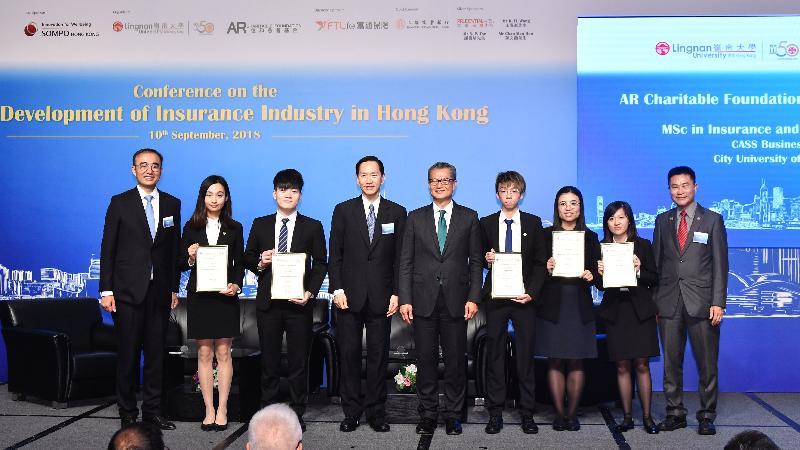
Speech by FS at Conference on the Future Development of Insurance Industry in Hong Kong (English only)(with photos/video)

     Following is the speech by the Financial Secretary, Mr Paul Chan, at the Conference on the Future Development of Insurance Industry in Hong Kong co-organised by Lingnan University and the AR Charitable Foundation this afternoon (September 10):
 
Rex (Council Chairman of Lingnan University, Mr Rex Auyeung), Leonard (President of Lingnan University, Professor Leonard Cheng), Mason (Director of the AR Charitable Foundation Mr Mason Wu), Bernard (Director of the AR Charitable Foundation Mr Bernard Chan), distinguished guests, ladies and gentlemen,
 
     Good afternoon.
 
     I'm pleased to join you this afternoon, to take part in today's conference on the future of the insurance industry, organised by Lingnan University and the AR Charitable Foundation.
 
     Insurance means many things to many people. As a product, it must be one of the very few odd things in life that both buyer and seller hope never need to use.
 
     At its most basic form, insurance offers protection. It is, in short, a form of risk management. Lingnan, of course, is the only UGC-funded tertiary institution offering a degree in Risk and Insurance Management.
 
     For that, this Financial Secretary is very grateful. It means that the University and the AR Foundation, which offers scholarships to selected students of the Lingnan insurance programme, are helping nurture a welcome stream of talented young professionals for the insurance industry certainly, but also for banking and finance as well as business management. All are essential to the continuing success of our financial services sector.
 
     For this term of government, we are determined to play the proactive role as a "facilitator" and a "promoter" and to drive Hong Kong's economic development in a forward-looking manner. We will actively pursue new opportunities and to support industries that Hong Kong enjoys advantages and potential.
 
     We set up the Financial Leaders Forum in August last year, which is chaired by myself and comprised of prominent members from the financial services sector as well as top leaders of our financial regulators. The main objective of the Forum is to examine strategic proposals that will further enhance Hong Kong's position as an international financial centre. One of the issues discussed by the Forum is how to further the development of the insurance industry of Hong Kong.
 
     In this year's government budget, I have also asked the Insurance Authority to work with industry stakeholders to explore ways of enhancing Hong Kong's competitiveness as an insurance hub, including introducing tax arrangements and modifying other regulatory requirements.
 
     In short, we will continue to maintain a conducive environment to help the insurance sector capture the massive opportunities ahead, in particular those arising from continued economic transformation and development of our motherland.
 
     Last month (July 2018), the China Banking and Insurance Regulatory Commission announced an arrangement that when a Mainland insurer cedes business to a Hong Kong qualified professional reinsurer, the capital requirement of the Mainland insurer will be reduced. This preferential treatment will facilitate co-operation between the Mainland and Hong Kong in cross-border reinsurance business, and enable Hong Kong's reinsurers to enjoy competitive advantages over other offshore reinsurers.
 
     We will also enhance Hong Kong's attractiveness as a domicile for captive insurers set up by Mainland enterprises. With the passage of the relevant amendment bill by the Legislative Council in July 2018, the 50 per cent profits tax concession has now been extended to cover both offshore and on-shore risks. In addition, the Insurance Authority will collaborate with the Insurance Society of China to set up a Mainland-Hong Kong Captive Research Centre to enhance our technical capacity for developing captive insurance business.
 
     We are also exploring further tax incentives and regulatory changes to spur the development of marine insurance, specialty insurance and reinsurance in Hong Kong. Thanks to the effort of the Hong Kong Federation of Insurers and other stakeholders, the Germany-based International Union of Marine Insurance chose Hong Kong as its first overseas hub. We firmly believe marine insurance can be another area that the Hong kong insurance industry can flourish.
 
     I am sure many of you are aware that Prudential, one of the leading insurance groups in UK, has recently announced it will demerge into two separate companies. And Hong Kong will become the main regulator for the company focusing on businesses in Asia, Africa and the US. We will continue to work hard to attract more overseas insurance companies to choose Hong Kong as their base for offshore operation and for expanding businesses to China and Asian markets.
 
     Looking ahead, the grand and visionary Belt and Road Initiative will provide unprecedented opportunities for Hong Kong as a whole, and the insurance sector in particular.
 
     Infrastructure development is a key driver of the Belt and Road Initiative. The Asian Development Bank estimates that as much as US$ 1.7 trillion per year is needed for infrastructure investment in Asia until 2030.
 
     However, while there are strong interests in investing in these projects, it is clear that profitable projects may only take off if there is adequate insurance cover to mitigate or share the associated financial, legal, political and regulatory risks.
 
     In a recent forum, the China Property & Casualty Reinsurance Company Limited, a subsidiary of the China Reinsurance Group, estimates that from 2018 to 2022, the Belt and Road Initiative will generate about US$16 trillion in risk protection demand for engineering insurance and property insurance.
 
     Hong Kong's deep pool of multicultural talent in law, accounting and finance can help manage these risks, by conducting legal due diligence, structuring the optimal deal through a combination of financial engineering as well as insurance and reinsurance arrangements.
 
     Hong Kong is home to a cluster of 160 insurers and reinsurers. We are well positioned to fill these gaps in the supply of insurance to support infrastructural developments under the Belt and Road Initiative.
 
     On the other hand, the development of the Guangdong-Hong Kong-Macao Greater Bay Area (Greater Bay Area) will provide fresh impetus for Hong Kong's economy and our insurance sector.
 
     The Greater Bay Area, covering Hong Kong, Macao and nine prosperous cities in the fast growing Guangdong Province, has a total population of 69 million and a collective GDP of about US$1.5 trillion, which is similar to the size of Korea.
 
     From Hong Kong's perspective, it means a potential market nine times the size of our population. And that can only pay dividends to our financial services sector. For you. A Hong Kong Trade Development Council survey notes that middle-class Mainland consumers allocated about 27 per cent of their household income to financial investment and insurance in 2017, as compared to just 16 per cent in 2013.  
 
     The HKSAR Government is striving to widen market access for our insurance sector in the Greater Bay Area. As a first step, we've proposed allowing Hong Kong insurers to set up post-sales service centers in the Bay Area. These would serve Mainland policyholders of Hong Kong insurance, as well as Hong Kong policyholders living or working in the Area.
 
     We are also in discussions with the China Banking and Insurance Regulatory Commission to enable the distribution of Hong Kong insurance products throughout the Greater Bay Area. That can only expand both opportunity for the industry and choice for the people in the Area.
 
     Ladies and gentlemen, I'm sure the plenary discussion to follow will offer more insights into building a winning talent strategy – one that serves both the insurance industry and the people of Hong Kong deep into the 21st century. 
 
Before I conclude, please allow me to congratulate Lingnan University on its 50th anniversary. A half century of exemplary education and continuing innovation. Of making a palpable difference on behalf of Hong Kong.
 
I wish today’s Conference every success and the students among us a long and rewarding future.
 
Thank you.
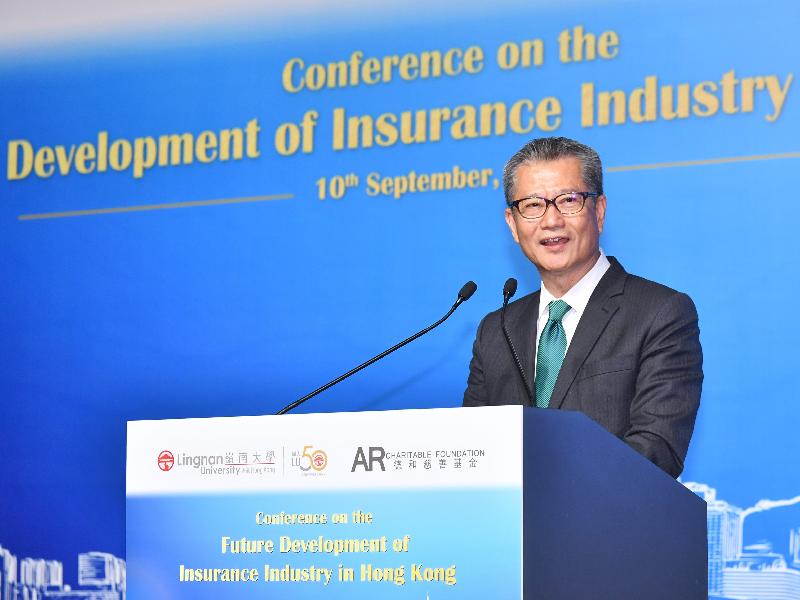
Photo  Photo  


Appeal for information on missing man in Tin Sum (with photo)

     Police today (September 10) appealed to the public for information on a man who went missing in Tin Sum.

     Lam Chi-wang, aged 27, went missing after he was last seen in Sha Kok Estate in the early hours of April 30. His guardian made a report to Police yesterday (September 9).

     He is about 1.7 metres tall, 55 kilograms in weight and of thin build. He has a square face with yellow complexion and short black hair. He was last seen wearing a long-sleeved shirt with camouflage pattern, blue shorts and slippers.

     Anyone who knows the whereabouts of the missing man or may have seen him is urged to contact the Regional Missing Person Unit of New Territories South on 3661 1176 or 9689 7445, or email to rmpu-nts-2@police.gov.hk, or contact any police station.

Photo  


Workshop on Preventing and Combating Trafficking in Human Beings 2018 commences (with photos)

     A two-day Workshop on Preventing and Combating Trafficking in Human Beings 2018, jointly organised by the Hong Kong Special Administrative Region (HKSAR) Government and the European Union (EU) Office to Hong Kong and Macao, commenced today (September 10).
 
     The two-day Workshop covers a wide-range of useful topics critical in combating trafficking in persons (TIP), including recent trends in TIP crimes, identification of victims, criminal and financial investigation, prosecution of relevant offences, assistance and protection for victims, and partnerships and international co-operation.
 
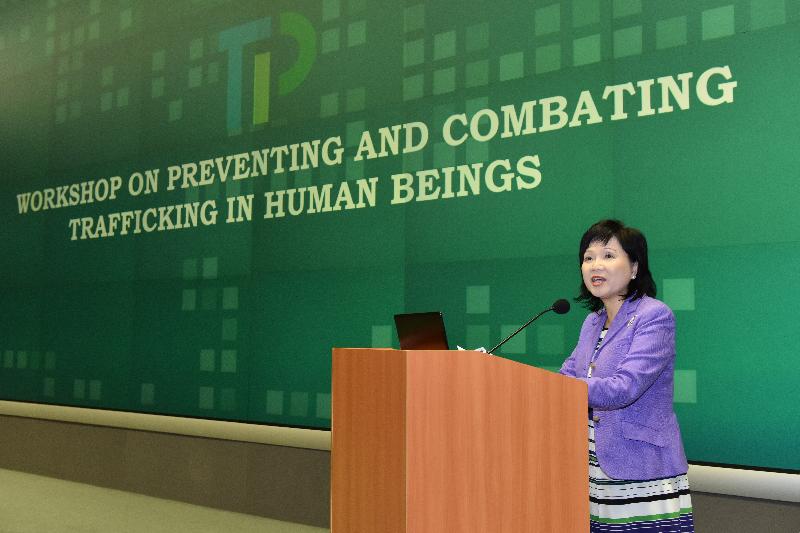
     The Permanent Secretary for Security, Mrs Marion Lai, addressed the guests and participants at the beginning of the Workshop. "The HKSAR Government tackles TIP through targeted and multi-pronged measures. Apart from victim identification, law enforcement, prosecution and victim protection, we also seek to continue to enhance staff training and to form closer partnership with local and overseas stakeholders," Mrs Lai said.
 
     "This year, we are taking a major step forward in the fight against TIP. To ensure effective implementation of the targeted and multi-pronged measures against TIP and to heighten public awareness, we set up a high-level inter-bureau/departmental Steering Committee to Tackle TIP and to Enhance Protection of Foreign Domestic Helpers (FDHs) in March. The Chief Secretary for Administration, Mr Matthew Cheung Kin-chung, personally chairs and oversees the work of the Steering Committee. Together with the Secretary for Security and the Secretary for Labour and Welfare both as Vice Chairmen, and the heads of relevant departments as members, the Steering Committee promulgated the Action Plan to Tackle TIP and to Enhance Protection of FDHs in Hong Kong at the same time, comprising over 30 strategic, comprehensive and targeted ongoing and new measures," Mrs Lai said.
  
      "The Steering Committee chaired by the Chief Secretary for Administration will ensure that clear policy steer and sufficient resources are available to different responsible departments on the overall strategy and implementation measures," Mrs Lai said.
  
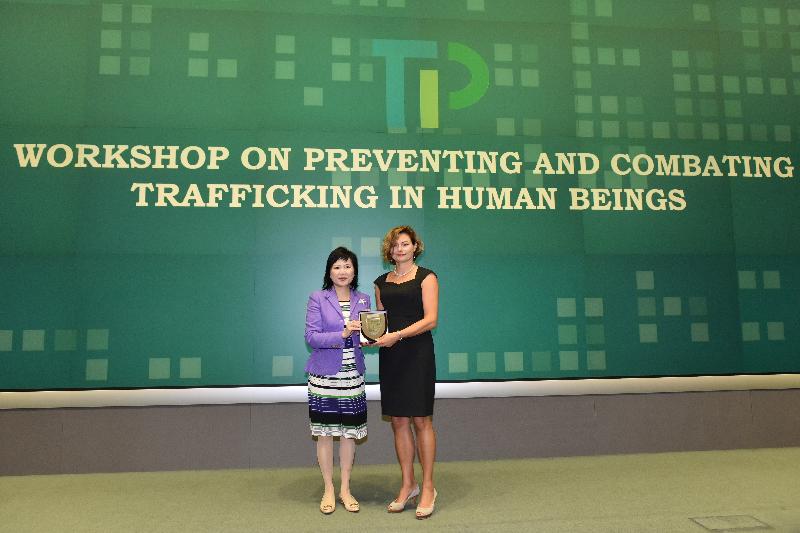
     Mrs Lai expressed gratitude to the Acting Head of the EU Office to Hong Kong and Macao, Dr Jolita Pons, for co-organising the Workshop with the HKSAR Government and the four experts from Belgium, Denmark, Romania and Spain for sharing their experiences in combating TIP with the participants.
 
     The Government has been providing relevant training to more officers of law enforcement agencies (LEAs), the Labour Department (LD) and the Social Welfare Department (SWD) and prosecutors of the Department of Justice (DoJ) over the years. In 2017, over 1 800 government officers received local or overseas TIP-related training, almost doubling the number of those who received similar training in 2016.
 
     Over 130 participants from the Security Bureau, LEAs, the DoJ, the LD, the SWD, the Hospital Authority and the CEASE Crisis Centre have joined the Workshop, which is one of the major TIP training events this year.

Photo  Photo  


AFCD announces new arrangements for mountain bike trails

     To ensure the safety of mountain bikers and protect environment in the countryside, the Agriculture, Fisheries and Conservation Department announced today (September 10) that two sections of mountain bike trails in country parks with serious erosion and potential hazards will be cancelled with effect from October 1, namely the trail from Pak Tam to Pak Sha O in Sai Kung West Country Park, and the ridge section of the Dragon's Back mountain trail in Shek O Country Park. Mountain biking activities will no longer be allowed on the above-mentioned trails on or after the effective date. However, the foothill section of the Dragon's Back mountain bike trail will be maintained, but excluding Sundays and public holidays to strike a balance between the needs of hikers and mountain bikers.
 
     Moreover, mountain biking in the Wan Tsai Peninsula of the Sai Kung West Country Park (Wan Tsai Extension) will be limited to designated trails with effect from October 1. Compared to the existing arrangement that mountain biking is allowed in the whole peninsula, the new arrangement is intended to protect the vegetation of the peninsula and ensure the safety of mountain bikers.
 
     In addition, the AFCD will make new arrangements for all mountain bike trails from October 1 onwards including clearer naming of sections and trails to facilitate management by the department and use by the bikers. The number of these trails will also increase from 10 to 15 (see Annex).
 
     A spokesman for the AFCD said, "The AFCD will implement the above new arrangements based on the results of the review of the existing mountain bike trails. The AFCD has liaised closely with the relevant stakeholders during the consultation and gathered their views. The AFCD will display relevant information on its website (www.afcd.gov.hk/english/country/cou_vis/cou_vis_mou/cou_vis_mou.html), at visitor centres and at entrances/exits of mountain bike trails, to enable mountain bikers to learn more about the new arrangements.
 
     "The AFCD will continue to explore the development of new mountain trails at appropriate locations, define the level of difficulty for each trail and adopt appropriate technical designs for mountain bikers' selection to enjoy the fun of mountain biking."
 
     The AFCD will continue to enhance the recreational experience of mountain biking in country parks, including inviting trail specialist to look into improving High Junk Peak mountain bike trail and Hoi Ha to Wan Tsai mountain bike trail. The AFCD is also erecting signage, such as distance posts, in phases along each mountain bike trail, so bikers can quickly locate themselves in case of accidents. Improvement works are also being undertaken by the Civil Engineering and Development Department (CEDD) on the mountain bike trail of Lantau South Country Park, and a new mountain bike training ground near Mui Wo and various connecting mountain bike trails are being constructed by the CEDD. The new trails will provide brand new spots for mountain cycling enthusiasts in the near future.


West Kowloon Station Bus Terminus to commence operation this Sunday (with photo)

     The Transport Department (TD) today (September 10) announced that the West Kowloon Station Bus Terminus, which is located at the north of the Hong Kong West Kowloon Station, will commence operation this Sunday (September 16) to replace the temporary bus terminus at To Wah Road in Jordan.
 
     The following 10 bus routes currently terminating at the temporary bus terminus at To Wah Road in Jordan will be relocated to the West Kowloon Station Bus Terminus:
 
(i) KMB Route No. 36B (to/from Lei Muk Shue Public Transport Interchange);
(ii) KMB Route No. 36X (from Lei Muk Shue Public Transport Interchange);
(iii) KMB Route No. 42A (to/from Cheung Hang);
(iv) KMB Route No. 46 (to/from Lai Yiu);
(v) KMB Route No. 60X (to/from Tuen Mun Central);
(vi) KMB Route No. 63X (to/from Hung Shui Kiu (Hung Fuk Estate));
(vii) KMB Route No. 69X (to/from Tin Shui Wai (Tin Shui));
(viii) KMB Route No. 81 (to/from Wo Che);
(ix) KMB Route No. 95 (to/from Tsui Lam); and
(x) KMB Route No. 268X (to/from Hung Shui Kiu (Hung Fuk Estate)).
 
     At the same time, the terminus of KMB Route No. 271 (to/from Fu Heng) will also be relocated to the West Kowloon Station Bus Terminus and en-route bus stops will be provided at Canton Road in Tsim Sha Tsui.
 
     In addition, with effect from September 23 (Sunday), three new bus routes, namely Citybus Route No. W1 (to/from Admiralty and Central), KMB Route No. W2 (to/from Kwun Tong and Lam Tin) and KMB Route No. W3 (to/from Sheung Shui, Tai Po and Sha Tin), will also provide services at the West Kowloon Station Bus Terminus to facilitate the commissioning of the High Speed Rail.
 
     Notices will be displayed inside bus compartments and at bus stops to advise passengers of the bus service arrangements. Members of the public may call 1823, visit the TD's website (www.td.gov.hk) and make use of the TD's mobile application "HKeMobility" to obtain public transport information.
 

Photo