Hong Kong Customs seizes suspected dangerous drugs (with photo)

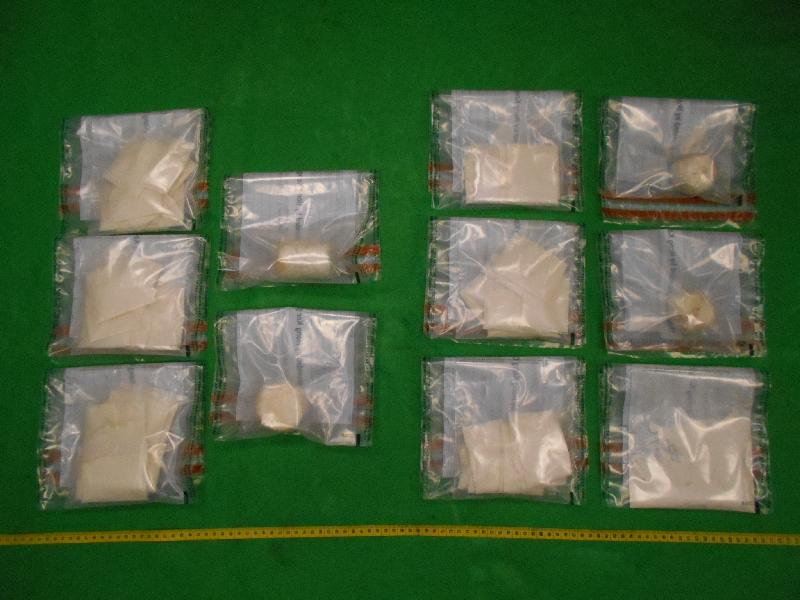
     Hong Kong Customs seized about one kilogram of suspected cocaine and about 55 grams of suspected synthetic cathinone (bath salt) with an estimated market value of about $1 million in total from two express parcels from Mexico at Hong Kong International Airport on September 24 and 25.

     Some suspected dangerous drugs were concealed inside wooden crafts and some were packaged as drink powder.

     After investigation, Customs officers yesterday (September 26) arrested a 30-year-old man suspected to be in connection with the case in Tsuen Wan.

     Investigation is ongoing.

     Under the Dangerous Drugs Ordinance, trafficking in a dangerous drug is a serious offence. The maximum penalty upon conviction is a fine of $5 million and life imprisonment.

     Members of the public may report any suspected drug trafficking activities to the Customs 24-hour hotline 2545 6182 or its dedicated crime-reporting email account (crimereport@customs.gov.hk).

Photo  


Secretary for the Environment visits Shing Mun Country Park

     The Secretary for the Environment, Mr Wong Kam-sing, accompanied by the Director of Agriculture, Fisheries and Conservation, Dr Leung Siu-fai, visited Shing Mun Country Park this morning (September 27) to inspect the damage caused by Super Typhoon Mangkhut to the country park facilities, as well as to see the progress made in clearing fallen trees.  
 
     As a large number of trees have fallen or have broken branches, the facilities in the country parks have suffered varying amounts of damages. In the previous week, the Agriculture, Fisheries and Conservation Department (AFCD) has been inspecting various park areas at full strength, in addition to making continuous efforts to clear fallen trees and repair damaged facilities with the assistance of various groups, so that some recreational sites could be reopened for the public to enjoy the Mid-Autumn Festival. The AFCD indicated that the department would continue to clean up the parks, in a bid to restore the country parks and reopen facilities for the public according to priority. The AFCD called on the public to visit its website for the latest updates on relevant facilities. The AFCD also reminded the public and hikers not to leave behind kindling in the country parks as there are many fallen trees with withered branches and dry leaves, which are highly inflammable, so as to avoid further damage to the country parks.
 
     Mr Wong was briefed by Dr Leung on the AFCD’s arrangements for dealing with the fallen trees. The AFCD has long been implementing measures to recycle yard waste (such as tree trunks and tree branches, etc) collected from conservation work for plants in the country parks. The AFCD explained that external yard waste might bring pests and diseases or seeds from external species, and consequently they are unsuitable for stockpiling in the country parks, which may cause harm to the natural ecology there.  As for fallen trees in country parks caused by the passage of typhoon this time, the AFCD will, as far as possible, cut them into logs for use as materials for providing country park facilities in future. Leftover wood and branches will be piled mainly on site for natural decomposition to release nutrients back to nature. 
 
     During the visit, Mr Wong Kam-sing also chatted with some staff members and volunteers who have helped to clean up. He thanked all AFCD staff and volunteers for their efforts in nature and ecology conservation, as well as for their contributions to restore the country parks. 
 
     Mr Wong also noted that many members of the public and groups had volunteered to clean up waste in the countryside and on the shorelines after the passage of the typhoon. He thanked the public for their selfless contributions and care for nature. He said that all relevant government departments (including the AFCD, the Food and Environmental Hygiene Department, the Leisure and Cultural Services Department and the Marine Department) are fully devoted to the cleaning of waste and debris onshore, as well as other relief work. At the same time, the Government is providing support for participating organisations through the platform of the Inter-departmental Working Group on Clean Shorelines, including reminding them of safety guidance for cleanup activities, providing cleaning tools and materials, and assisting in transporting and handling waste collected. Mr Wong also called on members of the public who are interested in participating in shoreline cleaning activities to check out the Facebook page on clean shorelines (www.facebook.com/cleanshorelines/) for information on relevant activities organised by various groups.
 
     Mr Wong said, "The Environment Bureau and the Environmental Protection Department will continue to work together with other departments on the post-typhoon relief work, such that the scenic views in country parks, beaches and shorelines and relevant facilities can be restored for the public’s enjoyment."


Hong Kong Customs combats unfair trade practices at medicine shop

     Hong Kong Customs today (September 27) arrested a salesman of a medicine shop suspected to have applied a false trade description in the course of selling a proprietary medicine, in contravention of the Trade Descriptions Ordinance (TDO).
      
     Customs officers conducted a test-buy operation at a medicine shop in Yau Ma Tei this afternoon. A salesman was suspected to have applied a false trade description on a brand of medicine by stating it was a particular brand of medicine. Customs officers then arrested the 31-year-old man.
      
     Investigation is ongoing and the arrested man has been released on bail pending further investigation.
      
     Customs reminds traders to comply with the requirements of the TDO and consumers to procure products at reputable shops.
      
     Under the TDO, any person who in the course of any trade or business applies a false trade description to any goods or services commits an offence. The maximum penalty upon conviction is a fine of $500,000 and imprisonment for five years.
      
     Members of the public may report any suspected violations of the TDO to the Customs 24-hour hotline 2545 6182 or its dedicated crime-reporting email account (crimereport@customs.gov.hk).


Veterinary drug chloramphenicol found in blue crab sample

     The Centre for Food Safety (CFS) of the Food and Environmental Hygiene Department announced today (September 27) that a blue crab sample was detected with a veterinary drug, chloramphenicol. The CFS is following up on the case.

     "The CFS collected the sample from a stall in Sai Ying Pun Market for testing under its routine Food Surveillance Programme. The test result showed that the sample contained chloramphenicol at a level of 0.4 parts per billion," the spokesman said.

     According to the Harmful Substances in Food Regulations (Cap 132AF), no fish (including shell fish) sold in Hong Kong for human consumption is allowed to contain chloramphenicol. Offenders will be liable to a fine up to $50,000 and to imprisonment for six months upon conviction.

     The spokesman said, "The CFS has informed the vendor concerned of the irregularity and instructed it to stop sale of the affected product."

     The CFS will continue to follow up on the case, including tracing the source of the affected product to safeguard food safety and public health.


Grants approved for flood victims in Kerala, India

     The Government of the Hong Kong Special Administrative Region has accepted the advice of the Disaster Relief Fund Advisory Committee and approved from the Disaster Relief Fund three grants totalling $15.721 million to three agencies for providing relief to flood victims in Kerala, India.
 
     Announcing the grants today (September 27), a spokesman for the Government said that the three grants – one of $6.508 million to World Vision Hong Kong, one of $5.6 million to Oxfam Hong Kong and one of $3.613 million to CEDAR Fund – will be used to provide food, shelter kits and hygiene and household items to benefit around 108 500 flood victims in Kerala, India. As the targeted townships of the three relief agencies are different, there will be no overlapping of resources. The Committee hopes the grants will facilitate the provision of timely relief to the victims and help them restore their normal living.
 
     "To ensure that the money is used for the designated purposes, the relief agencies will be asked to submit evaluation reports and audited accounts on the use of the grants after the relief projects have been completed," the spokesman said.