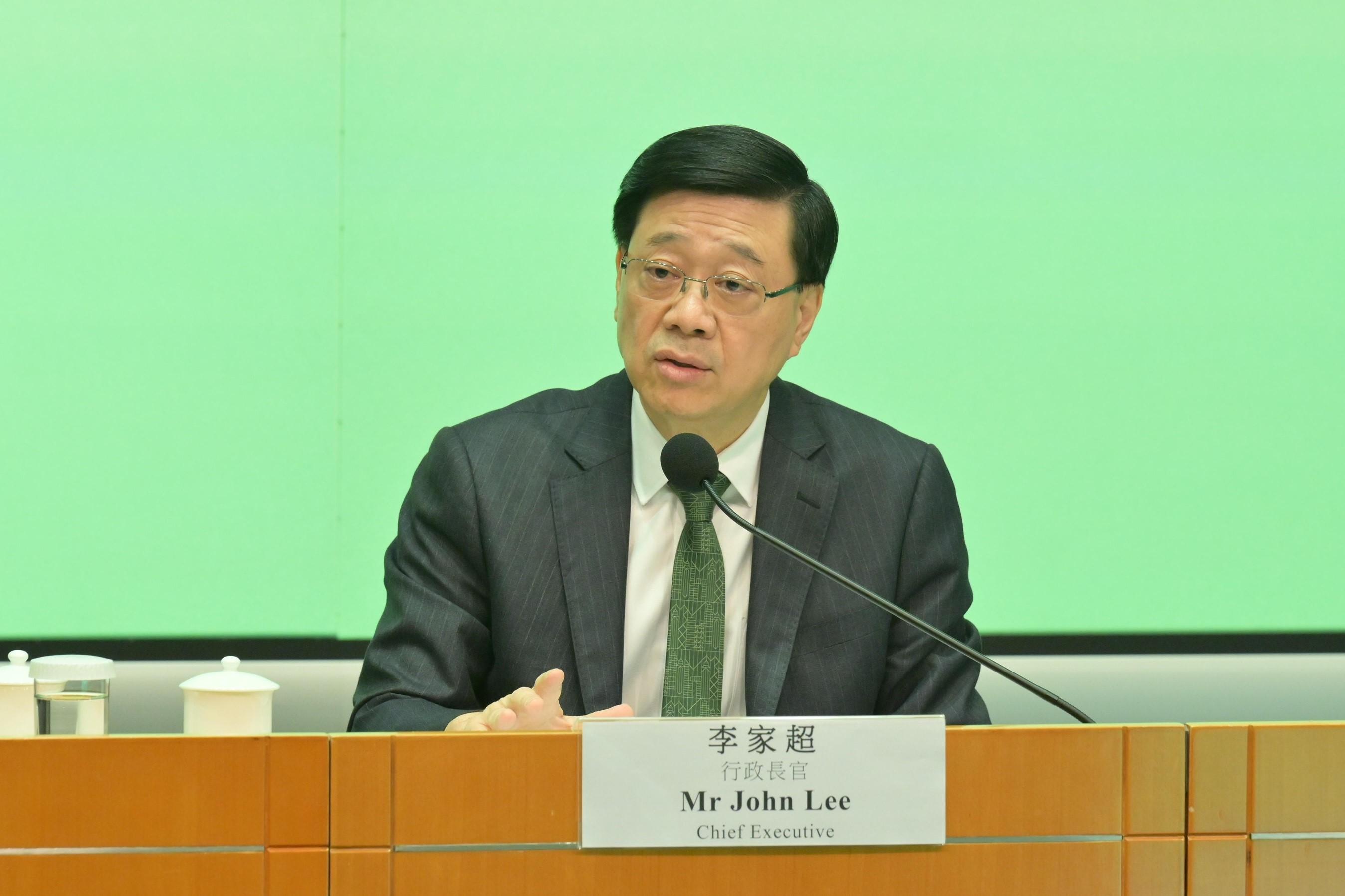
Remarks by CE at press conference on “The Chief Executive’s 2024 Policy Address” (with photos/video)
Following are the remarks by the Chief Executive, Mr John Lee, at the press conference on "The Chief Executive's 2024 Policy Address" today (October 16):
Reporter: Some opinions, such as the League of Social Democrats, have demanded democratic reform for Hong Kong. Are political reform and universal suffrage on the agenda of this administration? The second question: the proposed regulation on subdivided flats do not cover the so-called "coffin homes" or "cage homes". Why is this so? Will the Government consider extending the regulation to cover this type of subdivided flats? Thank you.
Chief Executive: I have said more than once that the political reform has been settled at this moment with the introduction of, first of all, the new election system for LegCo (Legislative Council) members, for the Chief Executive, and also after improving the district administration system. At this moment, I think it is important to ensure that all these improvements of the different election systems will be run smoothly and also that they function effectively to realise the maximum benefit that all these improved measures intend to create. We still have time to make all these systems run, so that they could synergise and create extra value for society. It takes the efforts of everybody in these three systems to think of what they should do: they reform themselves so that they can contribute even bigger value to the overall good. And all these three systems work towards the same goal of creating positive value for Hong Kong as a whole. So what you have just said, I think, is settled. It will not be an issue in this term of the Government.
The second thing regarding subdivided flats. The system that I want to introduce through legislation is not to make what is illegal now legal. What is illegal now will continue to be illegal under the respective ordinances. Enforcement will be taken accordingly. And of course, we will step up the enforcement in concert with the new policy on subdivided flats, which will be introduced in residential buildings. So the intention is to, first of all, regulate subdivided flats using this basic housing concept, so that we will have a standard below which we will take action against, because they will not be regarded as the right standard for our households to live in. I think that is the intention, and we make this policy knowing that it is a difficult matter. That is why I hope it will be thoroughly debated in LegCo so that we can enhance it.
We also want to ensure that this new system will be able to tell the market, which in some way needs to exist – by the sheer evidence that over 110 000 households are living in these accommodations. We want this market to be healthy in existence. In other words, all the standards have to be met, and we will be taking action after a reasonable registration period and a reasonable grace period, giving the Secretary for Housing the flexibility to define the unsatisfactory units and enforce actions according to the actual situation, so that we will take them off the market, lot by lot, to ensure that things will progress in an orderly manner. It is not easy, but I think it is a problem everybody wants to see solved, and it is under this determination that I would really request that collectively, we discuss the system that I have recommended, and then come to a good consensus eventually at LegCo, so that we can pass a law for all these things to happen. And I think, in due course, we should be able to solve the problem of people having to live in substandard accommodation.
Reporter: Two questions. First, some residents who are living in substandard subdivided units are worried that the new standards for Basic Housing Units will lead to higher rents, or that landlords will kick them out. How will the Government support these people who may lose their homes that they are currently living in? Second, in the sections on national security, part of the focus was put on public officers, such as proposing a new set of guidelines for them to abide by Article 23. Does this show that there are still some loopholes for public officers, such as within the civil service? Are civil servants confused on how to follow Article 23? Thank you.
Chief Executive: First of all, the problem of some households living in substandard subdivided flats is a problem that has been long-lasting. In other words, it has accumulated over the years. We are very conscious of the fact that we have to do it in an orderly manner, so that adjustments can be made by the parties affected.
From now to the time we will actually take enforcement action, I think there will be a few years, because, first of all, we will have to pass the legislation, which I think it will probably be next year the earliest. Then, we will introduce a registration period. My suggestion is either 12 months or 18 months, because we are talking about 110 000 households. If you are talking about a 12-month registration period, it is roughly 9 000 a month. Whether it should be 12 months or 18 months, I think we can debate. We can let LegCo debate it. I am very willing to listen. Then, we will introduce a grace period for adjustments to be made structurally. That may be one year, two years again, subject to discussion by LegCo, because under the present legislation, tenants of these units are guaranteed two tenancies. We have to ensure that tenants' rights are protected under the present law. Again, that is an issue for LegCo to debate. Over this period of time, I think people can make the right adjustment.
The third important point is the new entries. When there is a new supply of subdivided flats that haven't been rented out, i.e. there are no tenants yet, and if it is a new operator, they can only enter the market with units that satisfy the standard. Otherwise, they will not be allowed to register. It is designed this way so that there will be no increase in the number of substandard subdivided flats. In other words, all new supplies will have to be conforming to our standard. And this new supply will, of course, be available for present tenants to consider moving into, because I believe that once the standards are clearly defined, operators will know very well how to do their calculation on what subdivision they will create, what flats they will then have to build to satisfy our standard. This supply of flats will also come out for people to consider. Then, of course, if the rent is not set reasonably, they will not have tenants. There are a lot of things, and also individual cases – as we always have very special individual cases – we will deal with individual cases specifically.
But overall, I think what is important is when I design any new measures, I always ask myself a question: if this new measure solves 95 per cent of the problem, should I still go ahead and deal with the remaining 5 per cent after the first implementation, or should I ignore it until I have a perfect solution to solve 100 per cent of the problem? I decide to go all out, even though there may be individual cases that we need to address, but overall, if the system solves the majority of the problem, I think we should go ahead, and then, after implementation, we deal with the special cases.
Regarding national security, the law has been created. We are now talking about implementation, and for implementation, there is never the best, only the better. I have always said I look for continuous improvement. The law is new, and we all need to increase our knowledge about it. It is just natural. I think it is a natural thing for any government when there is a new law, they, first of all, have to do some education, enhance familiarisation, do some system building and do some enhancement in the course. It is a natural process.
Reporter: Good afternoon, Mr Lee. Firstly, with regards to the measure regarding the housing market in the Policy Address, why does the Government see the need to introduce property loan relaxation measures, and will this only benefit those who are looking to purchase high-end flats? And with subdivided units, how transparent would the Government be with the requirements and the corresponding criminal liabilities regarding the subdivided units? Is it worried that what it's doing right now is going against the wish of Beijing to get rid of subdivided housing altogether? And lastly, with the focus of the Government on the economy for this year's Policy Address, there doesn't seem to be further efforts to stimulate the economy beyond areas such as those vis-a-vis access for some countries, relaxation of loans and even the reduction of spirits tax. Would you be concerned that these efforts would not be enough to kick-start the economy? And what do you think is the most eye-catching point of this year's Policy Address? Thank you.
Chief Executive: Well, thank you very much. First of all, we allow the mortgage rate to go back to 70 per cent for all kinds of properties because I think the introduction of extra measures were made at a time when the property market was too much of a problem for people to buy flats, so it has gone out of control. And you know that the property market has somehow consolidated. It has now settled down, so it will be unreasonable for measures that were introduced for a specific purpose that no longer exists now to continue. I think it will be something you don't want the Government to not act on when some situation no longer exists, where what may be regarded as inappropriate still continues. So that is the first point.
The second point is, I do want to help people to buy their own flats if they can afford it, and from a lot of opinions I received in the consultation, the desire of Hong Kong people to buy their own flats continues to appear very strongly at the back of my mind. So I do want to help them to buy property by alleviating their burden of finding enough of a down payment. Of course, at the end of the day, he has to make his own calculation to assess whether he can afford it, but helping them in the first step to realise their dream, I think is something I should try to do my best. And that is why, when now I think the situation allows it, I set the mortgage rate to 70 per cent for all properties.
Regarding subdivided flats, I think we have to be realistic as to why subdivided flats exist. They exist over a long period of time because of need, because of actual needs of households, because of the lack of enough supply of flats. So we have to be realistic, pragmatic. We don't live in a dream world. We live in the real world. So how do we pragmatically address the problem? It's not easy, but I'm determined, and I think society supports that we should solve the problem. So I need collective wisdom, I think, during our consultation, during the study, when the study team worked very hard to do their own studies and consult stakeholders, they did an excellent job. And now I have come to a decision that, first of all, it has to be a legislative process so that it is clear. And when people are clear about what the rules are, then the market, which now exists but is not properly regulated, will become a regulated market, supplying flats which satisfy the standard. I think that is what any government would want to do. And I think what is done, what is proposed, is necessary according to the actual situation of Hong Kong. And I have said, the intention is not to make things that are illegal, legal. We just want to regulate residential flats that mainly create this market of subdivided flats, so the market will be providing flats of what we think will be a reasonable and liveable standard.
And if you spend time to read the Policy Address – in a way, I can understand why all these questions come out, because it is the first day of the release of the document. It has, in Chinese, over 31 000 words, so it does take time to really look at the things in detail. But a lot is done to help the economy to grow. What is important is that what we can strengthen, we will strengthen. At the same time, we look for new opportunities of growth. That is why, for some areas, we are recommending measures which I think is only probably 10 per cent of the final goal that I want to go. Some may be at a position of 20 per cent. So when all these things work together, they create a synergy effect.
Hong Kong has been growing as a whole from the macro angle because last year, the GDP (Gross Domestic Product) growth was over 3 per cent. This year, the economy will still grow. The GDP is expected also to grow between 2.5 and 3.5 per cent, and some analysts have suggested a rate of 3 per cent, so overall, we're still growing. The economy is still going ahead. But of course, different sectors are at different stages, and I have to tell those sectors that are not doing too well, that I will roll out measures to help you, but you also have to help yourself. You have to change. You have to reform, find new ways to make a difference, a difference for you to be able to win. I think that has been in the DNA of Hong Kong people. And I make it no secret that we all have to work hard. That is why I say "reform together and build our economy together". It is this togetherness that I want everybody to subscribe to, because working together will ensure that one plus one will be bigger than two. And when 7.5 million work together, when we work together, it will be bigger than a "7.5 million effect". Thank you.
(Please also refer to the Chinese portion of the remarks.)