Salary indices for managerial and professional employees for June 2018

     According to the figures released today (October 26) by the Census and Statistics Department (C&SD), the average monthly salaries for middle-level managerial and professional employees for all the selected industry sections surveyed, as measured by the Nominal Salary Index (A), increased by 3.5% in June 2018 compared with a year earlier.

     After discounting the increase in consumer prices as measured by the Consumer Price Index (C), the Real Salary Index (A) increased by 1.2% in June 2018 over a year earlier.

     Analysed by industry section and on a year-on-year comparison in nominal terms, the average monthly salaries for middle-level managerial and professional employees increased in all the individual industry sections in June 2018, ranging from 3.1% to 4.5%.

     After discounting the increase in consumer prices, year-on-year increases in the Real Salary Index (A) were also observed in all the individual industry sections, ranging from 0.8% to 2.2%.

     The Salary Index (A) measures changes in salary rates for all middle-level managerial and professional employees of the companies covered by the survey. Another index, the Salary Index (B), which excludes newly recruited and promoted employees and covers only those middle-level managerial and professional employees remaining in the same occupations and in the same companies in two consecutive years, is also compiled. Its main purpose is to measure salary changes due to general increment, meritorious performance and gain in seniority.

     Comparing June 2018 with June 2017, the overall Salary Index (B) increased by 4.8% in nominal terms or 2.6% in real terms. The different movement between the Salary Index (A) and the Salary Index (B) was mainly attributable to the lower pay usually received by new recruits (who were included only in the Salary Index (A) but not in the Salary Index (B)) as compared with existing employees. Hence, in general, increases in the Salary Index (B) are greater than the corresponding increases in the Salary Index (A).
 
     Statistics on the year-on-year percentage changes in the Nominal Salary Index (A), Real Salary Index (A), Nominal Salary Index (B) and Real Salary Index (B) for June 2018 in respect of the selected industry sections covered are shown in the tables attached.

     The survey findings also showed that in June 2018, about 40% of the middle-level managerial and professional employees were entitled to guaranteed year-end bonus/payment and about 70% to irregular profit-sharing bonuses. Moreover, the majority of them were entitled to fringe benefits of some kind, including paid annual leave and insurance protection (in addition to the statutory requirements), housing benefits, medical benefits, course fee subsidies for employees’ further studies, etc.

Commentary

     A Government spokesman noted that the average salaries of middle-level managerial and professional employees registered further solid increases in June 2018, representing across-the-board improvement in real terms after netting out inflation. This was underpinned by the keen demand for higher-skilled talents in the corporate sector amid the vibrant economic performance and Hong Kong's continual development towards a knowledge-based economy. Among the selected industry sections, more visible salary gain was observed in the building, construction and related trades section.

Other Information
 
     The salary indices are compiled annually based on the results of the Survey of Salaries and Employee Benefits – Managerial and Professional Employee (Excluding Top Management). This statistical survey has been conducted by the C&SD since 1984 to measure changes in salary rates for middle-level managerial and professional employees in selected industries. A sample of about 270 companies was selected for the survey in 2018.
 
     For the purpose of the survey, salary rate is defined to include basic salary, cost-of-living allowance, guaranteed year-end extra bonus/payment, commission, as well as other regular and guaranteed bonuses and allowances.
 
     Details of the salary movement, average salary rate for major occupations, and statistics on employees' entitlement to various fringe benefits, together with a description of the survey methodology and coverage, are published in the "2018 Report of Salaries and Employee Benefits Statistics – Managerial and Professional Employees (Excluding Top Management)". The publication is available for downloading free of charge from the website of the C&SD (www.censtatd.gov.hk/hkstat/sub/sp210.jsp?productCode=B1050010).

     Enquiries concerning the salary indices can be directed to the Wages and Labour Costs Statistics Section (2) of the Census and Statistics Department at 3105 2369.


Hong Kong signs MOU with Myanmar on education co-operation and launches Belt and Road Scholarship (Myanmar)

     The Education Bureau (EDB) of the Government of the Hong Kong Special Administrative Region today (October 26) signed a Memorandum of Understanding (MOU) with the Ministry of Education of Myanmar on education co-operation to enhance education collaboration between the two places. The MOU was signed by the Under Secretary for Education, Dr Choi Yuk-lin, and the Deputy Minister of Education of Myanmar, Mr Win Maw Tun, by means of exchange of documents.
 
     The MOU provides a framework to facilitate strategic collaboration between the education communities of Hong Kong and Myanmar. It covers initiatives including the provision of scholarships for students; exchange of expertise and experience; exchange of educational literature, teaching aids and demonstration materials; and exchanges of scholars, teachers, experts, students and other education personnel. The main text of the MOU is available on the EDB website (www.edb.gov.hk/en/edu-system/postsecondary/policy-doc/index.html).
 
     The EDB also announced today the launch of the Belt and Road Scholarship (Myanmar) with a view to attracting outstanding students from Myanmar to pursue undergraduate studies in Hong Kong from the 2019/20 academic year. Under the scholarship scheme, up to 10 scholarships will be offered annually to students from Myanmar who are enrolled in first-year undergraduate programmes of publicly funded institutions in Hong Kong. All awardees will receive scholarships to cover the full tuition fees of relevant programmes annually. The scholarships for the first 10 awardees will be supported by donations from the Chinese General Chamber of Commerce (CGCC) and CGCC (Foundation) Limited.
      
     "Signing the MOU with Myanmar and launching a new Belt and Road Scholarship can further internationalise the Hong Kong's higher education sector and enrich our pool of talents with international perspectives, with a view to contributing to the future development of Hong Kong," Dr Choi said.
 
     To internationalise and diversify the Hong Kong higher education sector, and groom talents with global vision and an international network to enhance human capital, the EDB launched the Belt and Road Scholarship (Indonesia) in the 2016/17 academic year. The scholarship scheme was expanded to cover Malaysia and Thailand in the 2017/18 academic year. At the same time, the scholarship awardees can act as ambassadors to strengthen exchange and people-to-people bonds between Hong Kong and these places.


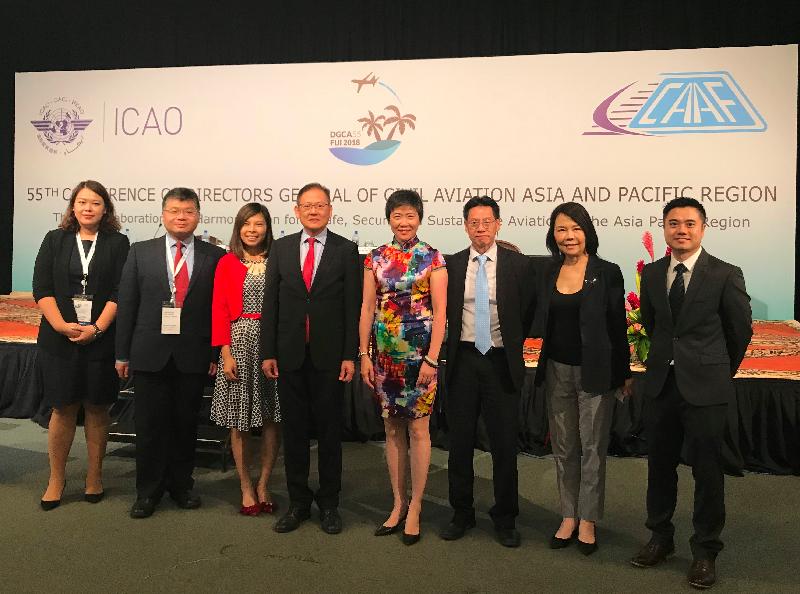
DGCA attends Asia-Pacific aviation heads conference in Fiji (with photo)

     The Director-General of Civil Aviation, Mr Simon Li, attended the 55th Conference of Directors General of Civil Aviation, Asia and Pacific Regions, organised by the International Civil Aviation Organization (ICAO) in Fiji.

     The theme for this year's five-day Conference, which concluded successfully today (October 26), was "Collaboration and Harmonisation for Safe, Secure and Sustainable Aviation in the Asia Pacific Region". The Conference was attended by over 200 delegates from about 50 states, administrations and industry organisations. Some 130 papers were submitted by aviation authorities and industry organisations to the conference covering a wide range of subjects, including aviation safety, air navigation, aviation security, unmanned aircraft systems and technical co-operation.

     In the light of the double digit growth in air traffic overflying the Hong Kong Flight Information Region (FIR) in recent years, and to put the idea of "Collaboration and Harmonisation for Safe, Secure and Sustainable Aviation in the Asia Pacific Region" into action, Mr Li held meetings with the Director Generals of Singapore and Thailand, being two of the major neighbouring FIRs with busy traffic flow to and from Hong Kong, China and through the Hong Kong FIR, to enhance air traffic flow in the Asia-Pacific region and to improve on-time performance of aircraft landing and taking off at Hong Kong International Airport. Mr Li will continue to liaise with aviation partners to share best practices and to closely follow ICAO guidelines and standards to promote aviation safety.

     Taking note that sustainability in aviation also includes a steady supply of trained personnel in the various sectors of aviation, Mr Li invited Mrs Vivian Cheung, the President of the Hong Kong International Aviation Academy (HKIAA), established by the Airport Authority Hong Kong, to join the Hong Kong, China delegation to the Conference. They met with the ICAO Secretary General, Dr Fang Liu; the ICAO Regional Director for the Asia Pacific, Mr Arun Mishra; and a number of Director Generals and key representatives from aviation partners in the Asia-Pacific region who sent representatives to attend the Advanced Master in Air Transport Management Programme jointly organised by the HKIAA and National School of Civil Aviation of France (Ecole Nationale de l’Aviation Civile) in Hong Kong. The programme has been well received by the industry. The HKIAA also took the opportunity to introduce to the Conference its curriculum for the coming years. The CAD will continue to support and strengthen its collaboration with the HKIAA to nurture local and regional talents in the aviation sector to further strengthen Hong Kong's leading status as a major aviation hub in the region.

Photo  


Draft Hung Shui Kiu and Ha Tsuen Outline Zoning Plan approved

     The Chief Executive in Council has approved the draft Hung Shui Kiu and Ha Tsuen Outline Zoning Plan (OZP).
      
     "The approved OZP indicates the broad land use zonings and major road network for the Hung Shui Kiu New Development Area (NDA) and Ha Tsuen area so that development and redevelopment of land in the area can be put under statutory planning control. It also provides the planning framework for preparing more detailed non-statutory plans which form the basis for public works planning and site reservation for various uses," a spokesman for the Town Planning Board said today (October 26).
      
     The Hung Shui Kiu NDA is an important component in the overall development strategy to provide housing land for Hong Kong in the medium to long term. The NDA will be one of the next-generation Hong Kong new towns and will be developed as a balanced and socially integrated community with an emphasis on environmentally friendly design. Upon full development, the Hung Shui Kiu NDA will accommodate a total population of about 218 000 including a new population of 176 000, and will provide about 150 000 employment opportunities. The NDA is positioned to become the regional economic and civic hub for the whole North West New Territories region.
      
     The planning scheme area, covering about 707 hectares, is bounded by the Tin Shui Wai New Town to the east, Castle Peak Road to the south, the knolls of Yuen Tau Shan to the west and the Lau Fau Shan Road/hill slope along Deep Bay Road to the north.
      
     About 24.12 hectares of land are zoned "Commercial" for commercial developments, functioning as territorial business/financial centre and regional or district commercial/shopping centre.
      
     About 3.65 hectares of land to the south of MTR Tin Shui Wai Station are zoned "Comprehensive Development Area", which is intended for comprehensive development of the area for residential use with provision of commercial, open space and other supporting facilities.
      
     About 69.44 hectares of land are zoned "Residential (Group A)" ("R(A)") for high-density residential development. The "R(A)" zone includes sites for private housing, public rental housing or subsidised sale flat developments. About 18.1 hectares of land are zoned "Residential (Group B)", which is primarily intended for medium-density residential developments. About 0.4 hectares of land are zoned "Residential (Group C)", which is primarily intended for low-rise and low-density residential developments.
      
     About 118.08 hectares of land are zoned "Village Type Development" ("V"), which is to designate existing recognised villages and areas of land considered suitable for village expansion. Three sites to the north of Tsing Chuen Wai and the north of Fung Kong Tsuen have been designated as "V(1)" for reprovisioning of the village houses under the Village Removal Terms due to the NDA development.
      
     About 15.07 hectares of land are zoned "Industrial", which is intended primarily for general industrial uses to ensure an adequate supply of industrial floor space to meet demand from production-oriented industries.
      
     About 68.52 hectares of land are zoned "Government, Institution or Community" ("G/IC") primarily for provision of G/IC facilities serving the needs of local residents and/or the community at wider district, regional or territorial levels.
      
     About 99.11 hectares of land are zoned "Open Space" for the provision of outdoor open-air public space for active and/or passive recreational uses.
      
     About 104.91 hectares of land are zoned "Other Specified Uses" to designate land for specific uses, including "Mixed Use" primarily for high-density residential and commercial development; "Enterprise and Technology Park" to provide development space for accommodating a variety of innovative and technology uses including research centres, testing and certification, data centres, modern industries and other related businesses and non-polluting industrial uses; "Logistics Facility"; "Port Back-up, Storage and Workshop Uses"; and "Parking and Operational Facilities for Environmentally Friendly Transport Services".
      
     About 55.92 hectares of land are zoned "Green Belt", which is intended primarily for defining the limits of urban and sub-urban development areas by natural features and to contain urban sprawl as well as to provide passive recreational outlets.
      
     The approved Hung Shui Kiu and Ha Tsuen OZP No. S/HSK/2 is now available for public inspection during office hours at the Secretariat of the Board, the Planning Enquiry Counters of the Planning Department in North Point and Sha Tin, the Tuen Mun and Yuen Long West District Planning Office and the respective District Offices and Rural Committees.
      
     Copies of the approved OZP are available for sale at the Map Publications Centres in North Point and Yau Ma Tei. The electronic version of the plan can be viewed at the Board's website (www.info.gov.hk/tpb).


Draft Ping Shan Outline Zoning Plan approved

     â€‹The Chief Executive in Council has approved the draft Ping Shan Outline Zoning Plan (OZP).
      
     "The approved OZP provides a statutory land use planning framework to guide the development and redevelopment within the Ping Shan area," a spokesman for the Town Planning Board said today (October 26).
      
     The planning scheme area covers about 355.82 hectares of land in the western part of the North West New Territories. It is bounded by the Tin Shui Wai New Town and the Hung Shui Kiu New Development Area in the west, Castle Peak Road in the south, Yuen Long New Town in the east and the fish ponds in Lau Fau Shan and Tsim Bei Tsui in the north.
      
     Five sites with a total area of about 25.09 hectares are zoned "Comprehensive Development Area" for comprehensive development/redevelopment of the area for residential use with commercial, open space and other supporting facilities. 
      
      About 6.91 hectares of land are zoned "Residential (Group A)" for high-density residential developments. About 3.91 hectares of land are zoned "Residential (Group B)" for suburban medium-density residential developments. About 4.54 hectares of land are zoned "Residential (Group E)" primarily for phasing out existing industrial uses through redevelopment for residential use.
      
     About 86.08 hectares of land are zoned "Village Type Development" to reflect existing recognised and other villages and provide land suitable for village expansion and reprovisioning of village houses affected by government projects.
      
     About 19.32 hectares of land are zoned "Open Storage" to cater for the demand for open storage uses and to regularise the existing open storage uses in the area.
      
     To serve the needs of the local residents and/or a wider district, region or the territory, about 12.73 hectares of land are zoned "Government, Institution or Community" to provide a wide range of government, institution or community facilities.
      
     About 3.46 hectares of land are zoned "Open Space" for outdoor open-air public space for active and/or passive recreational uses, while 37.17 hectares of land are zoned "Recreation" for recreational developments for the use of the general public.
      
     About 61.24 hectares of land are zoned "Green Belt" to define the limits of urban and suburban development areas and to provide passive recreational outlets. About 70.23 hectares of land are zoned "Conservation Area" to protect and retain the existing natural landscape, ecological or topographical features of the area.
      
     About 1.68 hectares of land are zoned "Other Specified Uses" to facilitate provision of complementary heritage and cultural tourism related facilities or uses.
      
     The approved Ping Shan OZP No. S/YL-PS/18 is now available for public inspection during office hours at the Secretariat of the Board; the Planning Enquiry Counters of the Planning Department in North Point and Sha Tin; the Tuen Mun and Yuen Long West District Planning Office; the Yuen Long District Office and the Ping Shan Rural Committee.
      
     Copies of the approved OZP are available for sale at Map Publications Centres in North Point and Yau Ma Tei. The electronic version of the plan can be viewed at the Board's website (www.info.gov.hk/tpb).