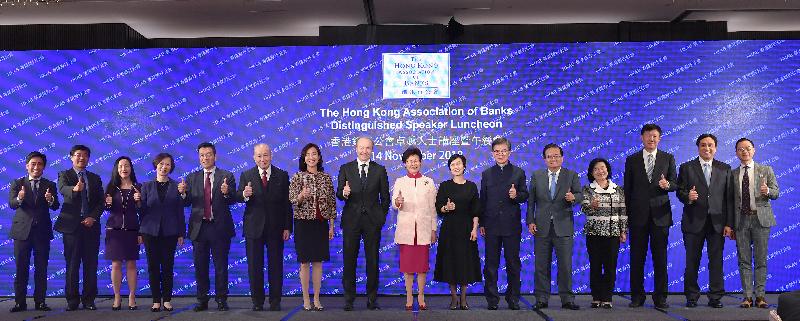
Speech by CE at Hong Kong Association of Banks Distinguished Speaker Luncheon (English only) (with photos/video)

     The following is the speech by the Chief Executive, Mrs Carrie Lam, at the Hong Kong Association of Banks Distinguished Speaker Luncheon today (November 14):
 
Diana (Chairperson of the Hong Kong Association of Banks, Ms Diana Cesar), ladies and gentlemen,
 
     Good afternoon. I'm pleased to be here today, speaking to a distinguished audience from the Hong Kong Association of Banks. As this year marks the 40th anniversary of the country's reform and opening up, and with an objective of steering Hong Kong to better integrate into the national development, I would like to share with you my recent experiences and observations in taking part in several national events.
 
     In April this year, I attended for the first time in my capacity as the Chief Executive of the Hong Kong Special Administrative Region the Boao Forum for Asia, which adopted the theme of an innovative and open Asia for the prosperous development of the world. In his keynote address, President Xi Jinping stressed that reform and innovation are the drivers of progress and the world must strive to work together through dialogue and shared responsibility. In respect of further opening up, President Xi announced important measures such as enlarging market access, creating a more attractive investment environment, strengthening intellectual property protection and taking the initiative to broaden imports. Some of these measures are applicable to the financial services sector.
 
     In August, I attended the inaugural Leading Group meeting chaired by Vice Premier Han Zheng as a full member to discuss the Guangdong-Hong Kong-Macao Greater Bay Area development. One of the initial focuses of the Greater Bay Area initiatives is to facilitate the flow of people, goods, capital and information within the Greater Bay Area, which naturally should be of considerable interest to the banking sector.
 
     Then, earlier this month, I led two delegations to the Mainland: one to attend the First China International Import Expo in Shanghai and the other to Beijing and Shenzhen to celebrate the 40th anniversary of the reform and opening up of the nation. On the former occasion, I was pleased to hear President Xi's strong commitment to pursue a high level of opening up and to widen market access to the rest of the world. On the latter occasion, I was much encouraged by the clear recognition by President Xi of Hong Kong's contribution to the country's success in the past four decades.
 
     Despite external uncertainties and the escalating trade conflicts around the world, principally between the world's two heavyweights, the United States of America and Mainland China, what I have seen and heard from our leaders have given me much hope and optimism for Hong Kong. I have no doubt that together with the Belt and Road Initiative, there are abundant opportunities for Hong Kong – the world's freest economy and an international financial centre after New York and London. The question is whether we – the Government and the industry – are sufficiently geared up to seize those opportunities in order to bring Hong Kong to a new height.
 
     It has always been my conviction that Hong Kong's fundamentals are strong and Hong Kong people are talented. Despite being a small and open economy susceptible to global uncertainties, we are blessed with deep capital markets and a robust regulatory framework that will minimise any financial fallout. Indeed, the Hong Kong banking sector performed well in the first half of 2018. Of course in the same way the Hong Kong economy performed well in the first half of 2018, making a real growth of 4 per cent. The aggregate profit of retail banks increased by nearly 25 per cent in the first half of this year, year-on-year, while capital and liquidity positions remained strong. The average capital adequacy ratio of locally incorporated banks stood at 19.4 per cent, well above the international minimum requirement of 8 per cent.
 
     But I believe the banking sector, like other sectors, will benefit from a more proactive government that stands ready to not only provide public service or regulate the market, but serve as a "facilitator" to create an environment that will enable our financial services sector to flourish while also acting as a "promoter" to market Hong Kong's strengths and competitiveness. Talking about promotion, I have brought with me a new publication on Hong Kong's financial connectivity and you can all pick up a copy when you leave this luncheon. We also need to play a more tech-savvy role to encourage innovation and technology in the banking sector. With this objective in mind, financial technology, or fintech, is a priority of my Government. As I outlined in my Policy Address last month, the Government believes in fintech. In order to accelerate its development, we have adopted a five-pronged approach: promotion, facilitation, regulation, talent and funding.
 
     Our long-awaited Faster Payment System is very much part of that approach. Launched in September, it sets in motion a new era for payment. The System is unique in supporting multi-currencies, instant payments on a round-the-clock basis and full connectivity between banks and stored-value facility operators. A common QR code standard was also launched. This enables retail payments across a variety of e-wallets, offering convenience to merchants and customers alike. By providing an open platform for access by retail banks and stored value facility operators in Hong Kong, the Faster Payment System provides a level playing field for healthy competition among banks and payment service providers, promoting innovation and bringing more efficient and user-friendly service to the public, which will in turn benefit the banking industry as well. At last count, 21 banks and 10 stored-value facility operators have embraced the System. As the System is still young, we will need to work together – government, regulators, the banking industry and the business community in general – to ensure that the System runs seamlessly for all concerned.
 
     Another important development is the promotion of virtual banking, a much anticipated innovation with the promise of promoting financial inclusion by serving the retail segment, including SMEs. More than 60 local and overseas companies have indicated interest in applying for a virtual bank licence, and about 30 applications have been received to date. The Hong Kong Monetary Authority (HKMA) is now evaluating the applications and hopes to begin granting licences to virtual banks by the first quarter of next year.
 
     As the Belt and Road Initiative gains momentum, demand for Hong Kong's financial services will surely proliferate. To help manage the demand, and create a clearing house for market information and communications, the HKMA set up the Infrastructure Financing Facilitation Office, the IFFO. To date, more than 90 stakeholders, including many from the banking sector, have joined the Office as partners. Indeed, the Hong Kong Association of Banks, in co-operation with the Office, organised in May a "Building a Sustainable Belt and Road" seminar, focusing on the potential for Belt and Road "partnership between Hong Kong banks and development banks".
 
     My Government is also working to promote Hong Kong's advantages. We have many, from our extensive corporate and investment banking networks to our deep capital markets, including the world's largest offshore Renminbi market, and sophisticated financial and business services. Add our competitive and simple tax regime, and excellent communications and transportation networks, and it's clear we have what it takes to manage the treasury activities of multinational and Mainland corporations investing in the Belt and Road.
 
     To create an even more tax-friendly environment for corporate treasury operations, we recently amended the Inland Revenue Ordinance, allowing interest deductions under profits tax for corporate treasury centres. The amendment also reduces the profits tax of qualifying entities by 50 per cent. Industry feedback has been positive, with more than 140 corporations benefiting to date.
 
     Risk management is essential to the projects of the Belt and Road, and we have the potential to emerge as the Belt and Road's risk management centre. A number of multinational insurers and reinsurers in Hong Kong have the experience and knowledge to underwrite major infrastructure risks. In this regard, the Insurance Authority and the China Banking and Insurance Regulatory Commission have come to an agreement. When a Mainland insurer cedes business to a qualified Hong Kong professional reinsurer, the capital requirements of the Mainland insurer will be reduced. This will increase the competitiveness of Hong Kong reinsurers in capturing reinsurance business ceded by Mainland insurers.
 
     The Insurance Authority is also setting up the Belt and Road Insurance Facilitation Platform. It will bring together key stakeholders to provide insurance and reinsurance services. It will also help Mainland companies taking part in Belt and Road projects find the insurance services they need right here in Hong Kong.
 
     As for the Guangdong-Hong Kong-Macao Greater Bay Area, with nearly 70 million people and a collective GDP of about US$1.5 trillion, Hong Kong as an international financial centre is well placed to provide the financial services to support its development.
 
     While physical connectivity in the Greater Bay Area has been much enhanced by the recent opening of two major cross-boundary infrastructure projects – the Hong Kong section of the Guangzhou-Shenzhen-Hong Kong high-speed train and the Hong Kong-Zhuhai-Macao Bridge, we plan to boost demand for cross-boundary financial services, thereby creating more opportunities for the financial services sector. We are also exploring ways to provide more financial services to Hong Kong residents living in the Greater Bay Area, from simplifying procedures for opening a bank account to allowing the use of Hong Kong e-wallets.
 
     Indeed, some connectivity has already taken place. Hong Kong Fintech Week, which ended early this month, illustrates the promise of innovation and technology for Hong Kong and the Greater Bay Area. This five-day event, which drew more than 8 000 professionals from more than 50 economies, became the world's first cross-border fintech gathering, moving the proceedings to Shenzhen on the final day.
 
     It's estimated that there are about 35 companies in the Greater Bay Area with a value of more than US$100 billion. My Government is committed to enhancing the competitiveness of our financial services sector so as to unleash the potential of these Greater Bay Area companies. We are determined to stay ahead of the curve, welcoming a new economic environment, while making Hong Kong's listing platform more attractive to issuers from a great variety of jurisdictions. That's why, earlier this year, we expanded our listing regime to allow the listing of companies from emerging and innovative sectors. As at the end of October, two companies with dual-class share and four pre-revenue biotech companies have listed on our stock exchange under the new regime. And by the way, also for the first 10 months of this year, Hong Kong ranked the world's number one in terms of funds raised through IPOs amounting to HK$250 billion.
 
     The Greater Bay Area development is a great opportunity to cement our position as the key international gateway to the Mainland. With the support of the Central Government, multiple mutual access arrangements between Hong Kong and Mainland financial markets are in place. The launch of Stock Connect, Bond Connect and the mutual recognition of funds arrangement over the last few years are testimony to Hong Kong's indispensable role in the internationalisation of the Renminbi and the opening up of the Mainland markets. And it was gratifying to hear President Xi himself acknowledging Hong Kong's contributions. Through the Greater Bay Area, we hope to expand further the channels for two-way, cross-border Renminbi fund flow, strengthening financial co-operation within the region.
 
     These, and many other promising opportunities, cannot become reality without the talent to drive them. With that in mind, I welcome the HKMA's recommendation which we have accepted to establish an Academy of Finance in Hong Kong in mid-2019. The Academy will develop tomorrow's financial leaders, while serving as a centre for monetary and financial research.
 
     The HKMA also launched the Fintech Career Accelerator Scheme with the Hong Kong Applied Science and Technology Research Institute and 12 banks in 2017-18 to expand the fintech talent pool in Hong Kong. The Accelerator Scheme was upgraded in January this year to help nurture talent at varying degrees of career development, offering a full-time placement programme, summer internships and a graduate programme organised with Cyberport and Hong Kong Science Park.
 
     We also welcome fintech talent from the Mainland and overseas. Indeed, Hong Kong's first Talent List, which was launched in September to attract quality people from around the world in a more effective and focused manner to support Hong Kong's development, features 11 targeted professions, including fintech.
 
     Ladies and gentlemen, I am confident that talent, coupled with the unwavering commitment of this Government as well as yours, will bring the banking and financial services sector as well as the Hong Kong economy to new heights. I look forward to working closely with you all as we take forward initiatives to consolidate Hong Kong's leading position as an international financial centre.
 
     Once again, my thanks to the Hong Kong Association of Banks for inviting me to speak to you today. I wish you all the best of business. Thank you very much.
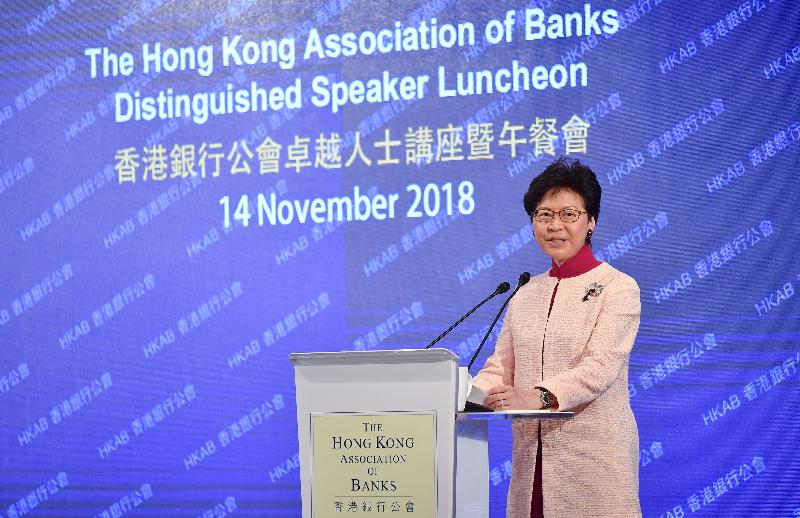
Photo  Photo  


24-hour A&E and inpatient services commence at Tin Shui Wai Hospital

The following is issued on behalf of the Hospital Authority:

     The Tin Shui Wai Hospital (TSWH) announced today (November 14) that the accident and emergency (A&E) services will be extended to 24 hours a day beginning next Wednesday (November 21) and a 32-bed mixed specialty ward will open the same day.
 
     The TSWH will provide round-the-clock A&E services to provide emergency medical care to residents of Tin Shui Wai area from 8am, November 21, while a mixed specialty ward managed by emergency physicians with a joint-consultation service will commence service at the same time.
 
     The Hospital Chief Executive of TSWH, Dr Deacons Yeung, said, "With due consideration to service demand of Tin Shui Wai residents, we further extend the operation of A&E to 24 hours and commence inpatient service upon completion of our preparations. Patients will receive initial treatment at the A&E department and be admitted to the mixed specialty ward for joint-consultation by emergency physicians and physicians for more comprehensive treatment and care.
 
     "The opening of inpatient service at TSWH will help apportion the service demand pressure of the New Territories West Cluster in the upcoming service surge."
 
     The operation of TSWH A&E has been smooth since service commencement in March last year, and it is currently providing a 12-hour service daily from 8am to 8pm. With an average daily attendance of around 250 and the peak attendance of 364, the TSWH A&E has effectively alleviated the service demand pressure of Tuen Mun Hospital and Pok Oi Hospital A&E.
 
     TSWH, the fifth hospital of NTWC, is currently providing A&E, special outpatient clinic, renal dialysis, allied health, diagnostic radiology, pharmacy and community nursing services.


Tender awarded for site in Kai Tak

     The Lands Department announced today (November 14) that the tender for a site, New Kowloon Inland Lot No. 6591 at Kai Tak Area 4B Site 4, Kai Tak, Kowloon, has been awarded to the highest tenderer, Rich Fast International Limited (parent company: Golden Sphere Developments Limited), on a 50-year land grant at a premium of $8,906.758888 million.

     The tenderers, other than the successful tenderer, in alphabetical order, with the name of the parent company where provided by the tenderer in brackets, were:

(1) Citypoint Investment Limited (CK Asset Holdings Limited);
(2) Infinite Sun Limited (Wheelock Properties Limited, New World Development Company Limited, Henderson Land Development Company Limited and Empire Development Hong Kong (BVI) Limited);
(3) Macfull Limited (China Overseas Land & Investment Limited);
(4) Marvel Planet Limited (K&K Property Holdings Limited);
(5) Tin Wah International Limited (K. Wah International Holdings Limited and Sino Land Company Limited); and
(6) Topco (H.K.) Limited (Sun Hung Kai Properties Limited).

     New Kowloon Inland Lot No. 6591 has a site area of about 9 708 square metres and is designated for private residential purposes. The minimum gross floor area and the maximum gross floor area are 32 037 sq m and 53 394 sq m respectively.


LCQ7: Measures to cope with increasing number of inbound tourists

     Following is a question by the Hon Wong Ting-kwong and a written reply by the Acting Secretary for Commerce and Economic Development, Dr Bernard Chan, in the Legislative Council today (November 14):

Question:
 
     With the recent commissioning of the Hong Kong Section of the Guangzhou-Shenzhen-Hong Kong Express Rail Link and the Hong Kong-Zhuhai-Macao Bridge, as well as the imminent opening of the Liantang/Heung Yuen Wai Boundary Control Point, the cross-boundary infrastructure facilities between Hong Kong and the Mainland are becoming more comprehensive. The Government anticipates that there will be an incessant rise in the number of inbound Mainland tourists. On the other hand, the patterns of inbound Mainland tourists' activities in Hong Kong have become increasingly diversified and their engagement in some activities (e.g. hiking and camping in the countryside and using public cultural and recreational facilities) has impacted on the daily lives of Hong Kong people. In this connection, will the Government inform this Council:

(1) whether it has studied the impacts of the improvements in recent years in cross-boundary infrastructure facilities on the various aspects (including the number of tourists) of the tourism industry, and whether it has reviewed the effectiveness of the various measures which aim to enhance Hong Kong's tourist receiving capacity and if such measures need to be strengthened; if it has, of the outcome; if not, the reasons for that;

(2) of the person-time, in each of the past three years, of inbound tourists using public cultural and recreational facilities, with a breakdown of such numbers by (i) type of facilities and (ii) place of origin of such tourists and their percentages in the total numbers;

(3) whether it will step up the management of those locations where tourists usually gather, such as (i) allocating additional resources and manpower for maintaining order and keeping such locations clean and (ii) planning for the provision of more tourism facilities; and

(4) whether it has conducted any investigation into the cases in which tourists occupied designated camp sites in country parks and caused damage to the ecological environment; if so, of the outcome, and the measures put in place to raise tourists' awareness of caring for the nature?

Reply:
 
President,
 
     The Government attaches great importance to the sustainable and healthy development of the tourism industry. Whilst ensuring the industry's stable and orderly growth, we also seek to minimise as far as possible the impact of tourist activities on the local community. With the relevant bureaux and departments consulted, our reply to the question raised by the Hon Wong Ting-kwong is as follows.

(1) and (3) As the Hong Kong Section of the Guangzhou-Shenzhen-Hong Kong Express Rail Link and the Hong Kong-Zhuhai-Macao Bridge (HZMB) were put into service only recently, their impact on Hong Kong's travel industry is still to be ascertained. In 2016, 2017 and the first nine months of 2018, the overall visitor arrivals to Hong Kong were 56.65 million, 58.47 million and 46.68 million respectively, of which 42.78 million, 44.45 million and 36.63 million were from the Mainland, accounting for approximately 76 per cent to 78 per cent of the overall visitor arrivals.

     In view of the steady growth in overall visitor arrivals to Hong Kong in recent years and the commissioning of various cross-boundary infrastructure in succession, the Government has strived to increase or improve Hong Kong's tourism facilities, as well as to enhance the city's tourist-receiving capacity.
 
     In October 2017, the Government published the Development Blueprint for Hong Kong's Tourism Industry. One of the four major industry development strategies therein is to nurture and develop tourism products and initiatives with local and international characteristics to cater for the needs and preferences of different visitor segments, thereby diverting tourists to sightsee and shop in different districts of Hong Kong strategically, and increasing the overall economic benefits brought by the tourism industry to all citizens in Hong Kong.
 
     The Government is collaborating with various stakeholders with plans to develop new tourist attractions and implement various cultural and creative tourism projects in places like Sham Shui Po, Wan Chai and Yim Tin Tsai, Sai Kung, as well as to promote green tourism development in New Territories and outlying islands along the principles of nature conservation and sustainable development. The Government completed the revitalisation of Dr Sun Yat-sen Historical Trail in April 2018. The revitalised trail, together with PMQ, Tai Kwun and the promotion campaign "Old Town Central" launched by the Hong Kong Tourism Board (HKTB), have transformed the Central and Western District into a new hub of heritage, cultural and creative tourism. The construction of a number of facilities in the West Kowloon Cultural District, namely the Xiqu Centre and the M+ Pavilion, will also be completed in phases in the next few years, contributing to the formation of a new tourist spot and thus the diversion of travellers. In addition, the HKTB has been actively promoting to visitors various activities in relation to traditional festivals with local distinctive characteristics, including the Yu Lan Ghost Festival, Cheung Chau Jiao Festival, the Tai O dragon boat water parade, Tai Hang fire dragon dance, etc., with a view to enticing tourists to patronise different districts of Hong Kong.
 
     In respect of theme parks, the Hong Kong Disneyland Resort is taking forward its expansion and development plan, and various attractions will be completed progressively from this year onwards till 2023, including the attraction "Moana: A Homecoming Celebration" stage show launched in May 2018. As regards Hong Kong Ocean Park, it is taking forward projects concerning an all-weather waterpark and two new hotels. Whilst one of the hotels has been soft-launched this year, the water park and the other hotel will be completed progressively from next year onwards until 2021. 
 
     Apart from developing various tourism attractions and projects, the Government will also promote the development of ancillary facilities in Hong Kong, such as putting forth in different districts sites designated for "hotel only" or commercial sites that allow for hotel development, with a view to encouraging the development of various types of hotels and further increasing the supply of hotel rooms in Hong Kong.
 
     Furthermore, the Government is pragmatic in tackling problems brought about by tourist flows in different districts. In response to the inconvenience caused by inbound tour groups to the community, the Government has, in collaboration with the trade, adopted various targeted measures to minimise the impact to the community. Such measures include encouraging tour coaches to use legal parking spaces, as well as appealing to the trade to maintain order when receiving tour groups and make good use of information technology to strengthen visitor and vehicular flow control, etc.
 
     In respect of environmental hygiene, the Food and Environmental Hygiene Department (FEHD) enhances the cleansing of streets and public toilets at popular gathering spots for visitors to keep the cityscape clean. For places where public cleanliness offences (e.g. littering, spitting, etc.) are frequent, the FEHD also increases the frequency of inspection and strengthens law enforcement. Moreover, the FEHD is implementing renovation or repair works for its 23 public toilets situated at tourist attractions, and has added five public toilets at the Hong Kong Port of the HZMB newly commissioned, so as to facilitate use by tourists. The FEHD also calls upon members of the public and visitors to maintain environmental hygiene through various channels, including its website, social platforms, television, radio, poster advertisement and publicity leaflets, etc.
 
     As regards crowd management, in case of crowding up of tourists in certain areas, the Police will, on a need basis, deploy more manpower to maintain public order and public safety, as well as smooth traffic flow thereat.

(2) We do not maintain figures in respect of inbound tourists using public cultural and recreational facilities.

(4) There are currently 41 designated campsites within country parks of Hong Kong, which are open for camping by the public including tourists. The Agriculture, Fisheries and Conservation Department (AFCD) displays camping codes at the designated campsites to remind members of the public and visitors of proper camping manners. It also disseminates relevant information on its website to encourage members of the public and visitors to plan ahead and be well-prepared before camping in country parks, as well as to make sure their camping activities are environmentally-friendly.

     In view of the increasing popularity of green tourism in recent years, the Tourism Commission (TC) has written to the Ministry of Culture and Tourism, reporting to it relevant trends and inviting it to, through appropriate channels in the Mainland, remind the travel trade and tourists to pay attention to certain codes of conduct when participating in green tourism activities in Hong Kong. Such codes of conduct include using public facilities near campsites in a proper manner, refraining from camping at non-designated camping areas and refraining from any acts that are harmful to the biological environment, etc. The TC has also frequently collaborated with the Guangdong Province Culture and Tourism Unit, the Guangzhou Tourism Administration and the Shenzhen Municipal Bureau of Culture, Sports and Tourism to, through Mainland online media and newspapers, release public notices targeting at Mainland residents who intend to visit Hong Kong, so as to raise their awareness of travelling manners.
 
     The TC will keep a close eye on the travel trends of Mainland tourists, and report destinations that the latter tend to visit to District Offices and other relevant departments in various districts for advance planning. The FEHD, the AFCD and the Leisure and Cultural Services Department will also from time to time review their site management and staffing mechanism, including deploying staff to step up inspection at popular destinations during peak arrival seasons of Mainland tourists, to advise and educate individuals involved in inappropriate behaviours and take enforcement actions against violations as appropriate, and at the same time to step up site cleansing and crowd management so as to minimise the impact of relevant activities on the districts concerned.


LCQ5: Lantau Tomorrow Vision

     Following is a question by the Hon Alice Mak, and a reply by the Secretary for Development, Mr Michael Wong, in the Legislative Council today (November 14):
 
Question:
 
     This year's Policy Address has put forward the "Lantau Tomorrow Vision" which proposes to progressively press ahead several development areas at Lantau Island and the coastal areas of Tuen Mun with the objective of increasing land supply and consolidating the sustainable development of Hong Kong. In this connection, will the Government inform this Council:
 
(1) regarding the preliminary planning of the Vision, how the Government will take on board the public views on the option of reclamation in the Central Waters set out in the report to be submitted by the Task Force on Land Supply; of the implementation timetable for the various phases and project scopes of the reclamation works, as well as the estimated costs of the first phase of reclamation and other works;
 
(2) as quite a number of members of the public are concerned whether the reclamation works in the Central Waters will damage the environment and whether the facilities on the artificial islands can withstand extreme weather, of the technologies and measures the Government will adopt to ensure that the various works concerned will strike a balance between development and conservation; how the Government will convince the public of the necessity of land formation by reclamation for Hong Kong; and
 
(3) as the Government will study the transport infrastructure facilities for linking up the artificial islands with districts such as Lantau Island, Hong Kong Island, Tuen Mun, Tsuen Wan and Kwai Tsing, whether the Government will concurrently conduct a comprehensive transport study for those districts?
 
Reply:
 
President,
 
     Hong Kong is currently facing acute land shortage problem. As pointed out in the preliminary observations by the Task Force on Land Supply (the Task Force) in September 2018, there is a need for more land in Hong Kong (estimated shortfall of at least 1 200 hectares). We will continue adopting a multi-pronged approach to proactively increase land resources.
 
     The construction of the artificial islands in the Central Waters that the Lantau Tomorrow Vision (the Vision) proposed to study can provide sizeable pieces of land. The proposals of forming artificial islands of about 1 000 hectares near Kau Yi Chau and the associated traffic and transport networks, if implemented, would benefit Hong Kong considerably. Apart from the revenue arising from residential and commercial land sale, developing the artificial islands will create substantial social and economic benefits, mainly from the 105 000 to 182 000 public residential units, 200 000 diversified, high-end and high value-added job opportunities, business opportunities emanating from the third Core Business District with a scale equivalent to 80 per cent of Central, a liveable city with holistic planning, comprehensive social facilities, and land development potential to be released by a broadened transport infrastructure network. In addition, the newly-built road and railway networks will serve to enhance the overall carrying capacity of the traffic and transport system in Hong Kong while effectively relieving the existing traffic load in the North West New Territories.
 
     My reply to various parts of the question raised by the Hon Alice Mak is as follows:
 
(1) As regards the implementation timetable of the artificial islands in the Central Waters, we will duly consider the final report to be submitted by the Task Force in end 2018 tentatively before firming up the details of the studies for the artificial islands in the Central Waters and consulting relevant district councils. We anticipate that funding approval will be sought from the Legislative Council (LegCo) in the first or second quarter of 2019 for commencement of the studies, which will focus on the artificial islands of about 1 000 hectares near Kau Yi Chau. Our work target is to commence the first phase of the reclamation works in 2025, with the first batch of residential units ready for intake in 2032. As for the remaining artificial islands near Hei Ling Chau, there is no concrete implementation timetable at the moment. Nevertheless, we will collect basic technical data in the above studies for future reference in long-term planning. The ultimate extent of reclamation should be subject to the results of the studies.
 
     On construction costs, the Government does not have a formal estimate of the cost of the infrastructure, including transport infrastructure, at this stage. That said, based on an average water-depth of seven metres at Kau Yi Chau, our preliminary estimate for the reclamation cost of the artificial islands will range from $13,000 to $15,000 per square metre, which is comparable to the resumption cost of private agricultural land of $14,500 per square metre. As regards the transport infrastructures, we need to conduct studies to establish a preliminary proposal, including the number of traffic lanes, alignment and the means to connect different places (e.g. bridge or tunnel). The estimated cost regarding infrastructure works is therefore not available at this stage. This is the same as the studies for the new development area projects that formal estimates on the cost of related infrastructure are not available before carrying out the respective planning and engineering studies.
 
     Having said that, with a view to addressing public concern over the construction cost of artificial islands, we will attempt to provide relevant estimate before seeking funding approval for the studies as far as possible by reviewing and analysing relevant information. But these estimates will be based on a host of assumptions.
 
     The Government has all along put in place a stringent audit and monitoring mechanism for the approval of funding for public works and the use of public funds. In formulating the implementation strategies, the Government will carry out detailed financial assessment by taking into account relevant factors like fiscal sustainability, and properly manage fiscal risk, to ensure that the project expenditure is fiscally affordable.
 
(2) The Government has taken into account the balance between development and conservation when formulating the Vision. Apart from shallower water-depth, the main reason for studying the formation of artificial islands in the Central Waters is the relatively low ecological sensitivity in the area.
 
     In taking forward the detailed engineering studies for individual projects, we will conduct the requisite environmental impact assessments under the Environmental Impact Assessment Ordinance, and make specific proposals on respective mitigation measures, thereby ensuring all relevant statutory requirements are complied with. The prevailing reclamation techniques are effective in reducing impacts on surrounding water quality and ecology arising from the works. For instance, the use of "non-dredging methods" for reclamation and "deep cement mixing" can effectively reduce pollution caused by the removal of seabed sediments. We will explore other more advanced and environment-friendly reclamation techniques and designs in the studies with a view to further protecting the environment. In addition, we will in the studies explore to retain the existing eco-shorelines as far as possible and establish eco-shorelines at the artificial islands if situation warrants.
 
     As always, we strive to encourage green groups and relevant stakeholders to participate in conservation initiatives. We will set up the $1 billion Lantau Conservation Fund mentioned in this year's the Policy Address as soon as possible and continue to take forward the planning, design and implementation of various development and conservation initiatives and local improvement projects in Lantau in a coordinated and integrated manner.
 
     In terms of addressing climate change, the Government is deeply concerned about the respective threats and set up the Steering Committee on Climate Change, which is chaired by the Chief Secretary for Administration in 2016, to steer and co-ordinate the work of government departments on climate change. As regards marine infrastructure works, the Civil Engineering and Development Department (CEDD) updated the Port Works Design Manual in early 2018, taking into account the future climate change projected in the Fifth Assessment Report of the Intergovernmental Panel on Climate Change set up under the United Nations (UN). The CEDD will pay close attention to the latest reports and timely update the design standards of port works as appropriate.
 
     To enhance resilience against extreme weather, we will make reference to the latest design standards when designing the artificial islands in the Central Waters under the coming engineering studies, and provide higher breakwater, wave breakers and non-building buffer zones along the shorelines as appropriate. It has been proved that structures and works (such as the Hei Ling Chau Typhoon Shelter and the Hong Kong International Airport near the artificial islands in the Central Waters), if suitably designed, could stand intact in the face of super typhoons like Mangkhut.
 
     Since the delivery of the Policy Address, we have, on various occasions (including press briefings, interviews on radio and in other media, meeting of the LegCo Panel on Development, etc.), explained the objectives, details and implementation plans of the artificial islands in the Central Waters, while paying heed to the views and suggestions from different sectors of the society. In addition, the relevant department has also briefed the public on the Vision which mentions the artificial islands in the Central Waters by means of distribution of pamphlets and webpages.
 
     We are aware of the public's concern about the technical assessment. We will conduct the needed site investigations, technical studies, and traffic and environmental impact assessments, etc. in the future studies and then draw up a detailed proposal. In the course of the studies, public engagement activities will be conducted to provide more comprehensive information for consulting the public and gathering their views and suggestions.
 
(3) According priority to transport infrastructure is one of the important policy directions for the Vision. In the future studies for the artificial islands in the Central Waters, we will conduct strategic studies on the major road and railway networks linking the proposed Kau Yi Chau artificial islands, Hong Kong Island West, North Lantau and the coastal areas of Tuen Mun. The studies will include related traffic assessments. On the whole, we believe that the new major road and railway networks can effectively relieve the existing traffic load of the North West New Territories to and from urban area.