Speech by STH at Hong Kong-London Maritime Day (English only)

     Following is the speech by the Secretary for Transport and Housing, Mr Frank Chan Fan, at the Hong Kong-London Maritime Day today (November 22):

     Lord Mountevans (Chairman of Maritime London, Lord Jeffrey Mountevans), members of Maritime London and the Hong Kong Maritime and Port Board, distinguished guests, ladies and gentlemen,

     Good morning. First of all, I would like to extend a very warm welcome to our friends from London. Welcome to Hong Kong, and we are very glad that you are here with us for the Hong Kong Maritime Week. We have packed together over 50 events this week to promote maritime services and foster closer ties among the maritime community. 

     Among the many activities during the Maritime Week, the Hong Kong-London Maritime Day is one that I have always been looking forward to. London was among the first overseas destinations I visited since I took office as the Secretary for Transport and Housing in July last year. The signing of the MoU with Maritime London on that sunny afternoon during the London International Shipping Week 2017 was indeed the first-ever agreement I have signed on behalf of the Hong Kong Maritime and Port Board. The Hong Kong-London Maritime Day today is the first-ever event co-organised by the Hong Kong Maritime and Port Board and Maritime London after conclusion of the MoU. The Hong Kong-London Maritime Day today therefore is a very special day.

     The Hong Kong-London partnership is no coincidence. Hong Kong and London share so many things in common. In terms of trade, Hong Kong and the UK are both among the world's top 10 trading economies. Both Hong Kong and London are service-oriented, with the service sector accounting for over 90 per cent of our respective GDPs. When it comes to maritime, both cities have a long maritime tradition and a strong maritime cluster. London, needless to say, has over 300 years of experience in providing maritime services. The fact that it is home to the International Maritime Organization speaks for itself.  

     Though with a shorter maritime tradition, Hong Kong is home to a cluster of over 800 shipping-related companies that offer a broad range of maritime services from ship agency and management, ship broking, ship finance and marine insurance to maritime legal and arbitration services. Both cities share so many common strengths that make us leading international maritime centres. More importantly, there is immense potential for Hong Kong and London to collaborate on the maritime front in leading the continual development of the industry across the globe. 

     International shipping forms a core part of the global economy and we must always be prepared for changes in the macroeconomic environment. At this juncture, the global trading environment is facing uncertainties. The US-China trade conflicts are clouding the global trade and shipping outlook, and their impacts would surface gradually. The fluid dynamics surrounding the Brexit negotiations are another source of uncertainty. Moreover, the consolidation and alliancing of liners have intensified regional competition among maritime cities. All these are imminent challenges that will have profound impact on the maritime industry in both Hong Kong and London.

     While we hope that these conflicts and uncertainties would eventually ease and settle, we need to look for new sources of growth. The global economic centre of gravity has shifted to the East. For the past decade or so, emerging Asia including Mainland China has seen the fastest growth. The region has been the key impetus to the global economy, contributing some 60 per cent to the world's GDP growth. Asia is also home to a rising middle class with strong purchasing power. The World Bank estimated that by 2030, two-thirds of the world's middle class will come from Asia. In short, Asia will remain the world's powerhouse of economic growth in future.

     Reflecting the growing demand, seaborne trade involving Asia has expanded to account for more than half of the world's trade volume. Nine of the world's top 10 ports in terms of container throughput are located in Asia, of which seven are in China. Over 90 per cent of shipbuilding activities took place in China, Korea and Japan alone. With these developments, the demand for professional maritime services in Asia is stronger than ever.  

     Indeed, using ship finance as an example, traditional shipping banks in Europe used to finance around 80 per cent of the shipping industry 10 years ago. While they still share some 60 per cent of the market nowadays, Chinese leasing firms are catching up and they now provide some one-fifth to one-fourth of financing for global shipping. The Belt and Road Initiative is also unlocking the immense potential flows of goods across the continents. Asia, in particular China, holds abundant opportunities for maritime services.

     As an international maritime centre, I am sure London would love to capture these opportunities, and Hong Kong is your perfect partner. Hong Kong is situated on the most thriving international sea routes at the heart of Asia. We are a regional transshipment hub well connected to over 470 destinations worldwide, including some 80 member states along the Belt and Road corridor. We also boast a strong presence of shipping principals including shipowners, cargo owners and traders, in addition to a vibrant maritime service cluster. Our strengths complement each other.  

     Hong Kong is well known for our business-friendly environment. We are the world's freest economy for 24 years in a row as well as the fourth easiest place to do business. As a Special Administrative Region of China, Hong Kong's maritime service providers enjoy preferential treatment when they access the Mainland market under the Closer Economic Partnership Arrangement. We therefore offer the direct gateway and springboard for the world to tap into the burgeoning Chinese market. 

     Our common law system, the rule of law, and cultural ties capable of bridging the East and West also make us the place to be for British companies seeking to expand in Asia. In fact, over 700 British companies have already established their foothold in Hong Kong and become our partners. The UK is our fourth largest parent source for regional headquarters, regional offices and local offices in Hong Kong, just after Mainland China, Japan and the US.

     Businesses aside, I would like to highlight manpower development as another potential area of collaboration. Hong Kong attaches great importance to nurturing maritime talents. Notably, we have set up the Maritime and Aviation Training Fund in 2014 to attract new blood to join the industry and enhance the competencies of existing professionals. To further strengthen the nurturing of maritime manpower, the Government will inject some GBP20 million to the Fund. With world-renowned marine education institutions in the UK, such as University of Southampton, South Shields Marine School and Warsash Maritime Academy, I look forward to closer exchanges on manpower development between Hong Kong and the UK to further consolidate our soft powers together. 

     In closing, may I wish you all a fruitful time at the Hong Kong-London Maritime Day. For our friends from overseas, please do find time to stroll around and savour our culture and local cuisine. You would be amazed.

Speech by CS at opening ceremony of Gerontech and Innovation Expo cum Summit (English only) (with photos/video)

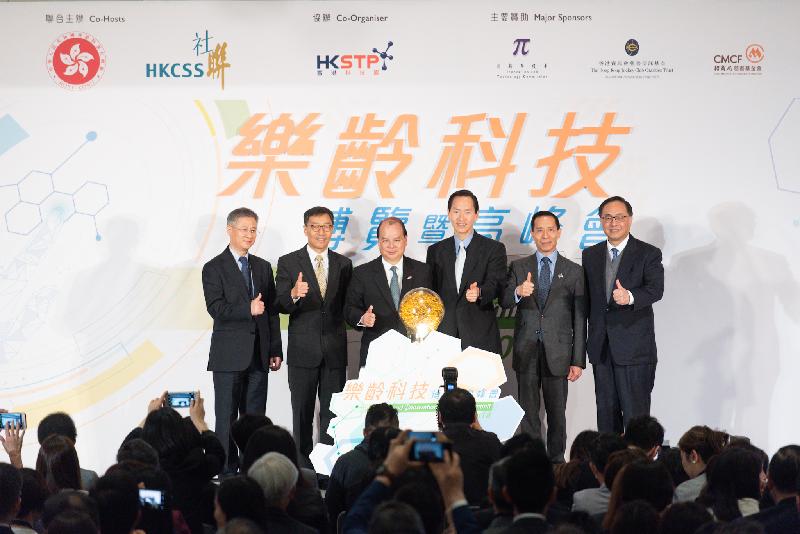
     Following is the speech by the Chief Secretary for Administration, Mr Matthew Cheung Kin-chung, at the opening ceremony of the Gerontech and Innovation Expo cum Summit today (November 22):
 
Dr Bernard Chan (Chairman of the Hong Kong Council of Social Service), Mr Albert Wong (Chief Executive Officer of Hong Kong Science and Technology Parks Corporation), Mr Richard Tang (Steward of The Hong Kong Jockey Club), Mr Chu Zongsheng (Member of the Board of Directors of the China Merchants Charitable Foundation), distinguished guests, ladies and gentlemen,
 
     Good morning. It gives me great pleasure to join you all again at the Gerontech and Innovation Expo cum Summit (GIES). First and foremost, I would like to extend my warmest welcome to all participants, especially those from different parts of the world.
 
     Following the successful launch of the first edition last year, which attracted over 43 000 visitors, this year’s Summit will feature a keynote session and three plenary sessions for international and local experts to share their experience and exchange views on issues related to population ageing and gerontechnology. The expo this year occupies over 8 000-square metres of exhibition floor to showcase around 380 inventions and products from some 130 local and international exhibitors.
 
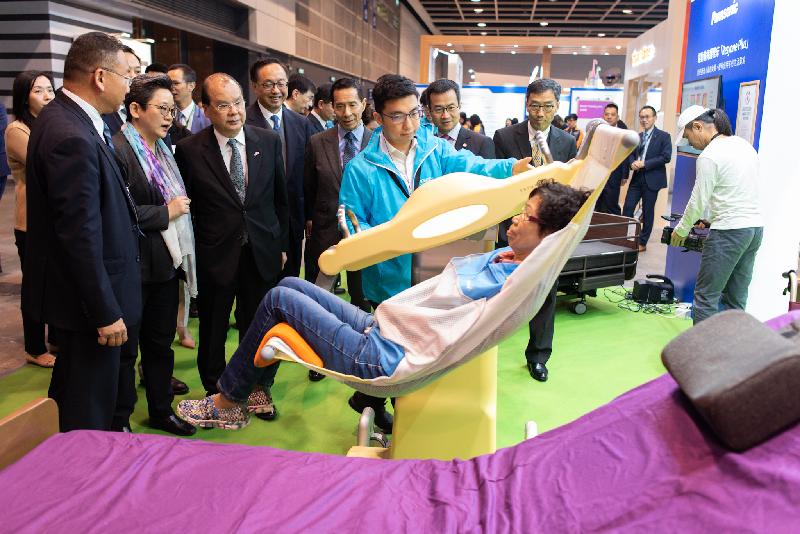
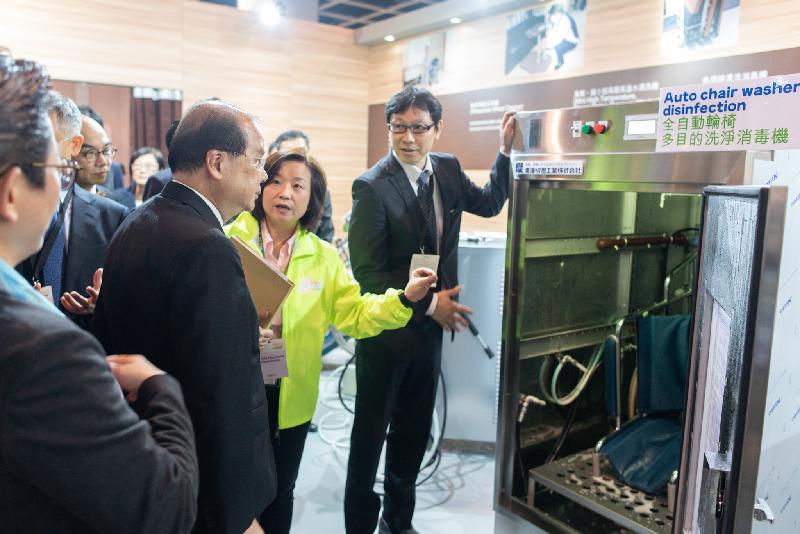
     I just had the privilege of touring around the Expo before coming here. I am truly amazed by the wide range of state-of-the-art technologies and the possibilities that they may create for our elderly citizens. Some products to be shown at the Expo will be exhibited for the first time in Hong Kong. I strongly encourage you to spare some time to visit the Expo in the next few days. As an important preamble, let me make the point that the Hong Kong Special Administrative Region (HKSAR) Government attaches great importance to the well-being of our elderly citizens. Government recurrent spending on the elderly, including social welfare services, medical services and other support services, amounts to 20 per cent, or HK$86 billion, of total government expenditure. 
 
     Thanks to our high quality and efficient healthcare services, increasing awareness of healthy diet, easy access to green space, country parks and beaches, Hong Kong has become one of the places enjoying the longest life expectancy in the world. Today, one in six people here is aged 65 or above, and this ratio will become about one in three in 20 years’ time. With a continuously increasing life expectancy and the "baby boomers" approaching old age, the number of "old-olds", that is, those aged 85 or above, will grow at an even faster rate, constituting around 16 per cent of the elderly population in 20 years' time and almost 30 per cent in 50 years.
 
     Whilst Hong Kong enjoys the status of an economy with the longest life expectancy worldwide, we must not be complacent. The HKSAR Government is mindful of the challenges posed by an ageing population and is determined to adopt an innovative approach in exploring solutions, including applying innovation and technology to elderly services and rehabilitation, and considering new modes of service delivery in order to keep abreast of the changing needs of elderly persons and ensure more effective use of limited resources.
 
     Gerontechnology, a combination of elderly services and innovation and technology, is increasingly seen as a key strategy to help fulfil the needs of an ageing population through technological intervention. Many places around the world, including Hong Kong, have begun to develop and adopt technology solutions that raise the efficiency of elderly care services whilst enabling the active and healthy living of the elderly.
 
     The development of gerontechnology brings many benefits to the elderly and improves their quality of life, such as sensor-based alarm systems, robotic training devices, remote monitoring of health conditions as well as user-friendly communication technologies, that can support the elderly to live independently, safely and securely at home and strengthen their social connections.
 
     Gerontechnology also provides technical support to caretakers, such as technologies for lifting and transferring persons that can relieve carers' physical burden, thereby improving efficiency for elderly care services and alleviating manpower pressure on the elderly care sector.
 
     Over the years, the HKSAR Government has rolled out different funding programmes under the Innovation and Technology Fund to provide subsidies to encourage universities, local public research institutions such as research and development (R&D) centres and private companies, to conduct R&D projects in various technology areas and conduct trials of their R&D outcomes in the public sector, including projects involving gerontechnology. 
 
     For example, the first round of the Midstream Research Programme for Universities held in 2017 supported eight projects under the theme "Elderly Health and Care", with a total funding of HK$33.6 million. We are also providing additional funding for Innovation and Technology Fund-funded R&D projects and incubatees, or graduate tenants of Cyberport and the Hong Kong Science and Technology Parks Corporation, through the Public Sector Trial Scheme for the production of prototypes/samples for trials in the public sector, such as elderly service units subvented by the Social Welfare Department.
 
     In addition, the HK$500 million Innovation and Technology Fund for Better Living was launched in May last year to finance projects that make use of innovation and technology to make people’s daily living safer, more convenient and comfortable, and address the needs of specific community groups including the elderly community. 
 
     However, driving the adoption of technologies for elderly care services is not without challenges. The adoption of gerontechnology solutions or products in Hong Kong remains limited mainly because many elderly-friendly technologies have not been widely applied in the elderly care sector. Possible difficulties include the lack of funding for product commercialisation, shortage of testing grounds, difficulties associated with localising imported products, and limited knowledge or affordability of the elderly.
 
     To proactively promote gerontechnology for improving the quality of life of elderly persons and reduce the burden and pressure of carers and care staff, I would like to take this opportunity to announce formally that the HK$1 billion Innovation and Technology Fund for Application in Elderly and Rehabilitation Care will be launched and open for applications on December 3 this year. 
 
     The Fund will subsidise elderly and rehabilitation service units to try out and procure or rent technology products. All NGOs and private organisations currently providing government subsidised residential care services, community care and support services and day rehabilitation services for the elderly or persons with disabilities are eligible to apply for the fund. It is estimated that over 1 260 service units could benefit from this new funding programme.
 
     The technology products that may be covered by the Fund include devices, equipment and tools that can help enhance the effectiveness and quality of care, such as electric climbers (電動爬樓梯機) and robotic care bed-cum-wheelchairs (電動輪椅護ç�†åºŠ). The Fund will also subsidise mobile applications as well as hardware and software systems that can effectively and accurately record the activities, health and medical conditions, etc, of elderly persons and persons with disabilities. Examples include infrared bedside sensors (紅外線離床警報器) and virtual reality-based rehabilitation systems (虛擬實景電腦輔助康復訓練系統). A briefing session for target service operators will be conducted later this month and more details regarding the application will be uploaded to the Social Welfare Department’s website.
 
     Apart from applying innovation and technology solutions to promote active ageing, the HKSAR Government strives to provide quality, cost-effective and long-term care services for elderly, with a view to achieving our policy objective of promoting "ageing in place as the core, institutional care as back-up". Services that we have introduced include both centre-based and home-based community care services for elderly persons who can continue to age in their own home and community safely, independently, and comfortably. We also provide residential care services for those who are unable to live at home owing to personal, social or health reasons.
 
     To better suit the needs of elders, we are exploring "innovative" modes of service delivery to enhance our capacity. We have implemented two pilot schemes to test a new funding mode, namely "money-following-the-user", to enable Government to provide subsidies directly to service users in the form of service vouchers. Through this new funding mode, the elderly can freely choose the best suitable service providers and service packages for themselves. This will, in turn, give service providers the incentive to improve service quality and be more responsive to elderly’s needs.
 
     The Pilot Scheme on Community Care Service Voucher for the Elderly allows elderly persons living in the community to choose community care services according to their needs. To enhance home and community care services for the benefit of more elderly people, we will increase the number of Community Care Service Vouchers for the elderly in 2019/20 by an additional 1 000 to a total of 7 000. As for elderly people who require residential care, the Pilot Scheme on Residential Care Service Voucher for the Elderly aims to provide more choices for elderly persons in need of residential care service. They can choose the services provided by eligible residential care homes for the elderly operated by NGOs or the private sector according to their needs.
 
     Most of the districts in Hong Kong are members of the WHO global network of age-friendly cities. To encourage our older generation to stay active, we have introduced the Government Public Transport Fare Concession Scheme for the Elderly and Eligible Persons with Disabilities, or the "two dollar scheme" (兩元乘車優惠), to enable elderly people and eligible persons with disabilities to travel on designated public transport modes and services at a concessionary fare of HK$2 per trip. Average daily passenger trips under the Scheme from June 2018 to August 2018 numbered about 1 290 000, among which about 1 130 000, or 88 per cent, were made by our elderly citizens.
 
     Ladies and gentlemen, the HKSAR Government will continue to promote gerontechnology and innovative solutions to ensure that our elderly citizens can spend their golden years actively, safely, happily and healthily. However, the Government's efforts alone can never be enough. We need cross-sector collaboration, cross-discipline, cross-generation co-operation to realise fully our goal. 
 
     The Gerontech and Innovation Expo cum Summit is a shining example of successful cross-sector collaboration to tackle population ageing, enhance the quality of life of elderly persons and address the needs of persons with disabilities. It is co-organised by the HKSAR Government, the Hong Kong Council of Social Service and the Hong Kong Science and Technology Parks Corporation. Together they develop this valuable platform for all stakeholders, from experts, industry leaders and policy makers in relevant disciplines to elderly persons and their families and carers to share their views and ideas to enhance public awareness on technology and innovation for our elderly population.
 
     Before I close, I must pay warm tribute to the Hong Kong Jockey Club Charities Trust, the China Merchants Charitable Foundation for their generous sponsorship to make this mega expo and summit possible. In particular, the Hong Kong Jockey Club has been instrumental over the years in promoting elderly services and elderly care. I must say that it has been a strong supporter of the Government, walking hand in hand for the benefit of our elderly population.
 
     On this encouraging note, I wish the Gerontech and Innovation Expo cum Summit 2018 a great success and all participants a most inspiring and fruitful experience. Thank you.

Photo  Photo  Photo  Photo  


CE expresses sorrow over passing of Mr Lau Nai-keung

     The Chief Executive, Mrs Carrie Lam, today (November 22) expressed deep sorrow over the passing of member of the Committee for the Basic Law Mr Lau Nai-keung.
 
     "Mr Lau had actively participated in public and community service for a long time, showing his care for the country and Hong Kong, in particular in the work on the Basic Law. He served as a member of the Basic Law Consultative Committee before Hong Kong's return to the motherland and had been a member of the Committee for the Basic Law of the Hong Kong Special Administrative Region under the Standing Committee of the National People's Congress since 2007, contributing significantly to the promotion and research of the Basic Law.
 
     "I am saddened by his passing. On behalf of the Hong Kong Special Administrative Region Government, I would like to extend my deepest condolences to his family," Mrs Lam said.


Red flag hoisted at Silverstrand Beach

Attention TV/radio announcers:

Please broadcast the following as soon as possible:

Here is an item of interest to swimmers.

     The Leisure and Cultural Services Department announced today (November 22) that due to big waves, the red flag has been hoisted at Silverstrand Beach in Sai Kung District.  Beach-goers are advised not to swim at the beach.


Regional Traffic Day of Kowloon West

     Police yesterday (November 21) held the Regional Traffic Day in Kowloon West to raise public awareness of road safety through stringent enforcement actions.

     A total of 238 officers from Traffic Kowloon West and District Traffic Teams of Kowloon City, Mong Kok, Sham Shui Po and Yau Tsim Districts were deployed to take enforcement actions at traffic black spots in Kowloon West.

     The operation resulted in the issue of 1,879 fixed penalty tickets and 122 summonses. Among the fixed penalty tickets and summonses issued, a total of 1,741 fixed penalty tickets were issued for illegal parking and the rest were for other traffic offences.

     Police figures revealed that a total of 2,723 traffic accidents involving casualties occurred in Kowloon West in the first ten months of 2018, of which 657 cases involved pedestrian injuries.

     Police will continue to take regular enforcement actions to ensure road safety.