LCQ15: Combating job-hopping acts of foreign domestic helpers

     Following is a question by the Dr Hon Chiang Lai-wan and a written reply by the Secretary for Labour and Welfare, Dr Law Chi-kwong, in the Legislative Council today (December 12):
 
Question:
 
     Since June 2013, the Immigration Department (ImmD) has stepped up its scrutiny of the employment visa applications of foreign domestic helpers (FDHs) who changed employers for several times, in order to curb suspected abuse by FDHs of the arrangements for premature contract termination in order to change their employers (commonly known as "job-hopping"). It has been reported that during the period from the implementation of the measure to August this year, ImmD found 10 863 cases of suspected job-hopping among 530 000 employment visa applications of FDHs, but eventually rejected 1 776 applications only. Besides, some employment agencies (EAs) have abetted FDHs to deliberately perform badly to get themselves fired, so that such FDHs can obtain one month's wages in lieu of notice as well as free air tickets and passages to return to their places of domicile while the EAs concerned can collect intermediary fees from new employers who have employed them (collusive job-hopping). There are views that the existing measures cannot effectively combat the aforesaid acts of FDHs and EAs. In this connection, will the Government inform this Council:

(1) in respect of the aforesaid cases of suspected job-hopping, of the number of those in which the ex-employers had given negative comments on the performance of the FDHs concerned in the premature termination notifications/complaint letters submitted by them, and among such cases, the number of those in which the employment visa applications of the FDHs concerned were subsequently approved;

(2) whether it will examine allowing employers to amend, subject to FDHs’ consent, the Standard Employment Contract for employing FDHs, such as by adding a probation period or stipulating a longer or a shorter termination notice period; if so, of the details; if not, the reasons for that;

(3) whether it will consider setting up an inter-departmental working group which comprises representatives from the Labour Department and ImmD to gather intelligence and conduct investigations in respect of acts of job-hopping and collusive job-hopping; if so, of the details; if not, the reasons for that;

(4) whether it will contact FDH employer groups to step up the publicity among employers that they can report to ImmD suspected acts of job-hopping and collusive job-hopping; if so, of the details; if not, the reasons for that;

(5) in each of the past three years and this year (as at the end of November), of (i) the number of complaints about collusive job-hopping received and, among them, (ii) the number of cases found substantiated, by the authorities as well as the penalties imposed on the EAs concerned; whether it will introduce a diversified punishment mechanism, such as requiring the management personnel of the EAs concerned to attend compulsory training courses; if so, of the details; if not, the reasons for that; and

(6) whether it has reviewed if the existing measures can effectively combat acts of job-hopping and collusive job-hopping, so as to suitably protect the rights and interests of employers of FDHs; if so, of the outcome; if not, whether it will conduct a review expeditiously?

Reply:
 
President,
 
     Having consulted the Security Bureau, our consolidated response to the Member's question is set out below:

(1) The Immigration Department (ImmD) has all along been processing employment visa applications of foreign domestic helpers (FDHs) in a rigorous manner. If the applicant has any adverse records or breaches, ImmD will refuse his/her application.
 
     Clause 12 of the Standard Employment Contract (SEC) for employment of FDHs provides that in the event of termination of the SEC, both the employer and the FDH shall give the Director of Immigration notice in writing within seven days of the date of termination. A copy of the other party's written acknowledgement of the termination shall also be forwarded to ImmD. These records will be kept and taken into account by ImmD when it assesses any future applications made by the FDH for employment visa or extension of stay.
 
     Since June 2013, ImmD has strengthened the assessment of employment visa applications from FDHs who changed employers repeatedly to combat abuse in changing employers through the arrangement for premature contract termination (commonly known as "job-hopping"). In assessing FDHs' applications for employment visa, ImmD closely scrutinises the case details such as the number and reasons for premature contract termination in the last 12 months, with a view to detecting any abuse of the arrangements for premature contract termination. From June 2013 to end-October 2018, ImmD received around 544 000 employment visa applications from FDHs, of which 11 077 were subject to further scrutiny, accounting for 2 per cent of the total number of applications. Among the 11 077 cases closely scrutinised by ImmD, various exceptional circumstances may be involved, including premature contract termination on grounds of the transfer, migration, death or financial reasons of the ex-employer, or where there was evidence suggesting that the FDH had been abused or exploited. Of these 11 077 cases, ImmD refused 1 817 applications, 819 applications were withdrawn by the applicants, and 658 applications could not be processed further.
 
     ImmD does not maintain statistics on the number of suspected "job-hopping" cases which involve adverse comments from previous employers on the work performance of their FDHs.

(2) Pursuant to clause 10 of the SEC, either the employer or the FDH may terminate the contract by giving one month's notice in writing or one month's wages in lieu of notice.  According to section 9 of the Employment Ordinance (Cap 57) (EO), an employer may terminate a contract of employment without notice or payment in lieu if an employee, in relation to his/her employment, wilfully disobeys a lawful and reasonable order from his/her employer, misconducts himself/herself, is guilty of fraud or dishonesty, or is habitually neglectful in his/her duties, etc., if the relevant conditions are fully established.
 
     The proposal of setting a probation period for FDHs or amending the notice period for contract termination involves complicated issues. Although the proposal may shorten the time required by employers to terminate the employment contract with their FDHs, it may give rise to other problems. For example, if a probation period is set, FDHs would also have the right to terminate a contract prematurely with their employers at any time within the probation period, and the employers are still required to bear the costs related to contract termination, including the return passage to the FDHs' places of origin. Also, employers cannot dispense with the expenses for hiring a new FDH, including travel expenses, visa fees and authentication fees, etc., even if there is a probation period. On the other hand, if FDHs are required to bear the risks of a probation period or a shorter notice period for terminating a contract, many FDHs may not be able to afford the costs of coming to work in Hong Kong, or they may suffer serious losses as a result of not passing the probation. This would affect the desire of FDHs to work in Hong Kong, thereby limiting employers' choices and even rendering them unable to employ FDHs.  
 
     The existing arrangement under the SEC that either the employer or the FDH may terminate the contract by giving one month's notice in writing or one month's wages in lieu of notice already provides a degree of flexibility to both parties and has taken into account the interests of both employers and FDHs. After considering the above factors, the Government has no plan to set a probation period for the employment of FDHs or amend the notice period required for contract termination.

(3), (4) and (6) The Government has all along been closely monitoring the suspected abuse of the arrangement for premature termination of contract by FDHs. Since June 2013, in order to combat suspected "job-hopping" by FDHs, ImmD has strengthened the assessment of employment visa applications from FDHs who changed employers repeatedly within a short period of time.  ImmD later implemented a series of measures to further combat "job-hopping", including improving the visa application assessment workflow, increasing manpower to handle cases, and issuing clear operational guidelines to staff, which include checking relevant records of employers and FDHs, and contacting the former employers and FDHs suspected of "job-hopping" to understand the reasons for premature contract termination etc.  ImmD will continue to strengthen the assessment and review the effectiveness of the measures from time to time. 
 
     In relation to the arrangement for FDHs to return to their places of origin after contract termination, the Labour Department (LD) has all along been encouraging employers to purchase air tickets for FDHs instead of providing them with cash equivalent to the value of an air ticket. This is to reduce the chance of FDHs or employment agencies (EAs) not returning to their places of origin or not arranging FDHs to return to their places of origin after receiving from employers free return passage to the places of origin.
      
     ImmD and LD will continue to maintain close contact on matters related to FDHs, and will follow-up and investigate as appropriate upon receiving complaints or reports of suspected "job-hopping" of FDHs.
      
     In addition, LD has all along been organising education and publicity programmes for FDHs and their employers, such as holding briefing sessions for FDHs and employers, publishing promotional materials, and producing promotional videos, etc., in order to enhance their understanding of their respective employment rights and obligations and channels for seeking assistance, including reminding FDHs not to abuse the arrangement for premature termination of contract. This September, LD issued "A Handbook for Employing Foreign Domestic Helpers" to enable employers to understand their employment rights and obligations, including the arrangement for and way to handle contract termination between employers and FDHs. 
      
     If employers and FDHs have disputes regarding the rights under the EO or the employment contract and cannot resolve them on their own, they may seek assistance from LD. LD will provide free consultation and conciliation services.
     
(5) EAs are not in breach of the relevant laws for providing job placement services to FDHs and/or employers. However, for each job placement, EAs are not allowed to charge the FDH commission of more than 10 per cent of the first-month wages after the FDH has been successfully placed in employment.
 
     The Code of Practice for Employment Agencies (CoP), promulgated by LD pursuant to section 62A of the EO, provides that EAs should exercise due diligence in checking the accuracy of the information provided by both job-seekers and employers as far as practicable, and ensure that any information that is made available to employers or job-seekers is consistent with the facts made known to the EAs.  The CoP also requires EAs to enter into service agreements with employers and list clearly the service coverage, itemised fees, date of reporting duty of the FDH, arrangement for replacing the FDH and refund policy, etc. Employers using the services of an EA should agree and clarify with the EA the service details before payment, and the agreed terms should be written down in a service agreement signed by both parties. When entering into a service agreement, employers and EAs may agree on matters about an FDH resigning shortly after arriving in Hong Kong, for example, whether a refund would be made and whether selecting another FDH would require separate service fees, etc. 
      
     If EAs cannot provide the services set out in the service agreement, employers can make a civil claim based on the service agreement to protect their rights as consumers. If EAs are in breach of the CoP requirements, including not entering into a service agreement with employers, their licences may be revoked or refused renewal by the Commissioner for Labour.
      
     LD and ImmD do not maintain the statistics requested in the question.
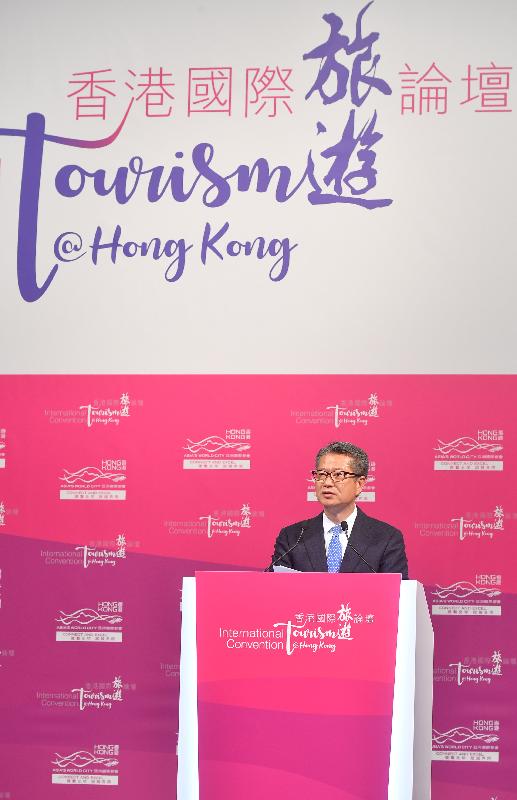


Speech by FS at Hong Kong International Tourism Convention (English only) (with photo/video)

     Following is the speech by the Financial Secretary, Mr Paul Chan, at the keynote luncheon of the Hong Kong International Tourism Convention today (December 12):
 
Mr Wan (Managing Director of the China National Travel Service Group, Mr Wan Min), Peter (Chairman of the Hong Kong Tourism Board, Dr Peter Lam), Jason (Chairman of the Travel Industry Council of Hong Kong, Mr Jason Wong), government colleagues, distinguished guests, ladies and gentlemen,
 
     Good afternoon.
     
     It's a great pleasure for me to speak today at this luncheon of the Hong Kong International Tourism Convention. First of all, my very warm welcome to all participants, in particular those from afar. Thank you for joining this important event. I hope those of you travelling from afar are here not just as convention participants, but also as a tourist and enjoy your stay in Hong Kong. After all, we are here for tourism!
 
     Secondly, the overwhelming attendance today clearly underlines the importance of developing tourism. Apart from its economic importance, tourism is also extremely crucial for people-to-people exchange. Such exchange is a cornerstone to mutual appreciation, harmony, co-operation, and, ultimately, a better world.
 
Hong Kong: Excellent connectivity
 
     It is most befitting for Hong Kong to play host to this Convention, when we are talking about people-to-people exchange. Hong Kong has long been the pre-eminent bridge connecting Asia, including the Mainland of China, with the rest of the world. This connectivity is underpinned by an extraordinarily strong tradition of Hong Kong being the bastion of free trade.
 
     Indeed, Hong Kong has been ranked the world's freest economy by the US-based Heritage Foundation and by the Canada-based Fraser Institute since 1995, without a break. This exceptional connectivity however is multifaceted. From finance, trade and logistics to, of course, tourism, Hong Kong is almost the synonym of connection, where ideas meet opportunities, investments meet ventures, demand meets supply, and where the East meets the West. This people-to-people connectivity has made Hong Kong the most visited city in the world according to Euromonitor International.
 
The Belt and Road Initiative and tourism development – Hong Kong as partner
 
     First announced by President Xi Jinping in 2013, the Belt and Road Initiative spreads across Asia, Europe and Africa to promote infrastructural connectivity and financial integration, boost trade and investment, deepen policy co-ordination, and create stronger people-to-people bonds among participating countries. The Initiative is about collaboration and sharing benefits. Hong Kong as the world's freest economy, most visited city and China's most international city, is an ideal partner in leveraging the potentials offered by the Belt and Road Initiative for tourism development. Let me take a moment to explain how this partnership works.
 
Hong Kong: Global financial centre
 
     Firstly, Hong Kong is the ideal place for arranging financing for any large-scale development projects with our deep liquidity and premier financial infrastructure. Hong Kong is the world's largest offshore Renminbi (RMB) business hub. And we have 44 heavy construction and engineering companies listed on our Stock Exchange. Hong Kong is also consistently ranked among the world's top initial public offerings (IPO) markets. It is highly likely that we will top the world again this year given the huge amount of funds raised so far this year. At the end of September, our stock market capitalisation stood at about HK$32 trillion, that is over US$4 trillion, which is 12 times our GDP.
 
     We have put in place measures to promote sustainable developments in the region. A Green Bond Grant Scheme was launched to subsidise the costs incurred by green bond issuers in obtaining green finance certification. A Government Green Bond Programme, with a borrowing limit up to HK$100 billion, will be rolled out soon. In addition, we have introduced a pilot Bond Grant Scheme plus tax incentives to attract more issuers to come to Hong Kong to issue bonds. Only in the first half of this year, we have attracted at least 15 green bonds issues, raising an aggregate amount of US$8 billion.
 
     Hong Kong is also a member of the Asian Infrastructure Investment Bank. We have also set up an Infrastructure Financing Facilitation Office under the Hong Kong Monetary Authority to provide a platform for pulling together investors, banks, financial institutions and infrastructure owners and operators to offer comprehensive services for various infrastructure projects.
 
     All the above have made Hong Kong an ideal partner for arranging financing for tourism projects, which are essential to propel tourism development.
 
Hong Kong: Regional education hub
 
     Secondly, Hong Kong, as a regional education hub, has world-class universities, professional bodies and international schools to provide a wide range of educational and training opportunities for students in Belt and Road countries in meeting global standards of excellence. For tourism in particular, we have one of the world's best hotel and tourism schools. The Hong Kong Polytechnic University's School of Hotel and Tourism Management has been ranked No. 1 in 2017 in the "Hospitality and Tourism Management" category in ShanghaiRanking's Global Ranking of Academic Subjects, as well as in the "Hospitality, Leisure, Sport & Tourism" subject area by the Center for World University Rankings. It is also ranked among the top three "Hospitality and Leisure Management" institutions globally in the QS World University Rankings by subject in 2017 and 2018.
 
     On top of that, we offer world-class training opportunities for hoteliers. Our city's many international hotel brands, including home-grown Mandarin Oriental and the Peninsula, make us the best place to acquire first-hand experience of world-class hotel operations.
 
     We are taking forward a number of measures to provide a quality education platform here for both local and non-local students, which include expanding quotas for admission of non-local students, setting up a Government Scholarship Fund for outstanding local and international students, and allowing students from outside Hong Kong to stay here without limitation for up to 12 months after graduation.
 
Hong Kong: Open immigration regime
 
     Thirdly, Hong Kong maintains an open immigration regime and we welcome talents from around the world to work, live, study, invest and travel in our city. Currently, nationals of about 170 countries and territories can visit Hong Kong for business or leisure visa-free. To further facilitate tourist flow between Hong Kong and Belt and Road countries, we will consider relaxing visa requirements for nationals of Belt and Road countries. We hope other countries will consider the same for the common good of our tourism sector.
 
Hong Kong: Diversified tourism offerings
 
     Fourthly, Hong Kong is a place full of contrasts, diversity and dynamism. We offer a broad range of tourism products to cater for the diverse interests of visitors. This involves constant upgrading and improvement of services, creating and reinvesting in new attractions, and rediscovering hidden treasures in our tourism resources.
 
     For example, Tai Kwun, the rejuvenation of three historical monument buildings in Central, is now a new exciting cultural landmark and a must-see for tourists. Our two flagship theme parks are also wasting no time to expand their capacity and enhance attractiveness. Hong Kong Disneyland will have new attractions almost every year to 2023 under its multi-year expansion plan. For Ocean Park, it just opened a new hotel last month, and will be commissioning a new waterpark and another hotel in the next few years. We will also see a much enhanced list of tourist attractions, including the heritage and cultural offerings at the West Kowloon Cultural District as well as the integrated development of the SkyCity development adjacent to the Hong Kong International Airport, comprising retail complexes, dining areas, hotels and entertainment facilities.
 
     We also roll out district tourism programmes to assist and entice visitors to explore Hong Kong's local life and districts' characteristics. Visitors will experience first-hand and in close encounters the local character of Hong Kong as a city where the East meets the West, where tradition crosses over with modernity.
 
     We are not missing our rich green tourism resources which are within arm's reach of our city centre. Apart from our normal countryside tourism offering, this year, we have launched a scalable School Excursion Programme package for secondary schools outside Hong Kong, combining school exchange with an immersive conservation and cultural focus. We pulled together the green tourism attractions in the "four corners" of Hong Kong, that is, the Ocean Park in the south, the Mai Po Ramsar Site and the Hong Kong Wetland Park in the north, the Hong Kong UNESCO Global Geopark in the east and Ngong Ping 360 in the west, together with Tai Kwun, PMQ and Dr Sun Yat-sen Historical Trail, etc, which offers a probably unrivalled experience of learning, adventure, fun, thrill and amazement, yet in a safe and easy to get around setting. We hope this programme can help contribute to better mutual understanding amongst the kids of different cultures.
 
     Creating new tourism products aside, city management, municipal services and quality assurance as well as safety are all important ingredients to fulfil a good tourist experience. Any city that is safe and easy to travel will be greatly welcomed by visitors. On this, I am proud to report that Hong Kong is one of the safest cities in the world, and a city that is easy for any tourists to get around with its efficient public transport and tourist-friendly facilities.
 
Regional co-operation for Belt and Road countries
 
     On top of our diverse tourism offerings, Hong Kong's advantages as a global aviation hub and well-connection with the Mainland offers enormous opportunities for regional co-operation, for instance, multi-destination travel and the development of "fly plus cruise" and "rail plus cruise" travel products.
 
     The Hong Kong International Airport provides excellent connectivity with over 120 airlines serving over 220 destinations worldwide. There are over 1 100 flights daily to and from the airport, reaching half of the world's population within five hours' flight time. The commissioning of the Hong Kong section of the Guangzhou-Shenzhen-Hong Kong Express Rail Link and the Hong Kong-Zhuhai-Macao Bridge has further enhanced our connections with the Mainland. Our Kai Tak Cruise Terminal can accommodate the largest cruise ships in the world. Together, we can create a win-win situation for all by strengthening the regional collaboration through for instance, development of mutually supporting cruise itineraries.
 
Greater Bay Area development
 
     As to the Guangdong-Hong Kong-Macao Greater Bay Area development, it is an ambitious city cluster development encompassing Hong Kong, Macao and nine cities in the Guangdong Province of the Mainland. Working together, the synergies to be brought about by these cities are obvious and tremendous.
 
     The Greater Bay Area city cluster possesses abundant tourism resources with distinctive appeals, such as Guangdong's traditional Lingnan culture and Macao's entertainment and leisure resources as well as Hong Kong's vibrancy and diversity as an international metropolis. Our different yet complementary advantages combined enable the Greater Bay Area to rival other famous bay areas in the world.
 
     Together, the Greater Bay Area presents to the world a model of cross-city co-operation and that tourism development is not a zero-sum game. We work together in every aspect to create an even bigger pie for all.
 
     In this connection, the city clusters would further collaborate to develop more "one trip multi-destination" tourism products and conduct joint promotions overseas. In fact, our survey suggests that 45 per cent of our short-haul visitors are taking multiple destination itineraries while the figure for long-haul visitors is remarkably over 80 per cent.
 
     To facilitate international travellers, foreign nationals in Hong Kong can visit the Guangdong Province for a maximum of 144 hours visa-free. This allows international travellers ample time to experience the diverse tourism offerings of Hong Kong and Guangdong Province, while ensuring the border crossing is hassle free.
 
     What's more is the exponential improvement in land connection with the Mainland and Macao that makes such "one trip, multi-destination" travel even easier. In addition to the commissioning of the Guangzhou-Shenzhen-Hong Kong Express Rail Link in September, and the opening of the Hong Kong-Zhuhai-Macao Bridge in October, another cross-boundary infrastructure in Liantang/Heung Yuen Wai, connecting Hong Kong to the expressway in the eastern part of Guangdong, is expected to be completed soon in 2019. Indeed, the commissioning of three key infrastructures in a city in about a year is probably very much unprecedented in the world. Hong Kong's enhanced connectivity with the Greater Bay Area and beyond would make Hong Kong an ideal launch pad for international travellers to start their vacations.
 
     On top of that, the Greater Bay Area adds more opportunities for Belt and Road countries. The Greater Bay Area has pulled together a spectacular 69 million population which is the most affluent part of China. The collective GDP is over US$1.5 trillion, comparable to that of South Korea. The Greater Bay Area is, I would say, a large source market for tourism for Belt and Road countries to tap.
 
Concluding remarks
 
     Ladies and gentlemen, I don't need to expound on the importance of tourism to economic development and the enrichment of people's life. The question is how we can do better and achieve more. The Belt and Road Initiative and the Greater Bay Area development, which are about collaboration and sharing benefits, have presented us with new potential. And Hong Kong as the world's most visited city, freest economy, top financial centre, safest city, and one which has one of the world's best educational facilities and the world's top hotel brands, is your ready partner to leverage on the opportunities offered by the two initiatives.
 
     We are committed to strengthening co-operation with different economies to promote tourism development, be it regionally or internationally. I hope today's conference has helped us not just to take on new tourism ideas, but new perspective, new horizons, and new hope, on how we can take our tourism development to a new height.
 
     I wish to thank all our sponsors for making this Convention a better one. I also wish to thank Guangdong Province and our 10 neighbouring cities in the Greater Bay Area for their support to this Convention. Also my heartfelt thanks to the Hong Kong Tourism Board, under the able leadership of Dr Peter Lam, and the Travel Industry Council of Hong Kong in co-organising the Convention with the Tourism Commission. Lastly, this Convention would not have been possible without your participation. So thank you all again for joining. And may I wish you all a very pleasant and enjoyable stay in Hong Kong.
 
     Thank you.

Photo  


Effective Exchange Rate Index

     The effective exchange rate index for the Hong Kong dollar on Wednesday, December 12, 2018 is 105.7 (same as yesterday's index).


LCQ3: Regulation of cannabis and products containing cannabis

     Following is a question by the Hon Chan Hak-kan and a reply by the Secretary for Security, Mr John Lee, in the Legislative Council today (December 12):

Question:

     The Canadian authorities have relaxed the control on recreational cannabis since October this year. Nationals of that country may purchase cannabis as well as food products and drinks containing cannabis from licensed suppliers. Given the frequent economic and trade exchanges and flows of residents between Canada and Hong Kong, some members of the public are concerned that the trend of consuming cannabis may spread to Hong Kong. Moreover, quite a number of parents of students are worried that their children who are studying or participating in study tours in Canada may bring cannabis or food products containing cannabis into Hong Kong when they return to the territory, thereby contravening the law inadvertently. In this connection, will the Government inform this Council:

(1) whether the Hong Kong Economic and Trade Office in Toronto (Toronto ETO) of Canada has publicised the perils of cannabis among the Hong Kong people who are studying, touring or operating business there, and reminded them and people intending to visit Hong Kong that the laws of Hong Kong prohibit the bringing of food products containing cannabis into Hong Kong; if Toronto ETO has, of the details;

(2) whether it will step up the interception of the various types of food products or gifts containing cannabis to prevent them from being brought into Hong Kong; and

(3) of the respective numbers of cases of law enforcement agencies smashing cannabis plantations and seizing food products containing cannabis, as well as the number of prosecutions for cannabis-related crimes and the penalties generally imposed on the convicted persons, in the past three years; whether it will step up law enforcement and publicity efforts to combat cannabis-related crimes?

Reply:

President,

     In Hong Kong, cannabis and tetrahydro-cannabinol (THC), a major compound of cannabis, are dangerous drugs controlled under the Dangerous Drugs Ordinance (Cap. 134). Any products, including food products and drinks, that contain cannabis or THC are also controlled under Cap. 134. Trafficking in dangerous drugs, or illicitly importing to and exporting from Hong Kong, procuring, supplying, manufacturing, or dealing in or with dangerous drugs, constitutes a criminal offence. The maximum penalty is life imprisonment and a fine of $5 million. Illicitly possessing, or smoking, inhaling, ingesting or injecting dangerous drugs is subject to a maximum penalty of imprisonment for seven years and a fine of $1 million. The Police and the Customs and Excise Department (C&ED) as the law enforcement agencies have been strictly enforcing the law to combat offences related to drugs, including cannabis.

     Cannabis is addictive and can cause serious harms to physical and mental health. According to researches in different places around the world (including those conducted by the World Health Organization), cannabis abuse has severe long-term harmful effects, such as causing irreversible impairment to cognitive functions, mental illness, anxiety and hallucinations, respiratory diseases, cardiovascular diseases and cancer. The United Nations has placed cannabis under drug control, requiring countries to exercise stringent regulation in respect of the production, manufacture, export, use, possession, etc. of cannabis. The Government and non-governmental anti-drug service organisations have been implementing various forms of preventive education and publicity on the harms of cannabis abuse and relevant offences. With the legalisation of recreational cannabis in individual overseas countries and regions, the Government will strengthen publicity and educational measures with a view to facilitating members of the public, especially young people, to have a correct understanding of the harms of cannabis abuse, and refrain from trying the drug under the influence of others or the misconception that cannabis is not harmful. The public will be reminded not to bring cannabis or any products that contain controlled cannabis compounds into Hong Kong, as this is against the law. Law enforcement agencies will also strengthen enforcement against cannabis as appropriate.

     For the three questions raised by Hon Chan Hak-kan, my consolidated reply is as follows.

     While Canada has legalised recreational cannabis with effect from October 17, 2018, the relevant legislation prohibits the sale or distribution of cannabis to any person aged under 18, or bringing cannabis into or out of the country. Sale of cannabis food products and drinks is still unlawful in Canada. With the legalisation of recreational cannabis in Canada and individual overseas regions, the C&ED issued a press statement in November this year to remind members of the public of the harms of cannabis abuse and the requirements under Cap. 134. The statement has particularly mentioned that as food products and drinks containing cannabis or THC may be available for sale in some overseas countries, members of the public should pay attention to the packaging labels of the products concerned while making purchases in those regions as well as the relevant domestic legislation in relation to cannabis, so as to avoid breaching the law inadvertently. The statement has also reminded members of the public that cannabis and THC are dangerous drugs in Hong Kong, and it is a criminal offence to possess or bring such products into Hong Kong.

     The Hong Kong Economic and Trade Office (Toronto) (Toronto ETO) has already uploaded the above-mentioned press statement onto its webpage. Through the regular distribution of its e-news bulletins, Toronto ETO has also reminded local business associations, community groups and individuals, especially local Hong Kong student groups, of the legislative control of cannabis in Hong Kong and the harms of cannabis abuse.

     As for law enforcement, the C&ED has, based on the principle of risk management, strengthened the inspection of travellers and cargoes at control points to interdict the import of cannabis or products containing cannabis or THC. The C&ED has also liaised with major air, marine and express cargo operators, reminding them to maintain alertness to goods suspected to contain cannabis and related products, and to report to the C&ED promptly in such cases.

     In 2015 to the first half of 2018, the Police and C&ED detected a total of 18 cases involving cannabis plantations, and the C&ED seized a small quantity of food products containing THC in five other cases. 1 183 persons arrested for cannabis-related offences were prosecuted. Generally, the majority of persons convicted of serious drug offences (such as manufacturing, trafficking or possession of a large quantity of drugs) would be sentenced to imprisonment, while those convicted of minor drug offences (such as possession of a small quantity of drugs for self-consumption) may be sentenced with other forms of penalty (such as admission to drug addiction treatment centres, probation orders or a fine). The Court will decide the actual penalty in each individual case having regard to its practical circumstances.

     As mentioned above, with the legalisation of recreational cannabis in individual overseas countries and regions, the Government will strengthen relevant publicity and education. Law enforcement agencies will, based on intelligence and risk management, stringently and proactively combat cannabis-related offences. In addition, the Centre for Food Safety has reminded food importers not to import any food products and drinks that may contain cannabis or cannabis compounds. Government departments concerned will continue to closely monitor the situation, and follow up and investigate any suspicious case timely.

     Thank you, President.


LCQ8: Capital Investment Entrant Scheme

     Following is a question by the Hon Christopher Cheung and a written reply by the Secretary for Security, Mr John Lee, in the Legislative Council today (December 12):

Question:
 
     The Capital Investment Entrant Scheme (the Scheme), introduced by the Government in 2003, was suspended on January 15, 2015.  However, applications which (i) had been submitted before that date and (ii) were submitted within six months from investments that had been made within six months before that date would not be affected.  As stipulated in the rules of the Scheme, an applicant/investor is not required to top up his/her investment in any class of the permissible investment assets should the market value of the investment fall below the Scheme's investment threshold (i.e. $10 million).  Nevertheless, some investors of the Scheme recently complained that the Immigration Department (ImmD) had demanded them to top up their investments after the market values of their investments had fallen below the threshold as a result of investment failure in bonds.  In this connection, will the Government inform this Council:
 
(1) of the following information in each year since 2015: the respective numbers of applications under the Scheme that were (i) outstanding at the end of the year, (ii) rejected within the year and (iii) approved within the year; (iv) the number of investors and their dependents who became eligible for and were granted the Hong Kong permanent resident status within the year; (v) the number of investors whose eligibility to stay in Hong Kong was cancelled within the year as the market values of their investments were lower than the threshold; (vi) the number of investors who were requested within the year to top up the values of their investments as the market values of their investments were lower than the threshold; and (vii) the number of investors whose eligibility to stay in Hong Kong was cancelled due to other reasons (set out in the table below);
 

Year (i) (ii) (iii) (iv) (v) (vi) (vii)
2015              
2016              
2017              
2018 (as at 30 November)              
Total:            

 
(2)   whether ImmD has, according to different classes of investment assets, treated differently investors whose investments had market values lower than the threshold; if so, of the details and justifications; and
 
(3)   of the reasons why ImmD demanded some of the investors whose investments had market values lower than the threshold to top up their investments; whether the authorities will examine afresh those cases and review the relevant practice?
 
Reply:
 
President,
 
     The reply to Hon Cheung's question is as follows:
 
(1) The statistics on the applications processed by the Immigration Department (ImmD) under the "Capital Investment Entrant Scheme" (the Scheme) from 2015 to 2018 (as at the end of November) are as follows:
 

Year (i)
Number of outstanding applications as at the end of the year
(ii)
Number of refused applications in the year
(iii)
Number of approved applications in the year
(iv)
Number of persons acquiring the right of abode in Hong Kong through the Scheme in the year (Note 2)
(v)
Number of persons whose eligibility to stay in Hong Kong was cancelled within the year as the market values of their investments were lower than the threshold
(vi)
Number of persons who were requested within the year to top-up the values of their investments as the market values of their investments were lower than the threshold
(vii)
Number of refused applications for extension of stay in the year
2015 11 429 2 2 739 404  
 
Not Applicable (Note 3)
0
2016 7 428 6 2 667 728 4
2017 3 375 4 2 640 1 101 4
2018 (as at end of November) 839 (Note 1) 0 1 507 1 463 24

Note 1: Pending the entrants' further submission of relevant supporting documents and information
Note 2: ImmD does not maintain statistics on the number of dependants who have acquired right of abode in Hong Kong through the Scheme
Note 3: The entrant is not required to top-up the value of his investment so as to be eligible for extension of stay if the value of his total investment falls below the requisite minimum level, not even in the event of a total loss.  Thus, there are no breakdown statistics on (v) and (vi).
(Dependants' applications are not included in the above figures)

(2) and (3) Entrants who apply for entry into Hong Kong and extension of stay in Hong Kong pursuant to the Scheme are subject to the "Rules for the Capital Investment Entrant Scheme" (the Scheme Rules), including the requirement of investing in Permissible investment asset classes and the portfolio maintenance requirements, etc. as specified in the Scheme Rules.  When the entrant furnishes proof to ImmD that his investment in Permissible investment assets has been completed, permission to stay for two years will be granted on the condition that he must continue to satisfy the requirements of the Scheme throughout the period.  Further extension for two years will be granted on the same conditions and basis.  The entrant is not required to top-up the value of his investment so as to be eligible for extension of stay if the value of his total investment falls below the requisite minimum level, even in the event of a total loss.  Therefore, whether the entrant is eligible for the Scheme depends mainly on whether the entrant invests according to the Scheme Rules, instead of the market value of the assets invested under the Scheme.
 
     To ensure that the entrant invests according to the Scheme Rules and does not reduce his investment commitment during his stay in Hong Kong, ImmD scrutinises whether the entrant has violated the investment commitment in accordance with the requirements of portfolio maintenance and switches between Permissible investment assets as stipulated in the Scheme Rules.  If the entrant invests in items other than those listed in the Permissible investment asset classes, ImmD will require the entrant to provide proof of making requisite level of investment in the Permissible investment asset classes.  ImmD will assess each application in accordance with the "Changes in the Value of Investment" stipulated in the Scheme Rules and on its own merits.  Under exceptional circumstances, ImmD will seek relevant professional advice prior to making a decision.