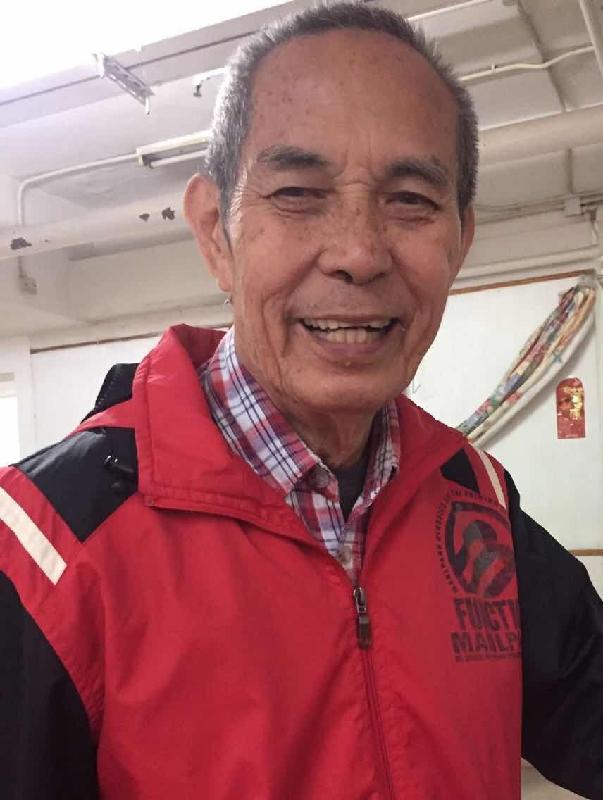
Appeal for information on missing man in Kwai Chung (with photo)

     Police today (December 31) appealed to the public for information on a man who went missing in Kwai Chung.

     Hung Yau-pui, aged 81, went missing after he left an elderly home on Tai Loong Street on December 29 morning. Staff of the elderly home made a report to Police on the same day.

     He is about 1.65 metres tall, 55 kilograms in weight and of medium build. He has a long face with yellow complexion and short grey hair. He was last seen wearing a red long-sleeved windbreaker (sleeves in black), dark trousers and blue slippers.

     Anyone who knows the whereabouts of the missing man or may have seen him is urged to contact the Regional Missing Person Unit of New Territories South on 3661 1176, 9689 7445 or email to rmpu-nts-2@police.gov.hk, or contact any police station.

Photo  


CFS announces food safety report for November

     The Centre for Food Safety (CFS) of the Food and Environmental Hygiene Department today (December 31) released the findings of its food safety report for last month. The results of about 16 400 food samples tested were satisfactory except for 16 samples which were announced earlier. The overall satisfactory rate was 99.9 per cent.
    
     A CFS spokesman said about 2 000 food samples were collected for microbiological tests, some 4 800 samples were taken for chemical tests and the remaining 9 600 (including about 9 100 taken from food imported from Japan) were collected to test radiation levels.
    
     The microbiological tests covered pathogens and hygienic indicators, while the chemical tests included pesticides, preservatives, metallic contaminants, colouring matters, veterinary drug residues and others.
 
     The samples comprised about 4 000 samples of vegetables and fruit and their products; 1 200 samples of meat and poultry and their products; 1 900 samples of aquatic and related products; 1 000 samples of milk, milk products and frozen confections; 1 100 samples of cereals, grains and their products; and 7 200 samples of other food commodities (including beverages, bakery products and snacks).
 
     The 16 unsatisfactory samples comprised five crab samples and two vegetable samples detected with excessive cadmium, three vegetable samples detected with pesticide residues exceeding the legal limits, two abalone samples found to contain chloramphenicol, two preserved leaf mustard samples detected with sulphur dioxide exceeding the legal limit, a sample of uncooked dumpling wrapper found to contain sorbic acid and an ox spleen sample found to contain excessive Clostridium perfringens.
 
     The CFS has taken follow-up action on the unsatisfactory samples, including informing the vendors concerned of the test results, instructing them to stop selling the affected food items and tracing the sources of the food items in question.
 
     Since the Pesticide Residues in Food Regulation (Cap 132CM) came into effect on August 1, 2014, as of November 30 this year, the CFS has taken over 162 000 food samples at the import, wholesale and retail levels for testing for pesticide residues. The overall unsatisfactory rate is less than 0.2 per cent.
        
     The spokesman added that excessive pesticide residues in food may arise from the trade not observing Good Agricultural Practice, e.g. using excessive pesticides and/or not allowing sufficient time for pesticides to decompose before harvesting. The maximum residue limits (MRLs) of pesticide residues in food set in the Regulation are not safety indicators. They are the maximum concentrations of pesticide residues to be permitted in a food commodity under Good Agricultural Practice when applying pesticides. In this connection, consumption of food with pesticide residues higher than the MRLs will not necessarily lead to any adverse health effects.
    
     The spokesman reminded the food trade to ensure that food for sale is fit for human consumption and meets legal requirements. Consumers should patronise reliable shops when buying food and maintain a balanced diet to minimise food risks.       


Public reminded to pay attention to marine safety when participating in major events at sea

Attention radio/TV announcers:
 
     Please broadcast the following at suitable intervals:
 
     In regard to the New Year's Eve countdown celebrations to be held tonight (December 31), the Marine Department reminds members of the public to pay attention to marine safety when viewing the display at sea. Parents or adults should look after their children and ensure that the children wear a lifejacket at all times. Coxswains should keep a passenger and crew list in case it is needed. In addition, passengers should note the locations of emergency exits and lifejackets, and the instructions on how to wear a lifejacket, before the vessel departs. Coxswains should refrain from speeding or overloading their vessels.
      
     Marine Department Notice No. 196 of 2018 has been issued with regard to special marine traffic control and safety measures for tonight. Members of the public can visit the department's website (www.mardep.gov.hk) for more details.


Appointment to Law Reform Commission

The following is issued on behalf of the Law Reform Commission:

     The Law Reform Commission (LRC) today (December 31) announced that Ms Winnie Tam Wan-chi, SC, has been appointed by the Chief Executive as a new member of the LRC for three years with effect from January 1, 2019.

     Ms Tam, who is a senior counsel with broad experience in commercial (especially intellectual property) litigation, will replace Mr Eugene Fung, SC, following his completion of two three-year terms as an LRC member. The LRC believes that the substantial expertise and experience of Ms Tam in the legal sector, as well as her diverse experience of public service, would benefit the LRC in law reform.

     The Secretary for Justice, Ms Teresa Cheng, SC, who is also Chairman of the LRC, thanked Mr Fung for his valuable contribution and advice to the LRC over the years.

     With this latest appointment, the LRC will comprise the following members:

Secretary for Justice (Chairman)
Professor Lin Feng
Ms Christine Fang
Mr Robert Y H Pang, SC
Professor Michael Hor
Professor Christopher Gane
Mr Allan Leung
Ms Alexandra Lo
Ms Melissa Wu
Mr Justice Andrew Cheung Kui-nung
Ms Winnie Tam Wan-chi, SC
The Chief Justice of the Court of Final Appeal (ex-officio member)
The Law Draftsman (ex-officio member)


Update on cases of Legionnaires’ disease

     The Centre for Health Protection (CHP) of the Department of Health today (December 31) reported the latest number of cases of Legionnaires' disease (LD), and stressed the importance of using and maintaining properly designed man-made water systems, and that susceptible groups should strictly observe relevant precautions.

     From December 23 to 29, one community-acquired LD case was reported. The female patient, aged 69 with good past health, lives in Block 15, Treasure Spot Garden (Phase 4), Tai Po.

     "Epidemiological investigations are ongoing to identify potential sources of infection, high-risk exposure and clusters, if any," a spokesman for the CHP said.

     As of December 29, 105 LD cases had been reported in 2018. In 2017 and 2016, there were 72 and 75 cases respectively.
 
     "Men, people aged over 50, smokers, alcoholics and persons with weakened immunity are more susceptible to LD. Some situations may also increase the risk of infection, including poor maintenance of water systems leading to stagnant water; living in areas with old water systems, cooling towers or fountains; using electric water heaters, whirlpools and spas or hot water spring spas; and recent stays in hotels or vessels," the spokesman said.

     Legionellae are found in various environmental settings and grow well in warm water (20 to 45 degrees Celsius). They can be found in aqueous environments such as water tanks, hot and cold water systems, cooling towers, whirlpools and spas, water fountains and home apparatus which support breathing. People may get infected when they breathe in contaminated droplets (aerosols) and mist generated by artificial water systems, or when handling garden soil, compost and potting mixes.

     Immunocompromised persons should:
 

  • Use sterile or boiled water for drinking, tooth brushing and mouth rinsing;
  • Avoid using humidifiers, or other mist- or aerosol-generating devices. A shower may also generate small aerosols; and
  • If using humidifiers, or other mist- or aerosol-generating devices, fill the water tank with only sterile or cooled freshly boiled water, and not water directly from the tap. Also, clean and maintain humidifiers/devices regularly according to manufacturers' instructions. Never leave stagnant water in a humidifier/device. Empty the water tank, wipe all surfaces dry, and change the water daily.

    
     The public should observe the health advice below:
 

  • Observe personal hygiene;
  • Do not smoke and avoid alcohol consumption;
  • Strainers in water taps and shower heads should be inspected, cleaned, descaled and disinfected regularly or at a frequency recommended by the manufacturer;
  • If a fresh water plumbing system is properly maintained, it is not necessary to install domestic water filters. Use of water filters is not encouraged as clogging occurs easily, which can promote growth of micro-organisms. In case water filters are used, the pore size should be 0.2 micrometres (µm) and the filter needs to be changed periodically according to the manufacturer's recommendations;
  • Drain and clean water tanks of buildings at least quarterly;
  • Drain or purge for at least one minute the infrequently used water outlets (e.g. water taps, shower heads and hot water outlets) and stagnant points of the pipework weekly or before use;
  • Seek and follow doctors' professional advice regarding the use and maintenance of home respiratory devices and use only sterile water (not distilled or tap water) to clean and fill the reservoir. Clean and maintain the device regularly according to the manufacturer's instructions. After cleaning/disinfection, rinse the device with sterile water, cooled freshly boiled water or water filtered with 0.2 µm filters. Never leave stagnant water in the device. Empty the water tank, keep all surfaces dry, and change the water daily; and
  • When handling garden soil, compost and potting mixes:

     1. Wear gloves and a face mask;
     2. Water gardens and compost gently using low pressure;
     3. Open composted potting mixes slowly and make sure the opening is directed away from the face;
     4. Wet the soil to reduce dust when potting plants; and
     5. Avoid working in poorly ventilated places such as enclosed greenhouses.

     The public may visit the CHP's LD page, the Code of Practice for Prevention of LD and the Housekeeping Guidelines for Cold and Hot Water Systems for Building Management of the Prevention of LD Committee, and the CHP's risk-based strategy for prevention and control of LD.