Hong Kong Customs seizes suspected rhino horns (with photo)

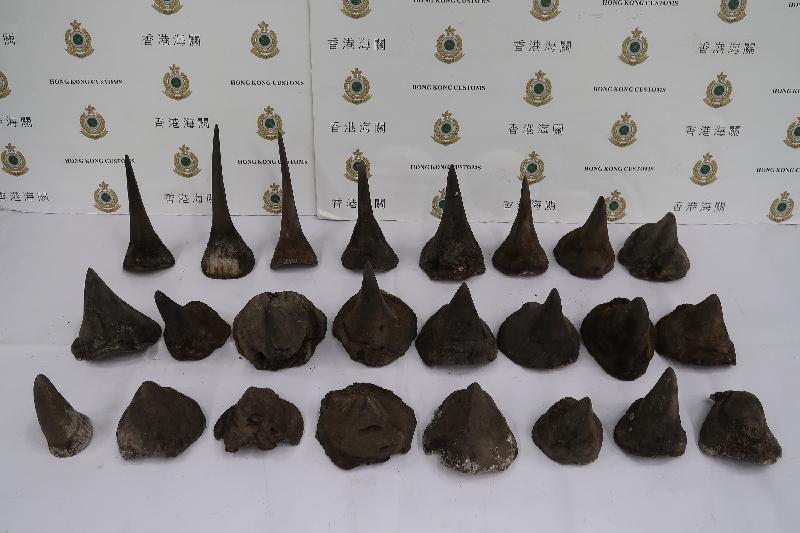
     Hong Kong Customs today (February 14) seized about 40 kilograms of suspected rhino horns, a record high seizure of rhino horns detected from arriving air passengers, with an estimated market value of about $8 million at Hong Kong International Airport.
           
     Customs officers intercepted two male passengers, aged 28 and 33, at the airport this morning. The two men arrived in Hong Kong from Johannesburg, South Africa. They were planning to transit to Ho Chi Minh City, Vietnam, by air.
           
     During Customs clearance, suspected rhino horns were found in their two check-in carton boxes. The two men were then arrested.
               
     The cases were handed over to the Agriculture, Fisheries and Conservation Department for follow-up investigation.
           
     To provide a stronger deterrent against the smuggling and illegal trading of endangered species, the penalties under the Protection of Endangered Species of Animals and Plants Ordinance have been increased drastically since May 1, 2018. Any person importing, exporting or possessing specimens of endangered species not in accordance with the Ordinance will be liable to a maximum fine of $10 million and imprisonment for 10 years. The specimens will also be forfeited upon conviction.  

     On February 8, 2019, two defendants were sentenced for 16 months imprisonment in the District Court for smuggling about 24kg and 17kg of agarwood. It was the heaviest sentence handed down so far for illegal import of endangered species under the present Ordinance.

     Customs and the Agriculture, Fisheries and Conservation Department reminded citizens not to illegally import or export any endangered species.

     Members of the public may report any suspected smuggling activities to Customs' 24-hour hotline 2545 6182 or its dedicated crime-reporting email account (crimereport@customs.gov.hk).
Photo  


SCS and SFH visit Kwun Tong District

     The Secretary for the Civil Service, Mr Joshua Law, and the Secretary for Food and Health, Professor Sophia Chan, visited Kwun Tong District today (February 14), where they met with members of the Kwun Tong District Council (KTDC) and visited a family service centre and a community health service centre.

     Accompanied by the Chairman of KTDC, Dr Bunny Chan, and the District Officer (Kwun Tong), Mr Steve Tse, Mr Law and Professor Chan first met with KTDC members and exchanged views on issues of concern.

     The two Directors of Bureaux later visited the Christian Family Service Centre Jockey Club Building to learn more about the integrated family services provided by the Centre to district residents. They also visited the Chinese and western medical clinics in the building to find out about the one-stop primary medical health care services offered.

    Finally, Mr Law and Professor Chan visited the United Christian Nethersole Community Health Service Medical Centre to learn more about the services provided by the community health service centre, which include emotional health education, Chinese medicine specialist services and community rehabilitation services.


Update on cluster of Influenza A cases in Siu Lam Hospital

The following is issued on behalf of the Hospital Authority:

     Regarding an earlier announcement on a cluster of patients infected with Influenza A in a female ward for severe intellectual disability, the spokesperson for Siu Lam Hospital gave the following update today (February 14):
 
     Three more patients (aged 41 to 66) in the ward presented with respiratory symptoms. Appropriate viral tests were arranged for the patients and their test results were positive for Influenza A. The patients concerned are being treated under isolation with stable condition.
 
     Admission to the ward has been suspended and restricted visiting arrangements have been imposed. Infection control measures have already been stepped up according to established guidelines. All other patients in the ward are under close surveillance.
 
     The cases have been reported to the Hospital Authority Head Office and the Centre for Health Protection for necessary follow-up.


Analytical Accounts of the Exchange Fund

The following is issued on behalf of the Hong Kong Monetary Authority:
  
     The Hong Kong Monetary Authority (HKMA) released today (February 14) the key analytical accounts of the Exchange Fund at the end of January 2019.
 
     Foreign assets, representing the external assets of the Exchange Fund, increased during the month by HK$68.8 billion to HK$3,557.3 billion.
 
     The Monetary Base, comprising Certificates of Indebtedness, Government-issued currency notes and coins in circulation, the balance of the banking system and Exchange Fund Bills and Notes issued, amounted to HK$1,655.7 billion.
 
     Claims on the private sector in Hong Kong amounted to HK$322.2 billion.
 
     The analytical accounts of the Exchange Fund are released in accordance with the International Monetary Fund's Special Data Dissemination Standard (SDDS) and are referred to as the Analytical Accounts of the Central Bank under SDDS (Annex).
 
*********************************************************
 
     At present, four press releases relating to the Exchange Fund's data are issued by the HKMA each month. Three of these releases are issued to disseminate monetary data in accordance with the International Monetary Fund's Special Data Dissemination Standard (SDDS). The fourth press release, on the Exchange Fund's Abridged Balance Sheet and Currency Board Account, is made in accordance with the HKMA's policy of maintaining a high level of transparency. For the month of February 2019, the scheduled dates for issuing the press releases are as follows:
 

February 11
(Issued)
SDDS International Reserves
(Hong Kong's Latest Foreign Currency Reserve Assets Figures)
 
February 14
 
SDDS Analytical Accounts of the Central Bank
 (Analytical Accounts of the Exchange Fund)
 
February 28
 
 
SDDS Template on International Reserves and
Foreign Currency Liquidity
 
February 28
 
Exchange Fund Abridged Balance Sheet and
Currency Board Account


Suspected MERS case reported

     The Centre for Health Protection (CHP) of the Department of Health today (February 14) reported a suspected case of Middle East Respiratory Syndrome (MERS), and again urged the public to pay special attention to safety during travel, taking due consideration of the health risks in the places they visit. The case is detailed below:
 

Sex Male
Age 8
Affected area involved Dubai, United Arab Emirates
High-risk exposure Nil
Hospital Princess Margaret Hospital
Condition Stable
MERS-Coronavirus preliminary test result Negative

     
     "Travellers to the Middle East should avoid going to farms, barns or markets with camels; avoid contact with sick persons and animals, especially camels, birds or poultry; and avoid unnecessary visits to healthcare facilities. We strongly advise travel agents organising tours to the Middle East to abstain from arranging camel rides and activities involving direct contact with camels, which are known risk factors for acquiring MERS Coronavirus (MERS-CoV)," a spokesman for the CHP said.

     Locally, the CHP's surveillance with public and private hospitals, with practising doctors and at boundary control points is firmly in place. Inbound travellers and members of the public who recently visited the Middle East and developed fever or lower respiratory symptoms within 14 days will be classified as suspected MERS cases. They will be taken to public hospitals for isolation and management until their specimens test negative for MERS-CoV.

     Travellers to affected areas should maintain vigilance, adopt appropriate health precautions and take heed of personal, food and environmental hygiene. The public may visit the MERS pages of the CHP and its Travel Health Service, MERS statistics in affected areas, the CHP's Facebook Page and YouTube Channel, and the World Health Organization's latest news for more information and health advice. Tour leaders and tour guides operating overseas tours are advised to refer to the CHP's health advice on MERS.