Department of Health mounts joint operation with Hong Kong Customs against suspected fake Chinese herbal medicine (with photo)

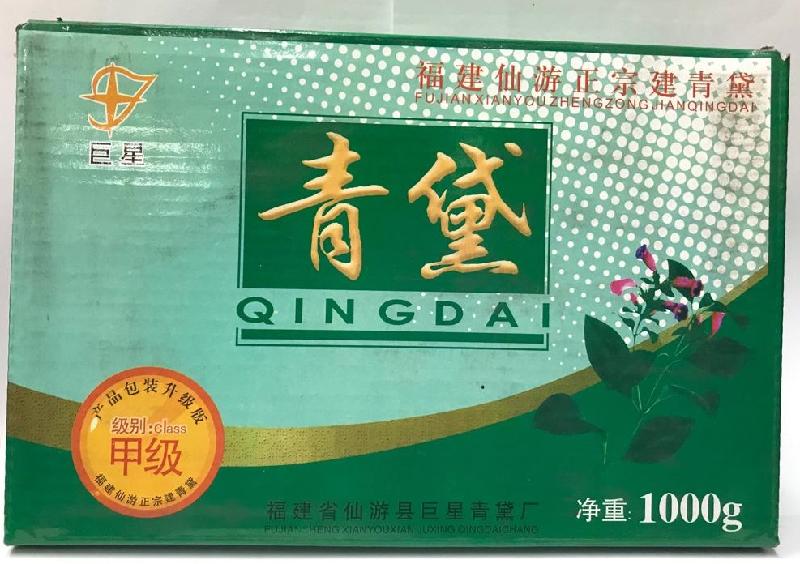
     The Department of Health (DH) mounted a joint-operation with Hong Kong Customs today (July 5) to raid the premises of Cai Chong Trading Company (Cai Chong), a licensed wholesaler of Chinese herbal medicines (Chm) in Sheung Wan, as the company was suspected selling fake Chm, namely Indigo Naturalis.
 
     During the DH's market surveillance, a sample of a batch of Chm, Indigo Naturalis (batch number: 2017.09.16) was collected from Cai Chong for identification. The test result from the Government Laboratory revealed the above Chm did not conform with the requirements for the identification of Indigo Naturalis as detailed in the Pharmacopoeia of the People’s Republic of China 2015 Volume 1. Hence, the sample was suspected not to be Indigo Naturalis.
 
     In the operation, Customs Officers seized a total of 14 boxes of suspected fake Chm and arrested a 46-year-old male manager of the wholesaler. Investigation is ongoing.

     The DH endorsed Cai Chong to voluntarily recall from the market the above batch of Chm. Cai Chong has set up a hotline (2559 9534) for public enquiries. So far, no adverse report related to the use of the aforementioned Chm has been received by the DH. The DH will closely monitor the recall.
 
     Indigo Naturalis is a Schedule 2 Chm of the Chinese Medicine Ordinance (Cap 549). It is dried powder or mass prepared from the leaf or the stem and leaf of Baphicacanthus cusia (Nees) Bremek, Polygonum tinctorium Ait or Isatis indigotica Fort. It is used to clear heat and remove toxins, cool the blood and resolve macule, as well as to purge fever and settle convulsions.

     Under the Trade Descriptions Ordinance (TDO), any person who supplies goods with a false trade description in the course of trade or business, or is in possession of any goods for sale with a false trade description, commits an offence. The maximum penalty upon conviction is a fine of $500,000 and imprisonment for five years.
 
     Customs reminds traders to comply with the requirements of the TDO and consumers to procure products at reputable shops. Members of the public may report any suspected violations of the TDO to Customs' 24-hour hotline 2545 6182 or its dedicated crime-reporting email account (crimereport@customs.gov.hk).
 
     The DH urged members of the public who have purchased the above batch of Chm to stop using it immediately and submit it to the Chinese Medicine Division of the DH on 16/F, AIA Kowloon Tower, Landmark East, 100 How Ming Street, Kwun Tong, Kowloon, during office hours for disposal. Members of the public who have taken the above Chm and feel unwell should seek advice from healthcare professionals.
Photo  


CHP investigates two cases of severe paediatric influenza A infection

     The Centre for Health Protection (CHP) of the Department of Health is today (July 5) investigating two cases of severe paediatric influenza A infection, and reminded members of the public who have not yet received seasonal influenza vaccination in the 2018-19 season that they can still receive it for personal protection against seasonal influenza.

     The two cases involve a pair of twin brothers aged 2 months with underlying illnesses, who have presented with cough and poor feeding since July 2. They were taken to the Accident and Emergency Department at Prince of Wales Hospital for medical attention on July 4 and were admitted and transferred to the paediatric intensive care unit of the hospital for further management on the same day.

     Their respiratory specimens tested positive for influenza A virus upon laboratory testing. The clinical diagnoses were influenza A infection complicated with pneumonia. They are now in critical condition.

     Initial enquiries revealed that the patients had no travel history during the incubation period. Their maternal grandmother had upper respiratory symptoms recently but had recovered. Their other home contacts have remained asymptomatic so far.

     The CHP's investigations are ongoing.

     "The latest surveillance data showed that the overall local seasonal influenza activity in the past few weeks was higher than that in early May. Members of the public aged 6 months or above (except those with known contraindications) who have not yet received seasonal influenza vaccination in the 2018-19 season can still receive it for personal protection against seasonal influenza," a spokesman for the CHP said.

     "Meanwhile, the public should continue to adopt strict personal, hand and environmental hygiene practices against respiratory illnesses and other infectious diseases," the spokesman added.

     The public may visit the CHP's influenza page and weekly Flu Express for more information.


Hong Kong signs Working Holiday Scheme agreement with Italy (with photos)

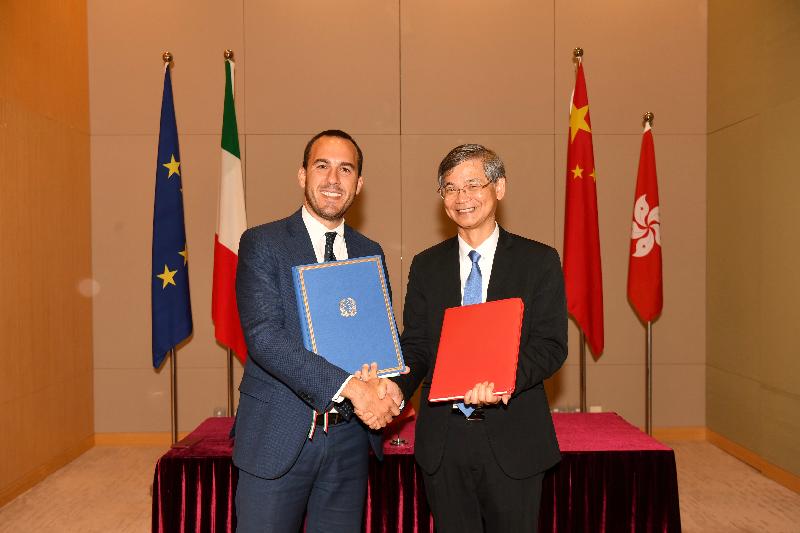
     Hong Kong and Italy today (July 5) signed an agreement to mark the establishment of a bilateral Working Holiday Scheme (WHS) for young people of the two places. 
      
     The agreement was signed by the Secretary for Labour and Welfare of the Government of the Hong Kong Special Administrative Region (HKSAR), Dr Law Chi-kwong, and the Under Secretary of State, Ministry of Foreign Affairs and International Cooperation of the Government of the Italian Republic, Mr Manlio Di Stefano, at the Central Government Offices, Tamar.
      
     Welcoming the establishment of the scheme with Italy, Dr Law said, "We are delighted to see that the WHS has been well received by the youth. The agreement will enable young people in Hong Kong and Italy to broaden their horizons and gain living and working experience in a foreign culture, as well as further reinforce our bilateral ties."
      
     Mr Di Stefano said, "We are glad to provide the Italian youth with this new and unique opportunity to experience living, studying and working in Hong Kong. We wish young people from Hong Kong will take advantage of the scheme to enjoy Italy as well. Investing in our youth is the best way to foster the ancient friendship between Italy and Hong Kong."
      
     The scheme with Italy is Hong Kong's 14th bilateral WHS. Since 2001, Hong Kong has established WHS arrangements with New Zealand, Australia, Ireland, Germany, Japan, Canada, Korea, France, the United Kingdom, Austria, Hungary, Sweden and the Netherlands. So far, about 90 000 Hong Kong youths have benefited from these schemes.
      
     Under the WHS between Hong Kong and Italy, youths from each side may apply for a visa which will allow them to stay in Italy or Hong Kong for up to 12 months. During the period, they may work to finance their stay or study short-term courses. The annual quota from each side will be 500.
      
     Details of visa application procedures for applicants from Hong Kong will be available on the website of the Consulate General of Italy in Hong Kong at conshongkong.esteri.it/consolato_hongkong/en/ in due course.

     Applicants from Italy may contact the Immigration Department of the HKSAR by telephone on 2824 6111 or obtain the necessary information from the department's website www.immd.gov.hk.

Photo  Photo  


Contractors fined for violation of safety legislation

     Kei Cheong Building Materials Limited and Kai Wan Construction Engineering Limited were each fined $89,000 at Kwun Tong Magistrates' Courts today (July 5) for violation of the Factories and Industrial Undertakings Ordinance, the Factories and Industrial Undertakings (Electricity) Regulations and the Construction Sites (Safety) Regulations. The prosecutions were launched by the Labour Department.

     The case involved a fatal accident that occurred on September 28, 2018 in Ngau Tau Kok. A worker, while dismantling chilled water pipes on the ceiling inside a shop under renovation, received an electric shock and collapsed. He was admitted to hospital and passed away a few days later.


Update on number of dengue fever cases

     The Centre for Health Protection (CHP) of the Department of Health today (July 5) reported the latest number of cases of dengue fever (DF), and strongly urged the public to maintain strict environmental hygiene, mosquito control and personal protective measures both locally and during travel.

     From June 28 to July 4, the CHP recorded six imported DF cases. The patients had been to Malaysia (two cases), Maldives (two cases), Cambodia (one case) and Thailand (one case) during the incubation period.

     As of yesterday (July 4), 73 cases had been recorded this year, all of which were imported. The cases were mainly imported from Thailand (15), Malaysia (14) and Indonesia (12). 

     The CHP has been closely monitoring the latest DF situation in neighbouring and overseas areas. DF is endemic in many tropical and subtropical areas of the world. According to the World Health Organization, some Asian countries are experiencing unusually high numbers of DF cases for this time of year. The number of cases in several countries including Malaysia, the Philippines, Singapore and Vietnam was about two to four times the number for the same period in 2018.
 
     In Taiwan, 229 cases (including 37 local cases) have been recorded in 2019 (as of July 4). According to the health authority of Taiwan, the number of imported DF cases recorded so far this year was the highest compared to the number for the same period in the past 10 years.
 
     Detailed information on the latest DF situation in Hong Kong as well as neighbouring and overseas countries and areas this year has been uploaded to the CHP's website (www.chp.gov.hk/files/pdf/df_imported_cases_and_overseas_figures_eng.pdf). 
          
     The public should take heed of the following advice on mosquito control at all times:
 

  • Thoroughly check all gully traps, roof gutters, surface channels and drains to prevent blockage;
  • Scrub and clean drains and surface channels with an alkaline detergent compound at least once a week to remove any deposited mosquito eggs;
  • Properly dispose of refuse, such as soft drink cans, empty bottles and boxes, in covered litter containers;
  • Completely change the water of flowers and plants at least once a week. The use of saucers should be avoided if possible;
  • Level irregular ground surfaces before the rainy season;
  • Avoid staying in shrubby areas; and
  • Take personal protective measures such as wearing loose, light-coloured, long-sleeved tops and trousers and apply insect repellent containing DEET to clothing or exposed parts of the body when doing outdoor activities.

    
     Members of the public must adopt personal protective measures against mosquitoes to prevent mosquito-borne diseases such as DF when visiting affected countries/areas. To reduce the risk of infections spread by mosquitoes, apart from general measures, travellers returning from areas affected by DF and Zika virus infection should apply insect repellent for 14 days or at least 21 days respectively upon arrival in Hong Kong. If feeling unwell, seek medical advice promptly and provide travel details to the doctor. DEET-containing insect repellents are effective and the public should take heed of the tips below:
 

  • Read the label instructions carefully first;
  • Apply right before entering an area with risk of mosquito bites;
  • Apply on exposed skin and clothing;
  • Use DEET of up to 30 per cent for pregnant women and up to 10 per cent for children*;
  • Apply sunscreen first, then insect repellent; and
  • Re-apply only when needed and follow the instructions.

 
* For children who travel to countries or areas where mosquito-borne diseases are endemic or epidemic and where exposure is likely, those aged 2 months or above can use DEET-containing insect repellents with a DEET concentration of up to 30 per cent.

     The public may refer to the CHP's tips for using insect repellents for details.