Tsuen Wan Police Station Report Room service suspended

Attention duty announcers, radio and TV stations:

Please broadcast the following message as soon as possible and repeat it at suitable intervals:

     The report room services of Tsuen Wan Police Station are now temporarily suspended. Police appeal to members of the public not to obstruct the emergency vehicles access so as to avoid affecting the emergency services provided to the public. In case of emergency, please call 999.


Lifesaving services at Golden Beach and Cafeteria New Beach resume

Attention TV/radio announcers:

Please broadcast the following as soon as possible and repeat it at regular intervals:

     Here is an item of interest to swimmers.

     The Leisure and Cultural Services Department has announced that the lifesaving services at Golden Beach and â€‹Cafeteria New Beach in Tuen Mun District resumed today (August 5). The lifesaving services at the beaches were suspended earlier due to an insufficient number of lifeguards on duty. 


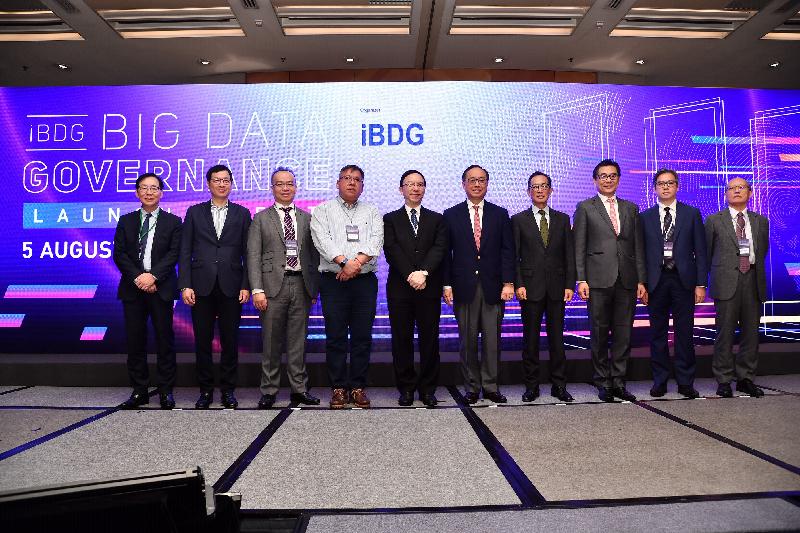
Speech by S for IT at Big Data Governance Launch Event (English only) (with photo)

     Following is the speech by the Secretary for Innovation and Technology, Mr Nicholas W Yang, at the Big Data Governance Launch Event organised by the Institute of Big Data Governance (iBDG) this morning (August 5):

Allen (Founding Chairman of the iBDG, Mr Allen Yeung), Herbert (Vice Chairman of the iBDG, Mr Herbert Chia), distinguished guests, friends, ladies and gentlemen,
 
     Good morning. It is a great honour and pleasure for me to join you at this Big Data Governance Launch Event. First of all, I would like to congratulate the Institute of Big Data Governance on launching this important initiative to promote the data governance standard for Hong Kong enterprises.
      
     Global technology advancement has transformed the role and importance of communication and data, anytime, anywhere. This has led to the dramatic evolution of data in terms of variety, volume and velocity. According to a recent market research, it is predicted that the global datasphere will grow from 33 zettabytes in 2018 to 175 zettabytes by 2025. Just imagine, with each sand particle counting as one byte, one zettabyte equals to the total number of sand on all the beaches in the world. Moreover, nearly 30 per cent of the world's data will need real-time processing. Today, data have far-reaching implications for individuals, businesses, and even the Government because data can provide invaluable insights to facilitate decision-making. As such, the capability to process and analyse large volume of data becomes the key to staying ahead of the competition.
      
     In Hong Kong, the Government has made a strong commitment to develop innovation and technology. One focused area is to open up government data.
      
     In October 2018, the Government announced the new open data policy requiring all government bureaux and departments to release their data in machine-readable formats for free public use, while protecting personal privacy. In December 2018, all government departments released their first-ever annual open data plans. In just eight-months' time since this new open data policy was unveiled, we have already opened up 500-plus new datasets by June 2019, and we are confident that our target of at least 4 000 open datasets can be met by the end of this year. At the same time, we have provided over 1 200 Application Programming Interfaces to enable the industry and the public to use the open data to develop innovative applications for the community. 
      
     In addition to open government data, we have been encouraging public and private organisations to open up their data that carry a high degree of public interest. Public transport operators, such as the New World First Bus, the Citybus, the New Lantao Bus and the MTR Corporation, have all responded positively to this call. They will begin open up their real-time arrival data by the end of this month. This is a very important step forward in pursuing our smart mobility development.
      
     Since the publication of the Smart City Blueprint for Hong Kong in December 2017, the 70-plus specifically listed initiatives have all made good progress. We are building a Next Generation Government Cloud Infrastructure, which will facilitate government departments in their digital transformation projects. Riding on this cloud infrastructure, we are developing a Big Data Analytics Platform to facilitate sharing of real-time trend data, ranging from traffic to weather and environmental data. These infrastructure initiatives will unleash the potential of big data for more effective and efficient city management.
      
     Big Data Governance standards will certainly play a pivotal role in Hong Kong's transition to become an international data hub. I salute to the Institute of Big Data Governance for taking the big bold step forward via today's event.
      
     On this note, I sincerely wish today's event a great success and all participants an enjoyable and rewarding experience. Thank you very much.

Photo  


Employers and employees should take precautions against heat stroke

     As the Hong Kong Observatory has issued the Very Hot Weather Warning, the Labour Department (LD) reminds employers and employees to take appropriate precautions to prevent heat stroke when working in a hot or humid environment.
 
     Heat stroke could occur if an employee works in a hot or humid environment for prolonged periods of time, as the body may fail to regulate its temperature by effective heat dissipation through sweating.
 
     The symptoms of heat-related illnesses include feeling thirsty, fatigue, nausea, vomiting, headache, dizziness, muscle spasm or even mental confusion, and loss of consciousness or convulsion in severe cases.
 
     Construction workers, cleaning workers, kitchen workers and porters, for example, are more prone to heat stroke as they may be working for long hours in such an environment, especially if appropriate preventive measures have not been taken.
 
     The LD reminds employers to arrange for a suitable assessment of the risk of heat stress in the work environment and take appropriate preventive measures. The LD has produced two leaflets entitled "Checklist for Heat Stress Assessment at Construction Sites" and "Checklist for Heat Stress Assessment at Outdoor Cleansing Workplaces" respectively. Employers engaged in construction or outdoor cleaning work are advised to refer to these checklists in assessing the risk of heat stress at their workplaces. As for heat stress assessment at a workplace in general, employers can refer to a booklet entitled "Risk Assessment for the Prevention of Heat Stroke at Work" produced by the LD.
 
     The LD also reminds employers and employees to take the following precautions to prevent heat stroke:
 
Employers
———
(1) Take heed of the weather report and adopt shift work arrangements for employees to reduce their exposure to the hot environment, or arrange appropriate rest breaks for them during very hot periods;
(2) Avoid working under direct sunlight and set up temporary sunshade wherever possible;
(3) Provide cool potable water for employees at all times during work. If necessary, provide drinks containing electrolytes for employees to replenish loss of salt during profuse sweating;
(4) Minimise physical demands by using tools or mechanical aids at work;
(5) Increase air flow by enhancing ventilation or air-conditioning as appropriate;
(6) Isolate heat-generating facilities at the workplace and use insulating materials to minimise heat dissipation to the other work areas; and
(7) Provide relevant information and training for employees on heat stroke such as preventive measures and first aid treatment.
 
Employees
———
(1) Wear clothing made of suitable materials (for example, cotton) that is loose-fitting and light-coloured to help heat dissipation, minimise heat absorption and allow sweat evaporation;
(2) Wear a wide-brimmed hat when working outdoors;
(3) Drink plenty of water or other appropriate beverages with electrolytes to replenish the fluids and salt lost through sweating; and
(4) Whenever there are any symptoms of heat-related illnesses, rest in a cool or shady place and drink water, and inform supervisors to take appropriate actions immediately.
 
     Some employees may have difficulty in adapting to a hot working environment owing to their own health conditions. Employers should take this into account and consider the recommendations of their doctors when assigning work to these employees.
 
     In addition to the publications on risk assessment, the LD has produced a leaflet entitled "Prevention of Heat Stroke at Work in a Hot Environment" for the public. The publications can be obtained free of charge from the offices of the Occupational Health Service of the LD, or downloaded from the department's webpage at www.labour.gov.hk/eng/public/content2_9.htm.
 
     The LD organises occupational health talks in public places and at its own training venues regularly to raise employers' and employees' awareness of occupational health. Details of health talks on the prevention of heat stroke at work in a hot environment in August and September are as follows:
 
(A)
Dates: August 13, 15 and 26 and September 5, 17 and 27
(am);
August 20 and 29 and September 9 and 24
(pm)
Time: Half-day
Venue: Occupational Safety and Health Training Centre of the Labour Department, 13/F, Kolour·Tsuen Wan I, 68 Chung On Street, Tsuen Wan, New Territories
 
(B)
Dates: August 9 and 27
Time: Half-day, morning
Venue: Occupational Safety and Health Centre of the Labour Department, G/F,
Kwun Tong Community Health Centre Building, 60 Hip Wo Street, Kwun Tong
(MTR Kwun Tong Station Exit A1)
 
(C)
Date: August 26
Time: 3pm to 4.30pm
Venue: Lecture Hall, Hong Kong Space Museum, 10 Salisbury Road,
Tsim Sha Tsui, Kowloon (MTR Tsim Sha Tsui Station Exit E)

     For enrolment or enquiries about these occupational health talks, please call 2852 4040 or 2361 8240 (for talks organised at the Occupational Safety and Health Centre). Moreover, the LD also provides an outreach health education service and occupational health nurses will, on invitation, disseminate occupational health information at workplaces at a convenient time. Please contact the nursing officer at 2852 4062 for details. All these health talks are free of charge.


Company and its director fined for failure to pay wages

     Domani GS Limited and its director were prosecuted by the Labour Department (LD) for failing to pay wages in accordance with the Employment Ordinance (EO). The company and its director pleaded guilty at Eastern Magistrates’ Courts today (August 5) and were each fined $28,000 for a total of $56,000. In addition, the company and the director were ordered to pay an outstanding sum of about $150,000 to the employee concerned.

     The company failed to pay one employee’s wages totalling about $240,000 within seven days after the expiry of the wage periods as required by the EO. The director concerned was prosecuted and convicted for his consent, connivance or neglect in the above offences committed by the company.

     "The ruling helps disseminate a strong message to all employers, directors and responsible officers of companies that they have to pay wages to employees within the time limit stipulated in the EO," an LD spokesman said.

     "The LD will not tolerate these offences and will spare no effort in enforcing the law and safeguarding employees' statutory rights," the spokesman added.