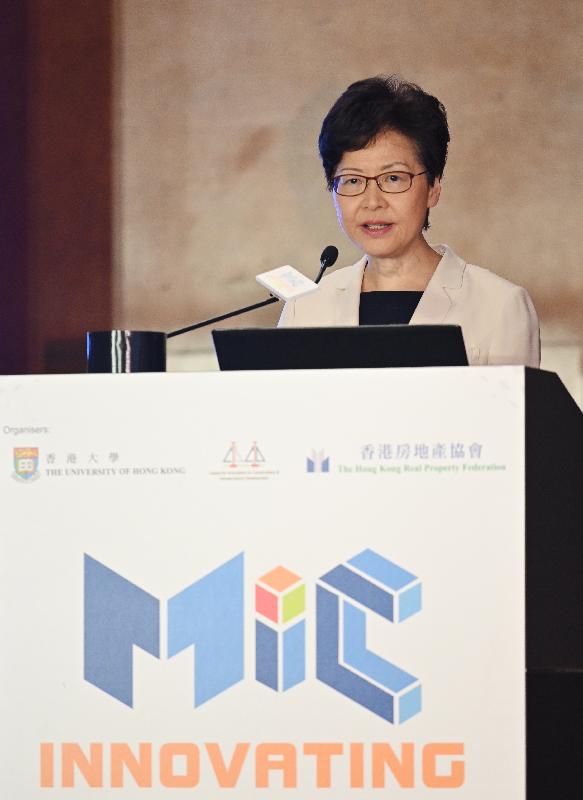
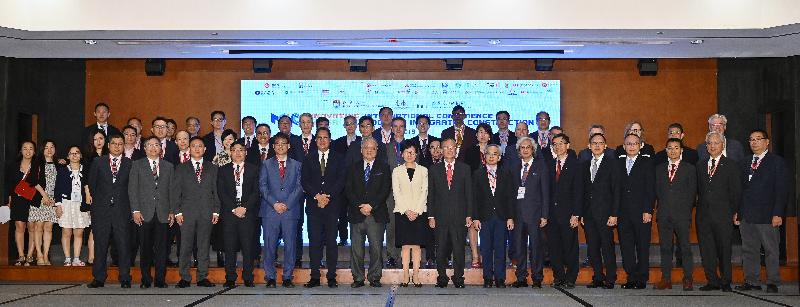
Following is the speech by the Chief Executive, Mrs Carrie Lam, at the International Conference on Modular Integrated Construction (MiC): Innovating Higher today (August 27):
Professor Lee (Joint-chairman of the Conference Advisory Committee Professor Lee Chack-fan), Anthony (Joint-chairman of the Conference Advisory Committee Mr Anthony Chan), distinguished speakers, ladies and gentlemen,
Good morning. It is a great pleasure to join you today for this International Conference on MiC.
Hong Kong has long been recognised, internationally, for its formidable strengths in infrastructure development. Our iconic cityscape and world-class transport system are vivid reminders of some of our achievements in this field. The World Economic Forum has ranked Hong Kong among the top globally in infrastructure for more than one decade.
To improve people's livelihood, as well as to maintain a sustainable growth of Hong Kong, the HKSAR Government will continue to invest in infrastructure development. We have a huge portfolio in infrastructure, comprising the housing and land-supply programme, hospital development plans and other livelihood projects. The Government's annual capital works expenditure will hit HK$100 billion in the next few years. The total construction output, covering both the public and private sectors, will triple that.
There are, however, some considerable concerns that must be addressed and some have been mentioned by Professor Lee. They include a shortage of labour and an ageing workforce. At the same time, it is hard to attract young people to join the construction industry.
High construction cost is another challenge to be tackled by the entire construction industry. According to reports published by some internationally renowned consultants in 2019, Hong Kong is still Asia's most expensive city in terms of construction cost and is ranked top five in the world.
To help relieve the situation, I urge the construction industry to embrace innovation and apply technology in a bolder and more proactive manner. Innovative technology is transforming the building sector worldwide. Hong Kong must respond effectively if we hope to maintain our competitiveness, while addressing the industry's pressing manpower needs. Through innovation, the industry will not only increase productivity, but also enhance quality assurance, improve site safety and reduce environmental impact. In addition, the use of advanced technology will boost the image of construction practitioners, and that will help attract young talents to the industry.
Modular integrated construction, or MiC in short, is one of the concrete examples of adopting innovation in the construction industry. The Development Bureau, in concert with the University of Hong Kong's Centre for Innovation in Construction and Infrastructure Development, conducted a study on the potential benefits of MiC in 2017. The study affirmed MiC's feasibility for Hong Kong. It also confirmed significant industry benefits, including lower project costs, better quality control, shorter construction time, faster capital return, enhanced site safety, and better environmental sustainability with less wastage.
Apart from conducting studies, we are also implementing pilot projects to build up the experience and confidence of the local construction industry in adopting MiC. Up to now, all the pilot projects have reported shorter construction period, less manpower requirement, and cost neutral or some cost saving situation. With more experience and better mastery of the MiC technology, we anticipate better cost performance in the long run.
I was glad to join the construction commencement ceremony of the InnoCell project, which is going to adopt MiC technology, by the Science and Technology Parks Corporation in May this year. I shared the enthusiasm of the industry for taking another step forward in adopting innovation. To further gear up the adoption of MiC, we have to support it through creating a steady demand, facilitating its adoption, as well as ensuring a capable supply chain.
As I have mentioned on a few other occasions, MiC will be applied in phases to government building projects, in particular the staff quarters, schools, government offices and other suitable building types. The Civil Service College is also on the list. For other buildings funded by the Government, from statutory bodies to NGOs, we will encourage or even mandate the use of MiC as appropriate. A steering committee on adoption of MiC has been set up under our Development Bureau to oversee the MiC policy. I believe that the use of MiC in public projects will provide the needed critical impetus to help develop a new market and, in doing so, serve the entire construction sector.
For the private sector, we have established MiC guidelines to help the industry meet Buildings Ordinance requirements. We have also set up a mechanism for granting in-principle acceptance of MiC systems. Such pre-acceptance will streamline workflow, allowing for early production of MiC modules during construction. I am pleased that the industry is responding positively. Seven MiC systems have, to date, been pre-accepted, and assessment of others continues.
In May, we promulgated the GFA (gross floor area) concession of 6 per cent of the MiC area for buildings adopting MiC to provide reasonable incentive to the industry for the use of MiC. Apart from building regulations, the industry may have concerns about other regulations that may impose potential hurdles for building projects adopting MiC. In this regard, the steering committee on adoption of MiC, of which the members are senior directorates from all regulatory departments, can definitely help in co-ordinating inter-departmental efforts in resolving these hurdles and facilitating MiC adoption in the industry.
For the supply chain, we can benefit from our proximity to the manufacturing bases in Mainland China for supplying modules in the short term. Actually, I went to visit one of these in the Greater Bay Area a few months ago. In the long run, we are exploring the feasibility of setting up local MiC manufacturing facilities. By shifting most of the site activities to an industrialised process in a factory-like environment, MiC would, I believe, provide a substantial change in the traditional "3D" image of the construction industry – "3Ds" referring to "dirty", "dangerous" and "dull". And this change would attract more young people to join the construction industry and help build Hong Kong.
I'm always excited to see smarter, greener and more sustainable ways to tackle development problems and create fresh opportunities. That's the way I feel about MiC, and we will continue to explore how best to encourage the adoption of MiC in Hong Kong. Apart from MiC, my Government is open to all innovative ideas that can make a difference for the construction industry, because that will, ultimately, make a difference for Hong Kong and for all of you.
Ladies and gentlemen, this "Innovating Higher" international conference is an ideal platform to gather MiC experts to share their valuable experiences and learn from each other. At this juncture, may I extend my deepest gratitude to our overseas speakers for joining us in this international conference. As Professor Lee has mentioned, we are going through some trying and testing times. Your presence here is a vote of confidence in Hong Kong. Thank you very much.