Asian Youth Orchestra performs in Kumamoto (with photos)

     The Asian Youth Orchestra (AYO) gave a concert at the Kumamoto Prefectural Theater in Kumamoto, Japan, today (August 27) as part of its concert tour across Asia.
 
     Comprising about 100 young musicians from various parts of Asia, including 14 from Japan, the AYO had earlier performed in Hong Kong, Shanghai, Nanjing, Tianjin, Beijing, Taipei, Chiayi City and Seoul during this season's tour. After the concert in Kumamoto today, the AYO will perform in Fukuoka on August 28 followed by concerts in Tokyo on August 30 and 31, which will conclude this season's tour.
 
     Speaking at a reception before the concert, the Principal Hong Kong Economic and Trade Representative (Tokyo), Ms Shirley Yung, said that the concert in Kumamoto was of particular significance because the AYO started in Kumamoto with its first rehearsal camp and concert in 1990. 
 
     "Tonight is a precious opportunity for friends in Kumamoto to renew their friendship and connections with the AYO, as well as for many others to become acquainted with this orchestra," Ms Yung said.

     Based in Hong Kong, the AYO attracts many bright young musicians from all over Asia to Hong Kong every year, and takes them to different parts of the world for performances and cultural exchanges.
 
     The AYO has played a significant role in promoting arts and cultural exchanges between Hong Kong and Japan. Since its first public concert in Kumamoto in 1990, Japan has been one of the destinations for the AYO tour almost every year. The AYO was awarded Japan's Praemium Imperiale Grant for Young Artists in 2010 in recognition of its outstanding contributions to the development of young artistic talent. It was also awarded the Nikkei Asia Prize for Culture and Community in 2015 for promoting friendship and understanding among young people across Asia through the common language of music.

     The performances by the AYO in Korea and Japan are supported by the Hong Kong Economic and Trade Office (Tokyo), which is currently the official representative of the Hong Kong Special Administrative Region Government in Japan and Korea.

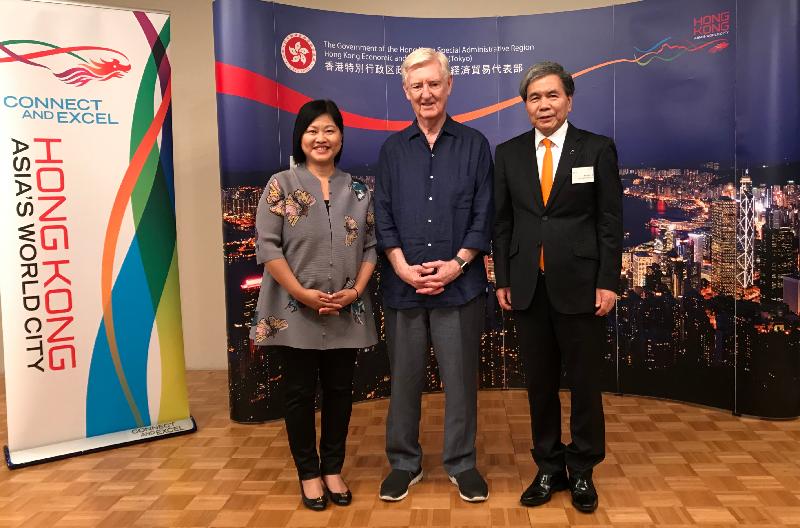
Photo  Photo  


SCED speaks on trade issues (with video)

     Following is the transcript of remarks by the Secretary for Commerce and Economic Development, Mr Edward Yau, at a media session on matters relating to trade conflict between China and the United States (US) after meeting with representatives of major chambers of commerce and associations of small and medium enterprises today (August 27):
 
Reporter: Two questions, one for Mr Yau, the other one for either of you (Chairman of the Federation of Hong Kong Industries, Dr Daniel Yip; and the President of the Chinese Manufacturers' Association of Hong Kong, Dr Dennis Ng). What is the exact percentage of the impact of these tariffs on the goods that went through Hong Kong to the US or both ways, in terms of last year's trade figures and in the first half of this year? And the second question is: have you seen any lay-offs or shut down of companies arising from this trade war situation?
 
Secretary for Commerce and Economic Development: In terms of US-China trade, in aggregate terms, seven per cent of US imports from China comes through Hong Kong, and the other way round, US products coming to China through Hong Kong accounts for about two per cent. So as a whole, nine per cent of Hong Kong's imports and exports is related to US-China trade. In statistical terms, that accounts for less than 10 per cent of our overall trade.
 
     But of course, we are not talking about just commodity trade. With the heightened tariffs and the very extensive coverage of almost all the products, basically, I think it is a total war in terms of commodity trade. With a very heavy and inhibitive tariff imposed on trading between these two countries, plus the fact that the US and China are the world's biggest trading partners, the impact of a trade war onto other economic areas cannot be underestimated.
 
     In the earlier estimate last year, we were talking about the initial phase of 25 per cent (US tariff) imposed on some of the (Chinese) products, at that time, some economists were estimating that the impact on Hong Kong's GDP (Gross Domestic Product) would range from 0.1 to 0.2 per cent. But as a matter of fact, Hong Kong's economy suffered a stronger hit on that basis.
 
     Talking about the new wave of heightened tariffs and a wider coverage, the direct impact might be smaller than the initial phase because of the marginal increase and the additional coverage. The indirect impact and the collateral damage, will certainly be no less than last time, because we are talking about a total coverage of all the commodities and very inhibitive tariffs imposed on each other. I think that would be our worry.
 
Reporter: So less than 10 per cent, do you mean the new tariffs or just the previous tariffs?
 
Secretary for Commerce and Economic Development: Including both.
 
(Please also refer to the Chinese portion of the transcript.)


Recall of two mercury-tainted proprietary Chinese medicines (with photo)

     The Department of Health (DH) today (August 27) endorsed a licensed manufacturer of proprietary Chinese medicines (pCms), Wing Ming Company (O/B Allways Health-care Corporation Limited), to voluntarily recall [Yuxiang] Pai Feng Pill (registration number: HKP-11670, batch number: 81515) and [Tung Yuen Tong] Pai Feng Pill (registration number: HKP-12768, batch number: 91606) from consumers as their samples have been found to contain excessive mercury.

     The action was taken after samples of the above pCms obtained through the DH's market surveillance. Samples of [Yuxiang] Pai Feng Pill and [Tung Yuen Tong] Pai Feng Pill were found by the Government Laboratory to contain about 9.2 times and 1.3 times the permitted limit of mercury under the registration criteria of pCms respectively.

     Initial investigation by the DH revealed that the above pCms were manufactured by Wing Ming Company for sale in the local market. According to their labels, the pCms are indicated for activating blood, tonifying qi and dysmenorrhoea.

     "Acute mercury poisoning can cause inflammation of the mouth while prolonged exposure to mercury can damage the neurological system and kidneys. The DH has not received any report of related adverse events so far," a DH spokesman said.

     Wing Ming Company has set up a hotline (2688 5491) for related enquiries. The DH will closely monitor the recall. The DH's investigation is ongoing.

     According to sections 52 and 54 of the Public Health and Municipal Services Ordinance (Cap 132), those who sell any drug not of the nature, substance or quality demanded by the purchaser and sell a drug intended for use by man but unfit for that purpose are liable to a maximum penalty of a fine of $10,000 and three months' imprisonment, and a fine of $50,000 and six months' imprisonment respectively. Upon completion of the investigation, the DH will work with the Department of Justice on prosecution matters. The DH will also refer this case to the Chinese Medicine Council of Hong Kong for possible disciplinary action.

     Members of the public who have purchased the above two batches of pCms should stop using them immediately. Those who have used the above pCms and feel unwell should seek advice from healthcare professionals. People who have the above pCms should submit them to the DH's Chinese Medicine Division on 16/F, AIA Kowloon Tower, Landmark East, 100 How Ming Street, Kwun Tong, Kowloon, during office hours for disposal.

Photo  


Missing man in Hung Hom located

     A Mainland man who went missing in Hung Hom has been located.

     Chen Shulin, aged 65, went missing after he left a hotel on Hung Lok Road on August 15 morning. His family made a report to Police on the same day.

     The man was located in a hospital in Yau Ma Tei this morning (August 27). No suspicious circumstances were detected.


CHP reviews local HIV/AIDS situation in second quarter of 2019 (with photo)

     A total of 137 additional cases of Human Immunodeficiency Virus (HIV) infection were reported to the Centre for Health Protection (CHP) of the Department of Health (DH) in the second quarter of 2019, bringing the cumulative total of reported HIV infections to 9 998 since 1984.
 
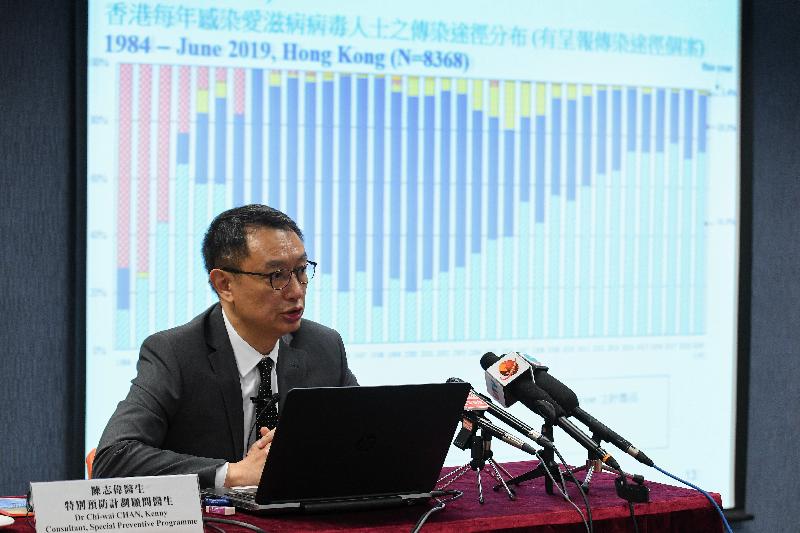
     Reviewing the latest HIV/Acquired Immune Deficiency Syndrome (AIDS) situation in Hong Kong at a press conference today (August 27), the Consultant (Special Preventive Programme) of the CHP, Dr Kenny Chan, said that sexual transmission remained the major mode of HIV transmission and stressed the importance of consistent and proper use of condoms in reducing the risk of contracting HIV.
 
     "HIV is the cause of AIDS and, without treatment, about half of HIV-infected people will progress to AIDS within 10 years. On the contrary, early HIV treatment with antiretroviral drugs helps prevent AIDS and its complications. It also makes a significant contribution towards improving the quality of life and prolongs survival of those infected," Dr Chan said.
 
     "Members of the public with a history of unsafe sex should take an HIV antibody test early. They can call the DH's AIDS Hotline (2780 2211) for a free, anonymous and confidential HIV test. HIV-positive people should seek specialist care as soon as possible," he continued.

     He supplemented that the DH has all along been promoting early HIV testing. At-risk populations, including men who have sex with men (MSM), are recommended to have at least annual testing, irrespective of any individually assessed risk of infection. As an additional approach to conventional HIV testing services, HIV self-testing refers to a process in which a user collects his/her own specimen, performs testing and interprets the result. Of note, Dr Chan emphasised that the HIV self-test only serves as a preliminary test and users of any self-test should seek further confirmation by conventional testing if positive. In addition, members of the public should only use qualified test kits. The public may visit the DH website (www.21171069.com/en/get_hiv_tested/self_testing.html) for related information.
 
     The DH is planning a study of using self-tests for MSM to expand testing coverage. The study will examine the feasibility and acceptability of using a web-based system that allows ordering of HIV test kits and uploading of test results. Confirmatory testing will be provided to those who have self-tested positive. Medical care will also be provided for the infected patients.
 
     Of the 137 HIV cases, involving 116 males and 21 females, reported in the second quarter, 70 acquired the infection via homosexual or bisexual contact, 25 via heterosexual contact and one via drug injection. The routes of transmission of the remaining 41 cases have yet to be determined due to incomplete information upon notification.
 
     The new cases were mainly reported by four major sources: public hospitals, clinics and laboratories (68 cases); private hospitals, clinics and laboratories (22 cases); DH AIDS Unit (19 cases); and the DH's Social Hygiene Clinics (19 cases). Also, 90 of the HIV-infected people (66 per cent) have already received HIV specialist services at the DH or the Hospital Authority.
 
     In addition, 33 new cases of AIDS were reported in this quarter, of which 20 cases (61 per cent) were attributed to homosexual or bisexual contact, and 10 cases (30 per cent) were related to heterosexual contact. The route of transmission of three cases (9 per cent) has yet to be determined due to incomplete information upon notification. As well in this quarter, the most common AIDS-defining illness was Pneumocystis pneumonia, a kind of chest infection.
 
     Since 1985, a cumulative total of 2 051 confirmed AIDS cases have been reported in Hong Kong.
         
     The public may visit the following pages for more information on HIV/AIDS: the DH's Virtual AIDS Office (www.aids.gov.hk), the Red Ribbon Centre (www.rrc.gov.hk), the AIDS Hotline website (www.27802211.com) and the Gay Men HIV Information website (www.21171069.com).

Photo